In both the U.S. and Canada, federal, state and local agencies and policymakers are promoting the electrification of heating systems through incentives, rebates, and regulations. Meanwhile, advances in heat pump technology have made electric heating more efficient and suitable for colder climates. Some professionals and homeowners see this shift as crucial for meeting climate goals and reducing dependence on fossil fuels.
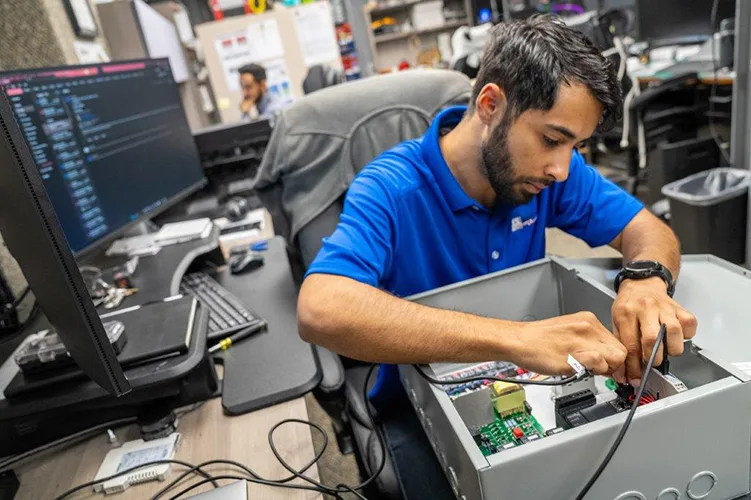
As an early adopter and market leader, Burnham Holdings, the parent company of U.S. Boiler Co., made a large investment in electric heating technology in 2021. The Burnham Holdings Engineering Co. built the 2,960-square-foot Ambient Electric Heating Laboratory in Lancaster, Pennsylvania. The purpose of the laboratory is to design, build and test new, cutting-edge electric, hydronic heating appliances.
Lab technicians are focused on developing commercial and residential electric products for several Burnham Holdings subsidiaries, including U.S. Boiler Co., Thermal Solutions and Bryan Boilers.
“This lab prepares Burnham Holdings’ subsidiaries for the future of hydronic heating,” says Chris Altenderfer, manager of electric heating development. “We are the premier wet heating manufacturer in North America, and we want to remain in the lead. That’s the sole purpose of this lab and our work here.”
Electric think tank
The electric lab team was first tasked with building the lab itself. Once complete, they developed the Ambient Electric Boiler (released Nov. 1, 2023) and the Ambient Air-to-Water Heat Pump (released Jan. 31, 2024).
Staffing the lab with the right team was a consideration long before construction began on the new facility.
Altenderfer has been with U.S. Boiler Company since 2011. His first job out of college was product development engineer, focusing on boiler combustion. He worked on the Alta, K2 and Alpine boilers. Today, he heads up the Ambient Electric team with assistance from Ed Johann.
Johann started his career as a physics research scientist and entered the boiler industry in 1980. Early on, he worked in the combustion field, taught at the University of Wyoming, and was responsible for some contract nuclear development. Johann holds several patents in combustion and heat exchanger design.
Henok Abebe, product development engineer, has been with Burnham Holdings for more than 10 years. He completed his undergrad in mechanical engineering at Rutgers University.
Pete Torres, lead laboratory technician, has more than 15 years’ experience with Burnham Holdings. He’s held various positions in boiler assembly, quality control and as a tech in the combustion laboratory.
Jayson Reyes, laboratory technician, has also been with the company for more than seven years. He was originally hired as a fire tester at Thermal Solutions then transitioned as a lab tech focused on combustion, where he worked on the Alta boiler and various control platforms.
Through the paces
The lab includes numerous cycle test stations, where durability, reliability, performance and safety verification occur. Two of the stations include high-current power supply for residential and commercial electric boiler development. Natural gas connections are included at each of the stations, specifically for dual-fuel system testing.
In the middle of the large lab space is a 100-square-foot cold room used to simulate outdoor air temperatures from 40 degrees to -20 degrees. Heat pump outdoor units are installed within the cold room and operated for months at a time to determine performance levels in different outdoor conditions.
“It defeats the purpose to run any heat pump when the COP (coefficient of performance) falls below 1,” Johann says.
COP is a measure of the efficiency of electric heating or cooling systems. It’s the ratio of useful heating or cooling output to the energy input. Electric resistance heating elements provide a COP of 1 (or 100% efficiency). A higher COP indicates better system efficiency. The COP of all heat pumps changes with the outdoor ambient conditions.
“The Ambient Air-To-Water Heat Pump is rated at nearly COP 4 (or 400%) with at 32 degrees outdoor ambient,” Johann explains. “At 45 degrees, the COP climbs to 5. That means that with a 45 degree outdoor temperature, the Ambient Heat Pump provides five times the BTUs per unit of energy input than an electric resistance heating system.”
Over the course of several years in the testing stage, the heat pump was installed in the cold room and at various beta test sites in the field. The electric team deduced that the heat pump can generate supply water temperatures up to 140 degrees with outdoor ambient conditions as low as 5 degrees and continue operating down to an outdoor temperature of -13 degrees. That’s not to say that the system is more efficient than fossil-fuel alternatives at -13 degrees.
Real world application
“The ideal scenario for a hydronic heat pump installed in moderate to cold climates is to use a dual-fuel approach,” Altenderfer explains. “That’s why we developed and sell a kit that includes everything needed to install the heat pump in a dual-fuel configuration. Pairing the heat pump with a boiler allows the system to switch between heat pump and boiler at a certain setpoint, utilizing whichever heat source is most efficient at the current outdoor conditions.”
Determining the most efficient switchover temperature from heat pump to boiler isn’t as simple as picking an outdoor ambient temperature. There are two primary variables that weigh heavily into that calculation. The first is the cost of electrical power.
Quebec, for example, has some of the cheapest electric in North America. This would justify running the heat pump in much colder outdoor conditions than an installation in California, where some of the highest electricity rates are found.
The second consideration is the cost to run the backup boiler. This is determined by the efficiency of the boiler and the cost of the fuel it uses. Obviously, fuel oil and propane costs are higher than natural gas. A system using natural gas in a condensing boiler is likely to benefit from switching the source of heat from the heat pump to the boiler at a higher outdoor ambient temperature.
“Regardless of the scenario, we sell a kit that allows the installer to provide the end-user with the highest efficiency solution no matter where they live or what they pay for energy,” Altenderfer says. “There are two kits available with the Ambient Heat Pump, and they were just as long in development as the heat pump itself. This system was designed for 90 percent of the homes in North America with the replacement market in mind.”
The low-temp kit, which is all electric, includes a buffer tank and a flat plate heat exchanger to isolate the pure water indoor loop from the glycol-treated outdoor loop. The buffer tank includes backup elements that are energized when the heat load of the home exceeds the capacity of the heat pump.
The high-temp, or dual-fuel kit, includes everything in the low-temp kit with the addition of a dual-fuel controller that greatly simplifies the addition of a boiler. Using this control, the system switches the heat source from the heat pump to the boiler based on installer-specified outdoor conditions and heat pump runtimes.
The supply water temperature needed by the system must also be considered. An old, poorly insulated home with fin-tube baseboard will require much higher supply water temperatures than a newer home with in-floor tubing, or even a well-insulated home with oversized cast iron radiators. As with boilers, heat pumps operate most efficiently when providing lower supply water temperatures.
Back in the lab
“We can’t have our customers discovering our problems for us,” Altenderfer says. “Cycle testing started on the Ambient Heat Pump in mid-2022 and had reached 10,000 cycles without failure by the end of the year. In 2023, we swapped the prototype test units in the cold room for production models. We’re now well over 20,000 cycles on the production models without failure.”
Long testing periods are common for all the products that have come out of the Ambient Electric Laboratory, and the products that have yet to be introduced.
Altenderfer offered that there are currently two products in development stage: a next-generation residential high-temperature hydronic heat pump, and a commercial hydronic heat pump. These systems share lab space with the existing electric boiler and heat pump units, which remain on cycle test.
“We think most customers in the Northeast want higher supply water temperatures, so we’re working on that,” Altenderfer says. “The caveat is new construction applications, where supply temperatures around 140 degrees are sufficient.”
“The upfront cost for a hydronic heat pump is higher per BTU than a boiler,” he adds. “We’ve found better performance in cold ambient temperatures using the next-generation refrigerants we’re currently testing. R-32 and R-454B are both on track to replace R-410A, and that’s a good thing as far as hydronic heat pumps are concerned.”
The future of the hydronic industry has arrived, and Altenderfer is in a great position to keep Burnham Holdings subsidiaries ahead of the market. The work that he and his colleagues have accomplished at the new laboratory in Lancaster is proof of it.



