When applying hydraulic separation in your hydronic systems, you typically have a good reason to. That reason may be as simple as “it was on the drawing” or “my wholesaler told me to,” but understanding why you’re using hydraulic separation and its benefits may also come in handy. On top of that, you should also be clear on some things that pop up with its application that may be unintended or even undesirable.
At its core, hydraulic separation is a piping concept that allows multiple circulators to operate independently without conflict. This could mean multiple circulators piped to a header. What we expect from this is the ability for every one of those circulators to operate without interfering with one another.
However, if that common header is not sized appropriately large enough, it could have a big impact on the performance of the heat emitters being served. Ever run into a zone system where one zone will only heat up if the other zone is off? This is what we’re talking about! To prevent this, we need to make sure that our common piping and headers are all sized with low velocity (2 feet/second) and low resistance in mind.
Common piping can also include other high-resistance components, such as heat exchangers, and this is where we start getting into hydraulic separation as we know it. As most manufacturers have minimum flow requirements for their boilers to achieve proper operation, this means your zone system may not meet that if only one zone is operational. This leads to a form of hydraulic separation where you’ll have a circulator dedicated to the boiler and circulator(s) dedicated to the system distribution.
In this case, we’re hydraulically separating the boiler circulator and loop from the system circulator and distribution (see Figure 1). This is also commonly referred to as primary-secondary piping. This can be done in several different ways, starting with closely spaced tees. With this piping arrangement, you have your first benefit: the boiler circulator can operate and provide the boiler with the appropriate flow, and the system circulator can do the same.
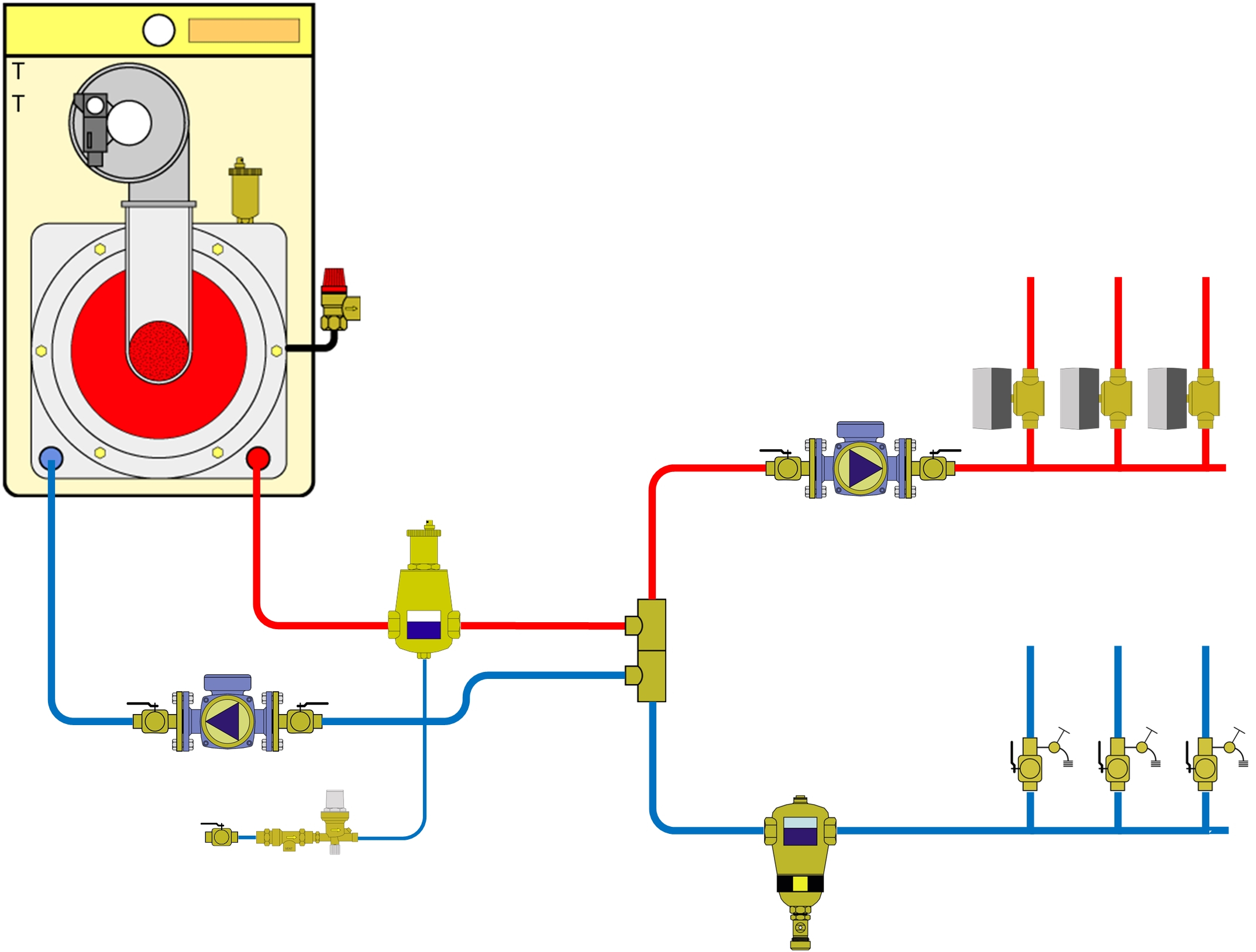
This brings another benefit of hydraulic separation: It can easily handle an imbalance in flow rates between the boiler and distribution, as any difference will flow through the runs of the tees. If you’re not zoning and your heat source only serves one large heat emitter, this may not be important to you. You may be able to use a single circulator without hydraulic separation.
In this scenario, you must ensure that the single circulator can provide the required flow and overcome the head loss from the heat emitter and the boiler heat exchanger.
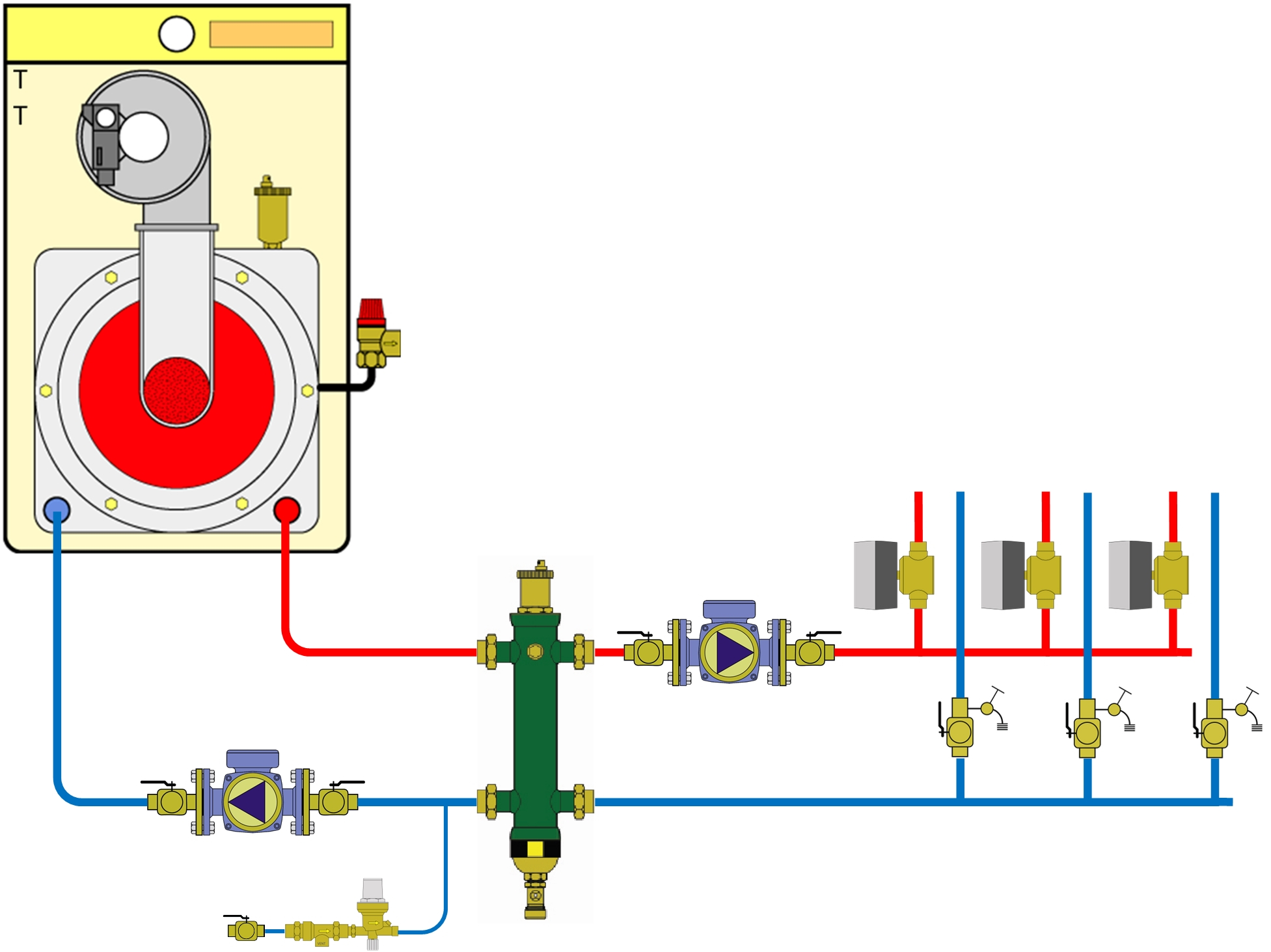
In addition to keeping the boiler happy and providing proper flow rates, you can upgrade your hydraulic separation game. As most hydronic systems require air, dirt and magnetic separation, you can add these functions into a dedicated hydraulic separator (see Figure 2).
With coalescing media at the top providing air separation on the supply and a collision media coupled with rare earth magnets on the bottom catching ferrous and nonferrous debris from the common return, you’ve got it all covered. An all-in-one device like this simplifies boiler room piping drastically while reducing time on the job!
Challenges and solutions
With all these great benefits, hydraulic separation is not without limitations. If the heat loss of the smallest zone is lower than the boiler’s minimum output, you will have problems with short cycling and inefficiency. This is where buffer tanks shine! Buffer tanks are an interesting form of hydraulic separation with added volume. This added volume of fluid ensures the boiler doesn’t short cycle and also stores heat so as not to waste it.
Sizing buffer tanks is based on the minimum output of the heat source, the smallest load in the system and the minimum acceptable run time for your heat source. The larger the tank, the longer your boiler runs, but you should consult your boiler manufacturer to see what it would recommend for minimum run time. Another thing to consider is that the added volume of your buffer tank may affect the sizing of your expansion tank. More volume equals more expansion.
Another phenomenon you may encounter is imbalanced flow rates through hydraulic separation. These varying flow rates can and will influence your boiler return and distribution supply temperatures. If your boiler flow rate is higher than your distribution flow rate, the excess flow from the boiler goes directly back into the boiler return. This raises your return temperatures as the boiler supply mixes with the distribution return.
Modulating boilers will take this opportunity to ramp down. Still, traditional bang-on/bang-off boilers will run until they hit the high limit, as they’re producing significantly more heat than the system needs.
If your boiler flow rate is lower than your distribution flow rate, the excess flow from the distribution goes directly back into the distribution supply. This lowers your distribution temperature and confuses you when your heating system isn’t keeping up while your boiler is producing an adequate supply of water temperatures.
I recently took a call from a contractor about this very anomaly. The boiler was producing 130-degree supply water temperatures while the distribution side of the hydraulic separator was only seeing 112 degrees For this, I recommended consulting the boiler manual or manufacturer to see if a sensor could be added to the distribution side of the hydraulic separator. This would allow the boiler to control temperature based on that and overcome any mixing in the hydraulic separator.
Hydraulic separation is a wonderful arrow to keep in your quiver, whether it be close tees, hydraulic separators or buffer tanks. It can solve a lot of problems and keep boilers happy and efficient. Understanding their capabilities and shortcomings (application-dependent) will help you to know when to use each option.