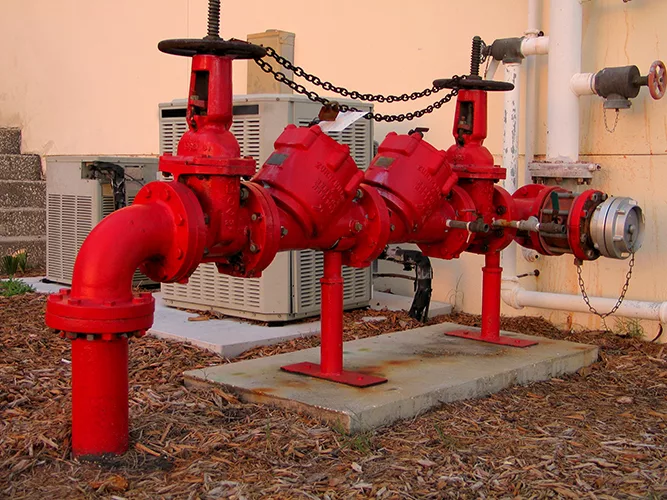
A significant amount of controversy over the last decade has centered on whether backflow protection should be provided for fire protection systems. Another controversy concerns which backflow prevention assembly should be provided for different types of fire protection systems.
To better understand the need for cross-connection control on fire sprinkler systems, two questions must be discussed:
1. What is the threat of the public water distribution system being contaminated as a result of a fire sprinkler system?
Based upon statistics from the University of Southern California Foundation for Cross Connection Control and Hydraulic Research and a Water Research Foundation (formerly the American Water Works Association Research Foundation) study (https://bit.ly/4sYXs6l), 308 illnesses and one death have been attributed to fire protection cross-connections in the United States since 1900.
2. What is the threat of building fires to the public?
According to the database maintained by the National Fire Protection Association (NFPA), other fire analysis and research, fire consistently kills thousands of people every year in nonsprinklered buildings. Statistics conclude that sprinklers reduce the risk of dying in a fire by one-half to two-thirds.
Based on those statistics, it can be concluded that both fire sprinkler systems and backflow prevention assemblies on fire sprinkler systems will improve or protect the public health, welfare and property.
Today, both the fire protection industry and the cross-connection control industry have a basic understanding of the potential water quality concerns if a backflow prevention assembly is not installed, as well as the potential detrimental effects to a sprinkler system design when one is installed. The two industries need to weigh the pros and cons of the issue to determine an agreeable resolution that satisfies the common goal of protecting public health, welfare and property. The key element discussed in this article is the supervision and testing of the backflow prevention assemblies and fire protection systems.
Background
Let’s start by providing some definitions and briefly discussing the objectives for both sides of the issue. This discussion is applicable to all fire protection systems for which backflow prevention assemblies are installed. The backflow prevention assemblies typically used on fire protection systems are either a double-check valve assembly, known as the “double check,” or a reduced-pressure principal assembly, known as the RP.
The term “backflow prevention assembly” is defined as the entire device composed of two independently acting check valves and two resilient-seated control/shut-off valves with properly located test cocks, which have been tested and listed as a single component.
The requirement for a backflow prevention assembly is typically driven by the adopted plumbing codes, the local jurisdiction ordinances or laws. This article is not intended to address when, how and why backflow prevention assemblies are to be installed, but will discuss the supervision and testing of backflow prevention assemblies and fire protection systems.
The Safe Drinking Water Act (SDWA) requires the water purveyor to provide clean and safe drinking water to the point of discharge. The water purveyor not only has to treat the water it supplies but also ensure that any connection to the distribution system does not contaminate or pollute the supply.
In an attempt to ensure the system is protected from any cross-connections, it will have a documented Cross Connection Control Program that describes when, how and why backflow prevention assemblies are to be installed, and the testing requirements for these assemblies.
To address this issue of supervision and testing, several facts must be addressed to further understand the issue at hand.
The water contained within fire sprinkler systems becomes stagnant, resulting in color, taste and odor problems, which are components of the SDWA; therefore, fire protection systems connected to the public water distribution system are considered cross-connections.
Some fire protection systems are provided with chemical additives, such as fire suppression agents (foam), antifreeze or corrosive inhibitors. Systems with chemical additives pose a greater hazard to the public water distribution system, if cross-connected, than systems without chemical additives.
If stagnant water or a chemical additive in a fire protection system backflows into the public water distribution system, it may cause illness or even death.
Not all existing fire sprinkler systems are maintained in accordance with NFPA 25, Standard for the Testing, Maintenance and Inspection of Water-Based Fire Extinguishing Systems.
Not all existing backflow prevention assemblies are tested and maintained annually as required by the backflow prevention guidelines and requirements.
The installation (retrofit) of a backflow prevention assembly on an existing fire sprinkler system may result in a system without the required flow and pressure to meet the system’s demands.
The current backflow prevention assemblies typically installed on fire protection systems have not been tested to ensure they are consistent with how the device will be used. A typical backflow prevention assembly installed on a normal potable system cycles (opens and closes) several times a day or minute, depending on the facility’s water usage.
However, the typical backflow prevention assembly installed on a fire sprinkler system is typically exercised only during quarterly and annual flow testing, which are required in accordance with NFPA 25. In return, the check valves in a backflow prevention assembly on a fire system may not be exercised for months or even years, potentially causing them to stick and not open when required.
One hundred percent of the water in a fire sprinkler system will not backflow into the public water distribution system due to the vacuum created within the system. Based upon limited simulated backflow testing in the research project “Impact of Wet-Pipe Fire Sprinkler Systems on Drinking Water Quality,” the Water Research Foundation concluded that an average of 100 gallons will backflow from a typical wet-pipe fire sprinkler system (https://bit.ly/4sYXs6l).
Depending on the length of the underground lead-in from the public water distribution system main to the automatic sprinkler system riser and the main’s diameter, the typical 100 gallons of water that may potentially backflow may never physically reach the public water distribution system. It takes approximately 100 gallons of water to fill 65 feet of 6-inch-diameter pipe.
If and when contaminated or polluted water from the fire sprinkler system backflows into the public water distribution system, this water will typically be diluted with potable drinking water, which will reduce the levels of contamination or pollution, but may still exceed the maximum contaminant levels set by the SDWA.
Now that several of the facts have been laid on the table, the need for supervision and testing of backflow prevention assemblies and fire sprinkler systems should be discussed.
Sprinklers in residences
Automatic fire sprinkler systems not only have an impact on community life safety and property protection, but they also have a significant impact on a community’s water supply by reducing the amount of water used to control fires. For residential fire sprinkler systems, the required water demand to control a fire is reduced by approximately 88%, according to the Home Fire Sprinkler Coalition’s 15-year study of Scottsdale, Arizona (https://bit.ly/4dCK0Am).
Because of this reduction in water usage, a community can reduce the size of water mains and the number of hydrants. Scottsdale, a sprinklered community for more than 15 years, has had infrastructure savings of $7 million as a result of the uniform application of automatic fire sprinkler systems. Additionally, the community benefits from the added life safety and property protection. During the 15-year Scottsdale study, 49 fires occurred in sprinklered homes with no fatalities. At the same time, 13 people died in fires in nonsprinklered homes.
The average loss per fire without sprinklers was $45,019, whereas with sprinklers it was $2,166. Automatic fire sprinkler systems effectively reduced the average loss per fire by 95%. Research like the Scottsdale report has gone a long way toward documenting the total community impact that automatic fire sprinkler systems can have on the community from fire protection and water authority perspectives.
The need for supervision
What does the term “supervision” really mean in the fire sprinkler industry, and is the use of that term different from the cross-connection control industry? Supervision in the fire sprinkler industry typically refers to control valves on the fire sprinkler system to ensure they are maintained in the open position. Supervision in the cross-connection control industry typically refers to the overall implementation and maintenance of the Cross Connection Control Program.
The term “control valve” in a fire sprinkler system typically refers to an OS&Y or indicating butterfly valve that controls the water supply to the system. The control valves on a fire protection system must be supervised to ensure they are maintained in the open position.
The method of supervision varies, depending on the adopted codes and standards and the local jurisdiction requirements. Most control valves on fire sprinkler systems are either equipped with an electronic tamper switch connected to the building fire alarm system or secured with a chain and padlock to keep the valve open.
When a backflow prevention assembly is installed on a fire sprinkler system, the OS&Y’s or indicating butterfly valves should be supervised to ensure they do not get accidentally closed, eliminating the water supply to the sprinkler system.
The need for testing
I believe we can all agree that if the specific system or equipment is not tested or maintained, there is no need to install it. However, we all know that is not the answer to ensuring safe drinking water or adequate fire protection.
The cross-connection control industry typically requires annual backflow performance testing to ensure the assembly will prevent backflow. This testing is typically required to be performed by a certified backflow prevention tester. The local water purveyor or authority having jurisdiction will typically track the annual testing of the assemblies and provide the testing protocol for each assembly type.
NFPA 25 provides specific criteria for the inspection, testing and maintenance of fire sprinkler systems. It also addresses the inspections and testing required for backflow prevention assemblies. NFPA 25 identifies two specific annual tests required for backflow prevention assemblies: a forward flow test and a backflow performance test.
The importance of the forward flow test is to ensure that the check valves in the backflow prevention assembly fully open, allowing a minimum flow rate to meet the sprinkler system’s demand. An adequate amount of water is defined as the system demand for the specific sprinkler system. The backflow performance test is important to ensure that the backflow prevention assembly will function as required and prevent the water from backflowing into the public water distribution system.
Unfortunately, testing of backflow prevention assemblies or fire sprinkler systems is not always performed at the frequencies required by codes or standards or in accordance with the testing criteria. Backflow prevention assemblies and fire sprinkler systems are designed and installed to protect the public health, welfare and property. If neither is inspected, tested or maintained correctly, there is a greater chance they will not work properly when needed.
Both the fire protection and backflow prevention communities want to protect drinking water and keep the public safe from fire. To accomplish these goals, both industries must understand the importance of the other industry to help ensure our drinking water is protected, and the fire sprinkler systems work as designed.
Jack Poole, PE, FSFPE, is a principal and founder of Poole Fire Protection, a family-owned code consulting and fire protection engineering firm located in the Greater Kansas City area (Olathe, Kansas). In 2026, the company will celebrate its 35th anniversary. Poole is a registered Professional Engineer in fire protection and licensed in 50 states, plus Washington, D.C., and Guam. He serves on many NFPA Technical Committees. Poole is also an SFPE Fellow and was the SFPE International president in 2021.