Backflow assemblies don’t typically come to mind when trade professionals consider new and advanced or emerging technologies. Yet lately, advancements in all sectors of the plumbing and mechanical industry are moving swiftly For those of us in the plumbing engineering field, we want our allied professionals to stay apace with these changes, allowing them to remain competitive and to get things done right the first time.
Yet plumbers and backflow testers, being cautious, tend to wait until technologies are fully proven before purchasing and installing them. Naturally, wholesale distributors sensibly exercise caution, as well.
Rest assured, a host of smart technologies involving backflow assemblies has entered our universe: connectivity to building management systems (BMS), monitoring of performance or system conditions and safety features such as flood or freeze protection.
Compound problems
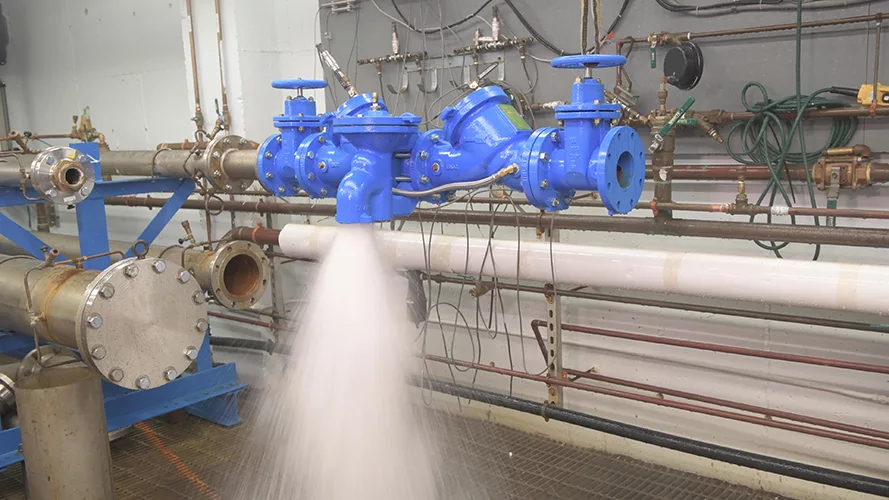
Reduced pressure zone (RPZ) backflow preventers now integrate a differential pressure relief valve that senses pressure imbalance across the first check and opens if the differential falls below a setpoint. This integrated safety feature ensures that potentially contaminated water is discharged, rather than flowing back into clean water sources.
The relief valve also serves as an informant, as a fouled first check will cause the relief valve to discharge. While this provides visual indication of failure — an important feature for a safety device — the valves are often in areas where discharge won’t be detected quickly, potentially leading to property damage. A related problem could be insufficient drain size or a clogged drain, or worse: no accommodation for drainage.
The compounding of these problems led to the first major digital technology backflow preventers have brought to market: flood detection and protection.
 These devices sense relief valve discharge, which activates an alert to users, giving them time to address the condition before things worsen. Relief valve discharge from a 3-inch RPZ backflow preventer can reach hundreds of gallons per minute, so it’s easy to understand the need for these protective measures. The average commercial flood claim is $75,000 to $100,000, but can easily surpass a million dollars, especially when the discharge occurs at night or over the weekend, when it may be left unaddressed for hours or days.
Flooded with risk
With the risk of flooding, why install backflow preventers in the first place? Is the risk real? Should the possibility of contamination be taken seriously?
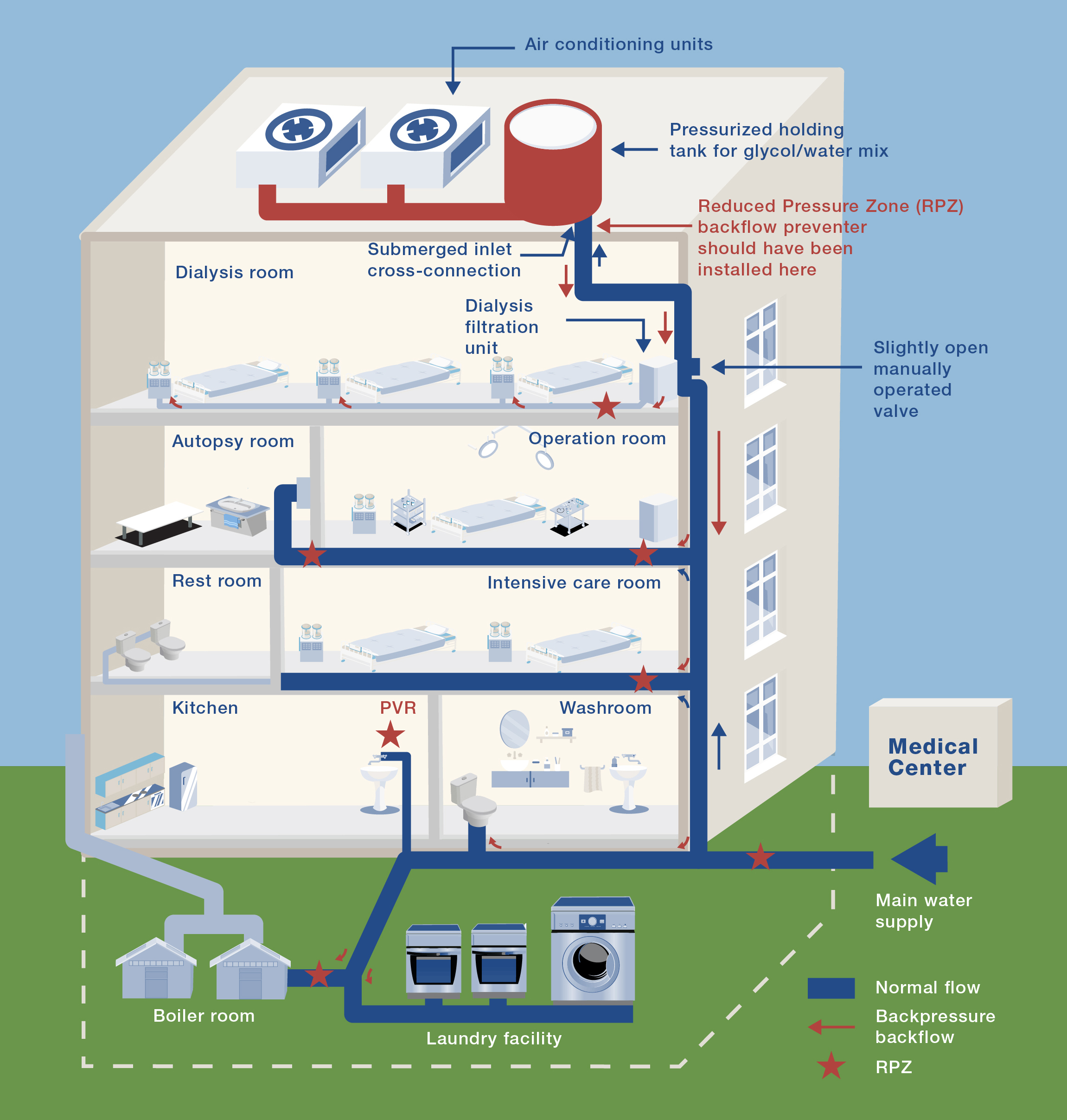
Consider this legal case from a medical center in North Dakota: a coroner’s jury ruled that the accidental contamination of dialysis machines at a medical facility was a “significant condition” in the deaths of two patients.
Glycol had entered the system through an air conditioning makeup water valve. With the valve partially open, water-glycol in the chilled water system was allowed into the medical center’s potable water system. From there, glycol made its way into the dialysis machines and eventually into patients’ blood.
The deaths could have been avoided had the proper backflow preventer, such as an RPZ, been used on the cross-connection between the potable water system and the chilled water system. In this case, backflow prevention could have been the difference between life and death.
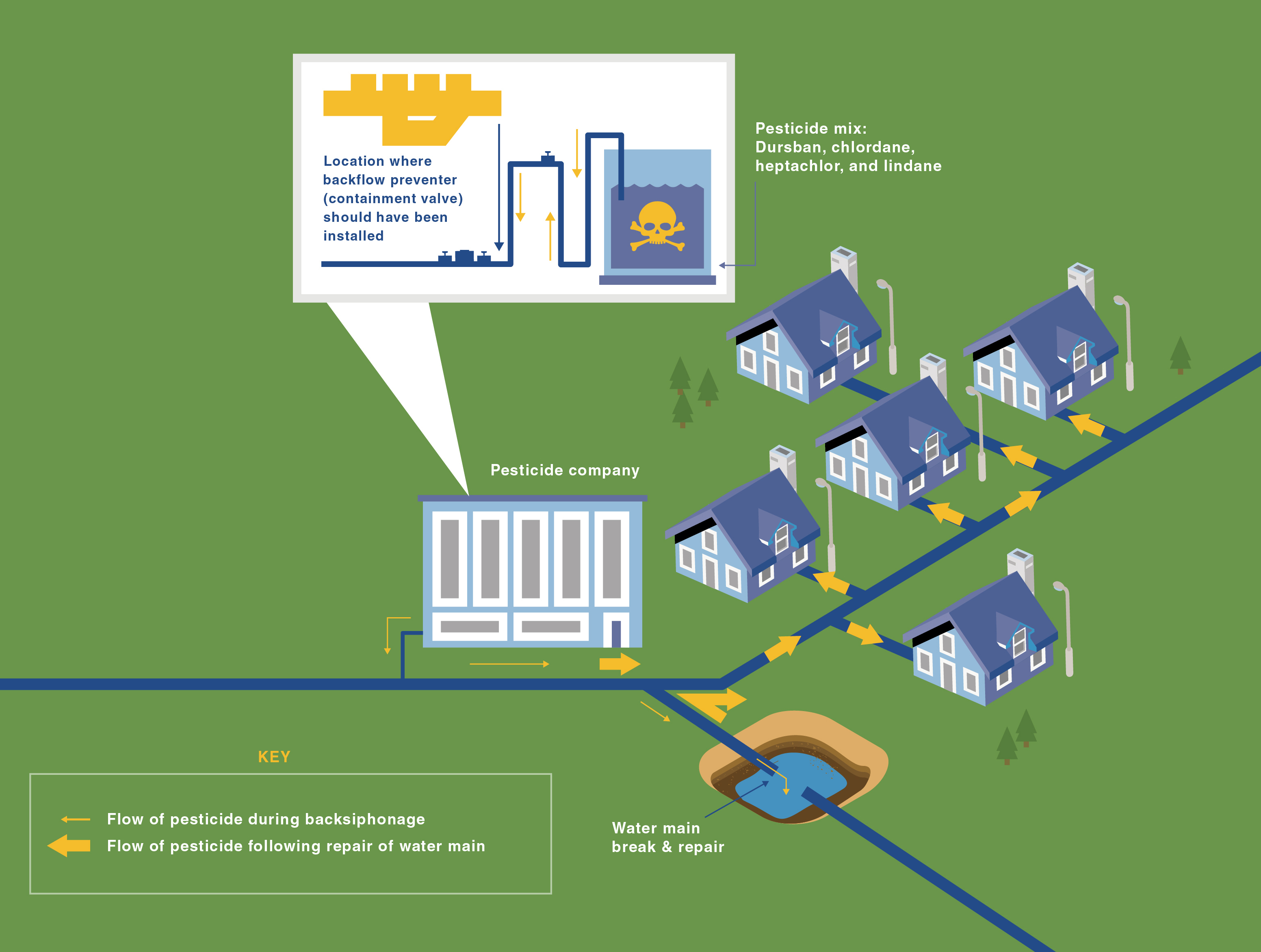
Another example: pesticides used for termite control were found in a New Jersey municipal water supply. A water main break had caused negative pressure in the distribution piping, siphoning water through unprotected cross-connections, including one at a pesticide manufacturer. Dangerous chemicals flowed into the water main over the two hours it took to repair the break.
As a result, 63 homes were without water for days while lines were flushed. They were unable to cook, bathe or wash clothes. The municipality had to keep a tanker truck parked in the neighborhood to provide clean drinking water, and residents were allowed to shower at local public schools.
Technology applied
Flood alerts vary by manufacturer but can include text, email and a phone call, via BMS, cellular or Wi-Fi. Devices that connect to a BMS or operate through a cellular connection are more appealing to building owners and operators, even if there is a nominal fee for the service.
The locations of web-enabled alert devices also differ between manufacturers. Some are built into the backflow preventer itself; others are installed on the drain line.
Another advantage of web-enabled backflow preventers: the devices can communicate with an automatic shutoff valve. This is a form of automatic control valve (ACV) that uses a diaphragm and a small solenoid to shut a valve. The advantage of using an ACV, as compared to something like an actuated gate valve, is that an expensive actuator that might require a 240 V power supply is not required. By using a diaphragm, these valves need only a small solenoid in order to shut down even very large valves.
Automatic shutoff isn’t necessary for every application. Hotels and hospitals, for instance, typically can’t afford to have the main water supply shut off automatically, even if it is to prevent a potential flood. However, other applications may benefit from automatic shutoff, such as a backflow device installed on a line supplying water to a cooling tower. In such an instance, the backflow device is likely to be in a mechanical room on a high floor, the worst setting for substantial water damage.
Backflow testing comes of age
Flood detection and protection is the first real foray of backflow preventer manufacturers into making their valves smarter and connected.
Yet even backflow testing has entered an innovative dimension. While testing has largely been performed the same way for decades, the recording and submission of test results have evolved substantially.
Backflow testing used to be arduous work. Testers could spend 20% of their time dealing with test reports and submittals, making sure they were filled out with all the necessary information, dealing with different test forms for each municipality, and submitting the information by mail, email and even fax — all wasteful of the industry’s scarcest resource: time.
For testers, backflow test management software now helps to automate redundant data entry, such as tester ID and credentials, test kit calibration, etc. They can even help keep track of previous tests, auto-fill forms and help the tester reach out to previous customers when they know their next backflow test must be completed. Some systems can even submit test results automatically.
Test management software can also help simplify the test itself. Backflow test forms can be confusing because they squeeze all the required tests onto a single sheet. RPZ, double check valve, double check detector assembly, reduced pressure detector assembly and pressure vacuum breaker tests all compete for space with other required information for the tester and valve.
Many municipalities have different variations of the form. Test management software residing on mobile devices reduces the clutter. The only thing a tester sees on a phone or tablet is the field that needs attention.
The backflow prevention industry is quickly adopting new digital technologies, products and systems to continue to maintain safe and clean drinking water.
Robin Drinkwine is an associate product manager at Watts. She has been with Watts for 20 years, working in various positions, including many years in the engineering department. Drinkwine holds a bachelor’s degree in business management and an MBA in marketing.