With a shared focus on expanding access to safer, more sustainable homes, the International Code Council Evaluation Service (ICC-ES) and BASE Bahay Foundation Inc. (BASE), a non-profit organization based in the Philippines, announced a new collaboration to support efforts to address urgent housing needs in vulnerable communities around the world.
Through this collaboration, ICC-ES and BASE will assemble a groundbreaking, industry-first working group of international experts to develop global Acceptance Criteria documents for structural bamboo, helping create code-compliant pathways for this alternative building material.The Acceptance Criteria will form the basis for structural bamboo Evaluation Service Reports (ESRs), which will verify the building product’s compliance with applicable codes and standards. ESRs give design professionals, building officials, and other stakeholders the ability to confidently specify, design, and build with innovative materials, such as structural bamboo products.ICC-ES will develop the Acceptance Criteria and resulting ESRs using the International Code Council’s I‑Codes as a performance-based technical foundation, ensuring a consistent, independent evaluation approach while allowing for alignment with local codes and regulatory frameworks in countries where structural bamboo is used.
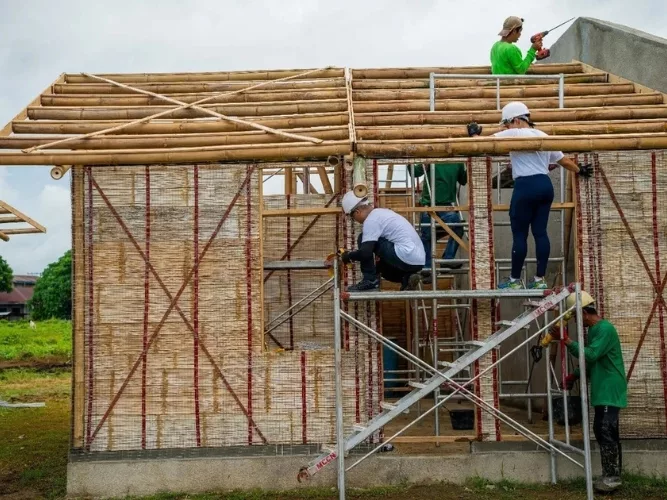
Structural bamboo has a long-standing history as an economical, fast-growing, and sustainable building material, used for thousands of years across South Asia, East Asia, and Central and South America. Yet despite its history and significant potential for modern applications, particularly in regions with economic and environmental challenges, it has not been formally and independently evaluated for code compliance in the current regulatory environment. The ICC-ES/ BASE initiative represents an important step toward establishing the technical basis needed to support its broader use.
For this effort, ICC-ES will provide testing, inspection, and certification services for structural bamboo, helping to enable its global acceptance and adoption and increase confidence in its use as an innovative building solution for social housing. It will focus initial efforts on Colombia, the Philippines, India, and Indonesia, with future expansion anticipated in Australia, Brazil, Fiji, Malaysia, Mexico, and Nepal. Across these markets, demand for safe, permanent, sustainable housing remains high, with shortages in many countries estimated in the millions of units.
BASE will support the collaboration by identifying global subject-matter experts to participate in the working group, engaging structural bamboo producers in participating countries, and helping align the resulting ESRs with existing technical research and in-field applications. These efforts will help ensure the evaluation framework reflects real-world construction practices, supports regional capacity building, and encourages broader adoption of structural bamboo as a safe and resilient building material. These efforts align with ICC-ES’s commitment to continue advancing safe, sustainable construction globally by applying a performance-based evaluation framework that helps bridge traditional materials and modern performance expectations. Through independent technical evaluation and code alignment, the collaboration supports regulators, designers, and builders in making informed decisions that reflect local building practices and regulatory requirements, while expanding access to resilient housing solutions for underserved communities worldwide.
“This collaboration reflects ICC-ES’s continued global growth and its mission to help create a safer built environment while addressing urgent housing needs,” said Chris Fennell, vice president of global business development, ICC Conformity Assessment Group (ICC CAG). “By combining technical evaluation, code development support, and product evaluation, ICC-ES is helping expand broader code acceptance of both traditional and innovative materials, including structural bamboo, in a way that supports regional adoption and long-term resilience.”
“Working with ICC-ES is a significant step toward strengthening confidence in structural bamboo as a reliable building material. By supporting the evaluation and recognition of bamboo within established codes and standards, this collaboration helps formalize its use in mainstream construction,” said Engr. Luis Felipe Lopez, general manager of BASE Bahay Foundation. “Incorporating bamboo into regulatory frameworks not only ensures safety, quality, and performance but also unlocks wider adoption of a regenerative, low-carbon material. Ultimately, this paves the way for more resilient, sustainable, and accessible building solutions for communities that need them most,” he added.
ICC-ES expects to complete development of the Acceptance Criteria by fall 2026, followed by development of the ESRs, with testing activities anticipated to be completed in early 2027.