Hard water — water rich in calcium and magnesium — has long been known for its stubborn impacts on daily life, from soap curd in the bath to scale buildup that damages plumbing and household appliances. Modern cation‑exchange water softeners effectively reduce the concentration of these minerals, along with other unwanted cations, preventing the familiar hassles and extending the life of plumbing and appliances.
Yet a persistent myth remains: softeners somehow make water corrosive. In reality, while corrosive water is a genuine problem in some regions, water softeners do not make water corrosive.
The term “hard water” was originally coined to describe waters that were difficult to use for washing and laundry. The calcium and magnesium present in hard water react with soap, reducing its effectiveness as a cleaning agent. Instead of creating a rich lather, the soap combines with these minerals to form insoluble compounds.
These insoluble compounds can form “soap curd” deposits, which are often noticed as an unappealing film on skin, in bathtubs, on shower walls, in sinks and on laundry. Soap curd can be grayish in color, it may be tinted the color of the soap or it can appear pink if bacteria take up residence in the deposit.
Water hardness is expressed in grains per U.S. gallon (gpg), where one grain equals 17.1 mg/L of hardness calculated as calcium carbonate equivalents. Degrees of hardness are categorized as follows:
Soft water |
<1 gpg of hardness |
Slightly hard |
1.0 to <3.5 gpg |
Moderately hard |
3.5 to <7.0 gpg |
Hard |
7.0 to <10.5 gpg |
Very hard |
10.5 gpg or more |
Hard water also causes scale deposits to form on surfaces it comes into contact with, damaging plumbing, fixtures, water heaters and other water appliances. Even a small amount of scale can significantly reduce the energy efficiency of a water heater and other water-heating appliances.
How cation exchange softeners work
Cation-exchange water softeners are highly effective at removing calcium and magnesium, preventing detrimental reactions with cleaning agents and other harmful effects of hard water. Water softeners can also capture harmful cations from the water, including radium, selenium and barium.
Some areas of the country have access to naturally soft water sources. Naturally soft water typically has low concentrations of dissolved minerals and is acidic. These chemical properties make the naturally soft water corrosive, meaning it can degrade metallic pipes, fixtures and water appliances.
However, softening hard water with a cation-exchange water softener does not create the same chemical conditions that make naturally soft water corrosive. While a water softener does reduce the concentration of calcium and magnesium in the water, these minerals are replaced (exchanged) with other minerals. Hence the name “cation-exchange.”
To be clear, if you are working with corrosive water, a water softener will not correct that problem. However, a water softener will not make noncorrosive water become corrosive.
What corrosion really is — and what causes it
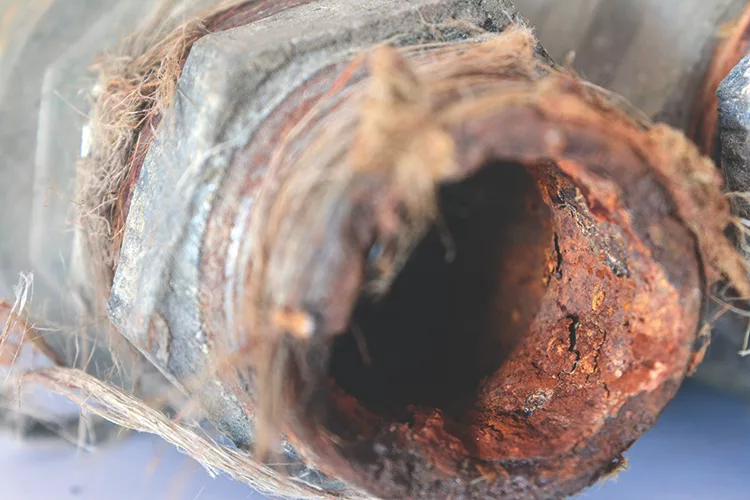
Let’s dive deeper into the topic of corrosion. In plumbing, corrosion is a natural, electrochemical process where metal slowly breaks down when it comes into contact with water. Rust, due to the corrosion of iron and its alloys such as steel, is the most recognizable form, but corrosion can affect many plumbing materials, such as copper, brass and aluminum.
Corrosion can cause multiple undesirable effects in the plumbing system, including reddish-brown staining from rust formation, leaks, pitting (small holes in metal) and blue-colored water associated with copper corrosion. Although not always visible, corrosion can release dangerous contaminants, including lead and copper, from piping into the water.
Water chemistry, temperature and flow conditions can trigger or accelerate corrosion. The materials in the plumbing system can also impact whether corrosion will occur, such as when dissimilar metals are in contact with each other, creating a galvanic cell.
Here are some common problems that can accelerate corrosion:
Low pH (acidic water). Provides excess hydrogen ions that attack metal surfaces.
High pH. Can cause pitting in certain metals, such as aluminum.
High total dissolved solids (TDS). Increases water conductivity, which in turn increases galvanic activity (corrosion of one metal due to contact with another metal in a conductive solution).
Low TDS. Water low in minerals is “hungry” and can leach metals from plumbing.
High water velocity or turbulence. Creates erosion corrosion, or the physical degradation of pipe due to fast-moving water, especially at fittings and turns in the plumbing.
High temperature. Speeds up reaction rates, especially at temperatures over 158 F (70 C).
Chlorine or chloramines. Strong oxidizers that, while important for disinfection, can increase corrosion in copper or lead-bearing plumbing.
Dissimilar metals. Can trigger galvanic corrosion (which is worsened when TDS is high).
Biofilm. Supports microbially induced corrosion, a localized form of corrosion that occurs when a group of bacteria attaches to a pipe and concentrates corrosive agents, alters pH or produces corrosive metabolites.
High chloride-to-sulfate ratio. High chloride levels, combined with low sulfate and alkalinity levels, create a favorable water chemistry for corrosion to occur.
Carbon dioxide. Can contribute to the formation of carbonic acid, decreasing the pH of water.
Stray electricity. A home’s electrical system may sometimes be grounded to the metal plumbing using a grounding strap or bonding jumper wrapped around the piping. If the grounding strap is disconnected from the plumbing, stray electrical current can cause piping corrosion.
It’s important to note that these conditions are not created by a properly configured and maintained ion exchange water softener. However, naturally soft water typically has two of these conditions, low pH and low TDS, which is why it is corrosive.
What the research says about softened water and corrosion
Although misperceptions still exist in the field, research has consistently shown that ion exchange softening does not increase the corrosivity of water.
In 1998, the U.S. Environmental Protection Agency conducted a study to evaluate whether ion-exchange softening altered water chemistry in a way that would accelerate metal release (https://bit.ly/3NtmATp). The work analyzed multiple plumbing materials and compared metal leaching under controlled conditions for both softened and nonsoftened water. It concluded that softened water did not produce higher levels of metal leaching than unsoftened water when all other factors were the same.
Another study by the METALogic research institute in 2007 monitored real-world plumbing systems over an extended period to assess long-term impacts (https://bit.ly/46SMSFj). The research found no difference in the impact of corrosion on copper or galvanized steel between hard water and softened water.
In 2012, the British Standards Institute, working with Midland Corrosion Services Ltd. on behalf of the UK Water Treatment Association, performed controlled testing using model central heating systems (https://bit.ly/46SMSFj).
This study tested natural hard water versus ion exchange softened water in heating systems using several metals (copper, brass, stainless steel, mild steel and aluminum). The study found no significant difference in corrosion rates between softened and unsoftened water across these materials.
All three studies point to the same conclusion: Ion exchange softening does not change water chemistry in a way that increases corrosion risk.
Symptoms of hard water can interfere with laundry and cleaning activities, cause mineral deposits on dishes and glassware, increase energy costs due to scale formation inside water heaters, damage plumbing and water appliances, and lead to ugly scale buildup on fixtures and sinks.
Cation‑exchange water softeners effectively address the negative effects of hard water and can potentially capture harmful contaminants often present in groundwater. And while corrosive water is a separate issue that softeners cannot fix, the myth that cation-exchange water softeners make water corrosive is unfounded.
Eric Yeggy, MWS, is technical affairs director for the Water Quality Association. Bryanna Poczatek is WQA’s technical affairs manager.