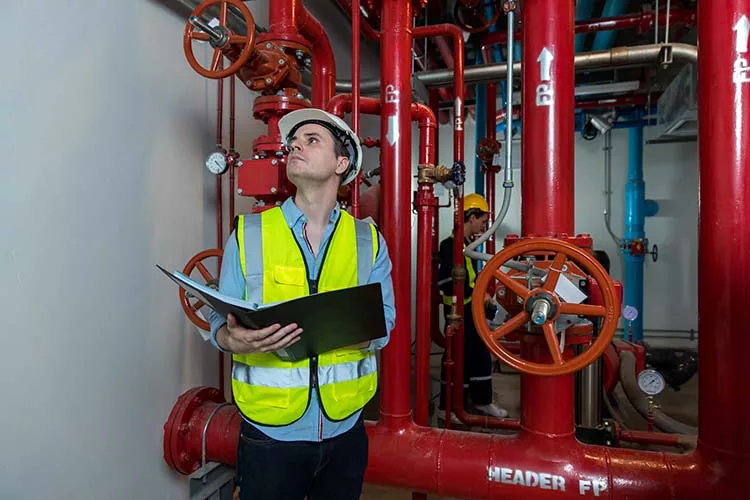
NFPA 13, Standard for Installation of Sprinkler Systems, does not require fire sprinklers in any building or structure. This statement may raise a few eyebrows, but keep reading and let us explain.
Codes vs. standards
In the practice of fire protection engineering, codes and standards are part and parcel of everyday life. There is a significant difference between a building/fire code and an installation standard. As the saying “words have meanings” implies, the definition of these two terms is distinct and important.
A building/fire code is a document legally adopted by an entity (a jurisdiction) and contains requirements based on the size, use, contents and other attributes of a building or structure. When it comes to fire sprinkler systems or fire alarm systems (and any other fire protection provisions), the building/fire code indicates when a system is required in a building or structure.
For example, let’s examine a single-story department store on a slab. Is an automatic fire sprinkler system required in such a structure? To answer that question, one would consult the 2021 edition of the International Building Code (IBC) Section 309.1, which classifies a department store as a Mercantile Group M occupancy. In accordance with IBC Section 903.2.7, if a Mercantile Group M occupancy’s fire area exceeds 12,000 square feet, an automatic fire sprinkler system is required; 12,000 square feet or less, no such system is required.
Note: The IBC defines fire area as: “The aggregate floor area enclosed and bounded by fire walls, fire barriers, exterior walls or horizontal assemblies of a building. Areas of the building not provided with surrounding walls shall be included in the fire area if such areas are included within the horizontal projection of the roof or floor next above.”
If you think of a typical convenience store (certainly not a department store, but a Mercantile Group M occupancy nonetheless), it is typically less than 12,000 square feet and, therefore, not sprinklered. So, it is the building code that requires automatic fire sprinkler protection of buildings/structures.
So where does NFPA 13 come into play? When a code requires a particular building/structure to be protected with a fire protection system, one refers to an installation standard, such as NFPA 13, to determine how that system is to be designed and installed. So, this is why NFPA 13 does not require fire sprinklers in any building or structure.
Codes and standards development/revisions
For the purposes of this discussion, we will use the term “standards” to refer generally to codes, standards and other criteria. Standards are developed by various organizations, but the two primary organizations developing standards used by fire protection engineers are the National Fire Protection Association (NFPA) and the International Code Council (ICC).
Fire protection engineers (FPE) practicing in the United States on federal and state projects are required to use criteria provided in documents developed by those government entities, such as the Federal Government’s Unified Facilities Criteria.
The NFPA code development process and that of the ICC are different in technical procedure, and those procedures are not within the scope of this article. What is important to the point of this article is that each code development process is similar in that each constantly produces new editions of its standards to keep pace with our changing world. Specifically, those new editions address changes in:
• Society in general;
• The built environment;
• New/changing hazards;
• Materials and how they are installed/used;
• Fire protection technology and systems.
Most standards are updated/expanded/revised every three to five years; this is evident simply by looking at the change in their physical size, both in page size and number. These documents developed by the NFPA and ICC are considered “model” codes and standards intended for adoption by an Authority Having Jurisdiction (AHJ).
Applicable codes and standards
So, if these standards are constantly updated, which edition should a fire protection engineer use for a project? The answer is “not always the latest and greatest edition,” unless the question is about a federal government project. (Typically, standards applicable to a federal government project are the latest editions available at the time of the 35% design submission.)
In private or commercial projects, the applicable edition is whatever edition has been adopted and enforced by the AHJ (which may be a few editions older than the latest). In most cases, an AHJ will modify or amend the model code as part of the adoption process.
The AHJ on a project could be a state, county, city, building department, fire department, health department, zoning board, project owner, insurance company, native Indian reservation, environmental agency or accreditation body. This is not meant to be an exhaustive and all-inclusive list.
Why would AHJs not enforce the most recent edition of a standard? Their adoption is typically periodic, allowing time for their analysis and review of the newer model codes and standards, including time to generate local amendments. Jurisdictions often add local amendments to adapt the model code/standard to specific environmental, economic or geographical needs.
The final output of this effort typically is submitted to legislative bodies to create enforceable law through legislative action, regulation or incorporation by reference. Adoption of a newer version of a standard also requires time for training the AHJ’s plan review staff.
Some jurisdictions will skip an edition or two of a new standard for various reasons, but sticking with an older version of a standard for too long can affect the Insurance Services Office (ISO) rating of the local fire department. Fire department ISO ratings are inverse to insurance premiums, so if the ISO rating decreases because a jurisdiction enforces an “old” edition of a standard (among other reasons), it usually results in complaints to elected officials when property owners get their insurance bill.
The use of newer editions when they are not the applicable edition
The ultimate question that emerges is: “Why use a newer code edition when it is not the applicable edition?” The answer is multilayered and may not be a one-size-fits-all approach. Though this does not represent an exhaustive list, here are six key considerations:
1. The older (currently enforced) edition does not address the hazard at all.
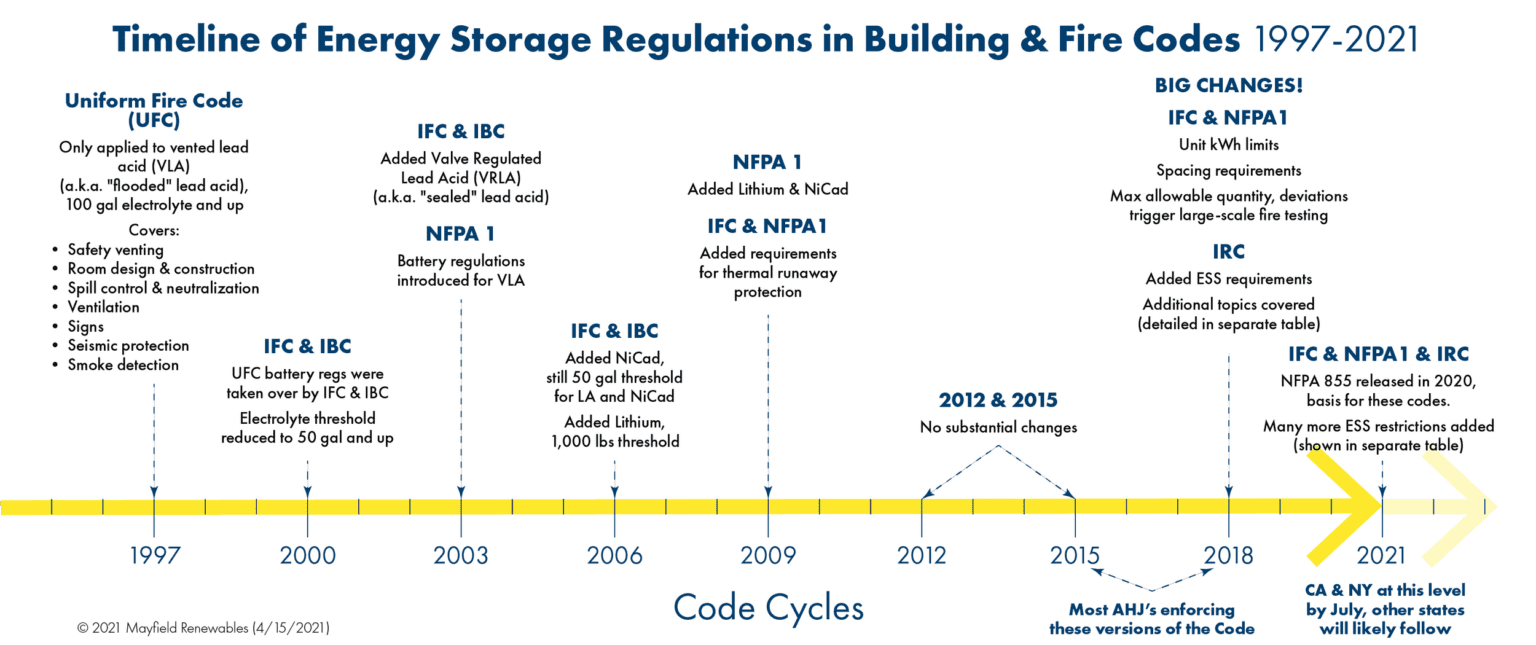
Standards are often updated as new hazards emerge and are recognized by the FPE community. For example, battery storage and the hazards of lithium-ion batteries have undergone significant development since the late 1990s. Figure 1 shows the lifecycle of energy storage regulations in building and fire codes since 1997. It was not until 2020 that the first edition of NFPA 855, Standard for the Installation of Stationary Energy Storage Systems, came to fruition.
Before that, standards such as NFPA 1, The Fire Code, covered such topics at a high level but not in the detail warranted for such hazards. It is imperative to consider the need for new codes as well. For example, NFPA 800 is in development stages and will address the entire battery lifecycle. It will cover fire, electrical and life-safety hazards that are otherwise not covered by NFPA 855 or other existing standards. In such cases, the FPE may petition an AHJ to use a new code where no version of that document is even referenced/adopted by the jurisdiction.
2. The older (currently enforced) edition addresses the hazard, but not very well.
What if a standard does not address a hazard very well? For example, let’s look at NFPA 13. Obstructions, specifically conveyors, can prove quite vague. An American Fire Sprinkler Association “Technical Review” article in its Sept. 20, 2021 Tech Update Newsletter provides the following clarification on this topic:
“Prior to the 2022 edition, the sprinkler type installed at the ceiling level was required to be installed below obstructions. The 2022 edition of NFPA 13 added language that permitted different sprinkler types to be installed below conveyors depending on the hazard below. Quick-response standard spray sprinklers can be used below conveyors when no high-piled storage is beneath the conveyor. The same type of sprinkler installed at the ceiling level is required to be installed below the conveyor when high-piled storage is present under the conveyors.
The NFPA 13, 2022 edition states:
“14.2.11.4 Conveyors. Sprinklers shall be arranged with respect to conveyors in accordance with one of the following:
“(1) Quick-response standard spray sprinklers shall be permitted to be installed below conveyors without high-piled storage located underneath.
“(2) Ceiling level sprinklers shall be installed below conveyors with high-piled storage located underneath.
“(3) Additional sprinklers shall not be required below belt or similar type conveyors where the conveyor in a horizontal profile is a minimum 70[%] open.
“(4) Additional sprinklers shall not be required below belt conveyors up to 4 [feet] (1.2 m) wide where the area below the conveyor is void of high-piled storage.
“(5) Additional sprinklers shall not be required below roller conveyors where the horizontal opening between rollers equals or exceeds the width of the roller.
“(6) Additional sprinklers shall not be required below roller conveyors where the area below the conveyor is void of high-piled storage.
“This language was added by Second Revision 1124 (SR-1124) to specifically address obstruction rules caused by conveyors.”
Prior to this revision, it was not well established whether obstructions beneath conveyors were covered by NFPA 13. As such, now that modern codes cover this topic and concern, it is imperative that the most recent version of the standard be applied to ensure the hazard is properly protected. As fire protection engineers, we know we are obligated to protect the public and not merely comply with the code minimum; hence, we may need to employ a not-yet-adopted edition of the code.
3. Newer FP systems/technology that can’t be applied to the situation if the older version of the code/standard is enforced
Fire protection research has evolved over time, particularly in the 21st century. We have applied quantitative results and research to qualitative observations that may have previously been accepted. As new research evolves, codes often change, and new provisions are adopted by the code developers. A major development that shows such a change is in NFPA 13.
The 1999 edition was the first to allow a design area reduction for the use of quick-response (QR) sprinklers in wet-pipe systems in light or ordinary hazard occupancy, where the ceiling height is a maximum of 20 feet. The research found that QR sprinklers provided a faster response to fire than standard spray sprinklers. Without a jurisdiction applying the 1999 and newer NFPA 13, an option would possibly be missed that would provide the best option for the end user.
Another example that has been supported by the increase of research provided within NFPA 13 is that of storage protection. Originally, this information was adopted as NFPA 231C, the Standard for Rack Storage of Materials. As time has progressed, this has evolved into a combined section within NFPA 13, Chapters 20-27 in the current edition (2025).
This has evolved from simple design curves in the 1970s to well-researched and supported data that now include: control mode density/area sprinklers, control mode specific application sprinklers, and early suppression fast response sprinklers with various temperature ratings and K-factors ranging from 11.2 to 25.2. Research continues to evolve and is influenced by the ever-demanding needs of the fire protection industry.
Without proper application of the latest code, much information is lost and missed that is supported by scholarly, data-driven research. In the extreme, if we are not going to use modern data-driven science, there would be no reason not to use the 1896 edition of NFPA 13 and ignore the science that exists today. However, we know this to be an incorrect response to such a problem and, as such, we should choose to apply modern codes.
Another consideration that supports the need to apply the most modern code is when multiple codes are consolidated into a single code. An example of this is found within NFPA 1140, Standard for Wildland Fire Protection. This code combines NFPA 1051, NFPA 1141, NFPA 1143 and NFPA 1144 into one standard as part of the NFPA Code Consolidation plan.
NFPA aims to better serve emergency response and responder safety and create better efficiency for the technical committees (https://bit.ly/4aQTa9q). This streamlines and creates a better resource for code users that allows codes to be adopted and enforced. By using the most researched and best-supported code, rather than a previous adoption, it is known that the proper code edition is being used.
4. New advancements in FPE, such as performance-based design or firefighting standards
Prior to 2000, there was no Performance-Based Design chapter in NFPA 101, Life Safety Code. By incorporating Chapter 5, Performance-Based Option, many more options and opportunities became available for the FPE to find a solution for something that may not otherwise be provided by a prescriptive-based option. This negates the one-size-fit-all approach to protecting fire hazards, and supports the need to use the modern and most updated version of codes and standards.
What about codes that support and affect those that serve and protect us? NFPA 1700, the Guide for Structural Fire Fighting, provides a basis and understanding of fire dynamics and fire science. NFPA 1700 acknowledges occupant life threats; it also addresses the protection of firefighters from immediate dangers to life and health by reinforcing the need for personal protective equipment and contamination control methodologies.
The focus of the document is to provide guidance to individuals and organizations on interacting within a structure on fire with proven approaches based on documented fire investigations, research and fire dynamics testing to achieve the most successful outcome. Chapters are dedicated to establishing strategies with tactical considerations to provide effective search, rescue and fire suppression operations, as well as civilian and responder safety (https://bit.ly/4tUHhYW).
5. A code becomes stricter due to a fire or fires that resulted in an unacceptable risk or loss of life.
One of the most significant fires of the 21st century is that of the Station Nightclub Fire in West Warwick, Rhode Island, Feb. 20, 2003. Prior to the fire, the main entrance and exits were required to accommodate 50% of the building’s occupant load in a place of assembly. After the fire, the code change increased the required width of the main entrance/exit to accommodate at least two-thirds of the total occupant load for bars with live entertainment, dance halls, discotheques, nightclubs and assembly occupancies with festival seating.
It is unfortunate but important to note that many significant changes to standards come out of tragic circumstances. As a result, it is imperative that (again) codes and standards (or portions thereof) that properly address the hazards are used.
Another fire that underscored the need to adopt modern fire codes occurred at the MGM Grand Hotel on Nov. 21, 1980. As a result of that disaster, as well as similar incidents, complete active and passive fire protection systems, such as automatic sprinklers, fire detection/alarm/communications systems, limited combustible and noncombustible materials, HVAC shutdown, elevator recall and interior finish requirements are required by today’s codes.
6. A code becomes more acceptable because of fire loss data that indicates a code is unnecessarily strict.
Recently, the modern edition of NFPA 409 implemented major changes, providing alternatives to the requirements of the fire foam suppression system. NFPA 409 created provisions that allowed for more tailored fire suppression approaches. A prescriptive option, risk assessment option and risk-based approach all provide options the FPE can examine, balance and apply to the project. This is yet another supporting reason to apply a more modern code edition.
By looking at the synopsis of changes at the front of NFPA standards, an FPE can see a picture of the general changes to a specific code/standard over the years. That will be very helpful in finding out where and when such changes happened, allowing the engineer to point out and use these examples.
Ultimately, many areas support the use of applying the most modern provisions of a code/standard, but it is up to the engineer to make a case for the local AHJ as to why newer (and not currently adopted) editions should be used. In other words, making the case for allowing the use of this not-yet-adopted edition. This article provides a snapshot of many reasons that support such arguments.
Thomas W. Gardner, PE, FSFPE, LEED AP, is a registered Professional Engineer (Fire Protection Engineering) in 17 states and has more than 45 years of experience. He is the chairman of the Society of Fire Protection Engineers’ Greater Atlanta Chapter Annual Fire Safety Conference & Expo. Additionally, Gardner has 21 years of experience as a volunteer firefighter and was previously a captain. He is the past chair of the SFPE’s Engineering Education Committee, past chair of the NFPA’s Health Care Section, an SFPE Fellow and a senior fire protection engineer with the Harrington Group.
Elliot M. Paisner II is a member of the Society of Fire Protection Engineers’ Greater Atlanta Chapter Annual Fire Safety Conference & Expo committee. Additionally, Paisner has five years of experience as a volunteer firefighter and EMT. He is an Eagle Scout and an active volunteer with the Atlanta Area Council of Scouting America and serves in various roles and responsibilities at the unit, district and council levels. Paisner is a fire protection consultant with the Harrington Group.




