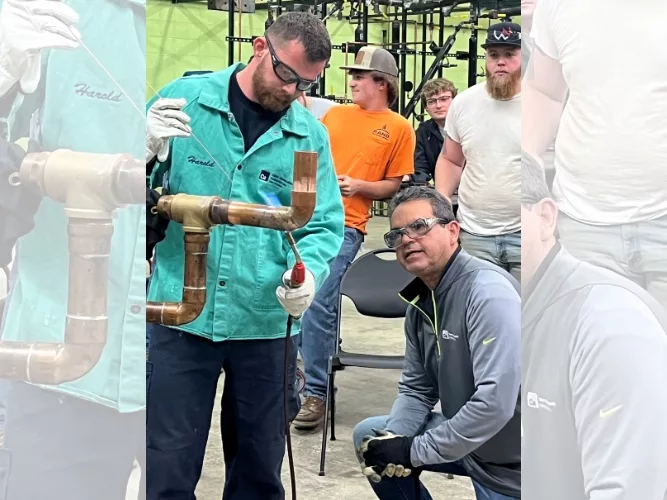
The Copper Development Association (CDA) is now offering its Do It Proper with Copper training program, a no-cost, expert-led educational initiative designed to help communities successfully plan and execute lead service line replacement (LSLR) projects. The training provides practical guidance on the proper installation of copper service lines, including techniques, materials science, and industry-recognized best practices.
The Environmental Protection Agency (EPA) recently finalized the Lead and Copper Rule Improvements (LCRI), a critical regulatory update to strengthen protections against lead exposure in drinking water. Building on the original Lead and Copper Rule (LCR) of 1991 and its 2021 revisions (LCRR), the EPA finalized the LCRI in October 2024. It mandates that public water systems replace all lead service lines within 10 years to reduce lead exposure in drinking water. Key requirements include lower action levels, improved tap sampling, and notifications to communities, schools, and childcare facilities by November 1, 2027.
The 2021 Bipartisan Infrastructure Law (IIJA) from the Biden administration allocated $15 billion specifically for lead service line replacement, to be distributed in five annual tranches of roughly $3 billion each. In late 2025, the Trump administration announced an additional $3 billion in funding for lead pipe replacements, the fourth of the five rounds. The administration also reallocated an additional $1.1 billion in previously awarded but unused funds from other states to help maximize the immediate impact.
As municipalities and utilities across the country prepare to ramp up their lead service line replacement efforts, access to high-quality training on installation fundamentals is increasingly essential.
“When copper service lines are installed correctly the first time, communities gain long-term reliability and peace of mind,” said Harold Moret, CDA project manager and piping applications specialist. “This training gives crews and decision makers the practical knowledge they need to do the job right and build systems that last.”
Who Is the Training For?
The Do It Proper with Copper program is tailored for:
- Utility contractors, engineering crews, and water utilities seeking hands-on guidance to properly install copper service lines while enhancing system performance, durability, and compliance.
- City and municipal leaders responsible for planning, managing, and overseeing LSLR efforts.
These sessions are designed to support crew or teams of all sizes, from small systems planning their first project to larger agencies coordinating comprehensive replacement programs.
Individuals who want to train in their personal capacity can sign up to receive the on-demand webinar, “Best Practices for Lead Service Line Replacement.”
Why You Should Participate
Copper is a proven material for underground water service lines, and its long-term performance depends on proper installation. The Do It Proper with Copper training helps ensure that crews install lines correctly the first time.
Proper installation can reduce boost efficiency and support compliance with evolving project requirements. Whether your team is launching a major replacement program or refining its existing processes, this training gives participants confidence, clarity, and practical tools they can use on the job.
How to Participate
The training is offered free of charge and can be delivered in-person or virtually to accommodate the team’s needs. CDA works directly with communities to tailor sessions based on crew size, local codes, and project goals.
Interested organizations can begin by:
- Complete the short interest form on CDA’s website: info.copper.org/do-it-proper-with-copper-training
- Receive follow-up from a CDA expert to discuss scope and delivery format.
- Schedule a session that fits the team’s timeline.
- Participate in expert-led instruction with opportunities for Q&A and demonstrations.
Frequently Asked Questions
1. How much does it cost?
Nothing. The training is offered free of charge.
Because CDA is a not-for-profit trade association funded by its members, there is no cost to qualifying municipalities or utility partners. In some cases, where the training must be customized to a commercial project or an engineered specification, CDA may discuss cost-sharing. But for public LSL replacement programs, there’s no invoice—just results.
This training is intended to support utilities doing critical infrastructure work without adding extra financial strain.
2. What does the training cover?
Whether delivered in person or virtually, the Do It Proper with Copper training covers the essential components of underground copper installation. It’s also fully customizable and can be tailored to your project needs, crew size, and regional code requirements. Not every topic needs to be included; we’ll focus on what’s most relevant to your team.
Underground Installation Techniques
- Best practices for handling, bending, and installing copper tubing in trench or directional boring conditions
- Tips for preventing corrosion and material degradation
- Guidance on soil conditions, backfill selection, and proper trench compaction
Connection Methods
- Correct use of flaring, compression, and brazing fittings
- Specific requirements for approved joints and connections
- Why soldering is rarely used underground—and alternative approaches that meet code
Material Science and System Longevity
- An overview of copper’s full lifecycle—from mining to installation
- Environmental and technical factors that impact copper’s durability underground
- Common causes of installation failure and how to prevent them
3. What format is the training available in?
CDA offers flexible training options to fit the size and scope of your crew or project. In-person, live virtual, and hybrid models are available, combining classroom learning with shop-based demonstrations when needed. CDA Project Manager and Piping Applications Specialist Harold Moret will work directly with you to determine the best format based on your location, crew size, and schedule. Most sessions run between one and three hours and include time for Q&A, live demonstrations, and resource sharing.
We’ll work with your schedule to make training accessible without disrupting your operations.
4. What do attendees receive?
Participants receive access to a range of practical resources that support the training, including digital guides, reference handouts, optional printed materials, and direct links to copper installation standards and technical specifications. All resources are designed to be easy to access and useful in the field—giving crews a reliable point of reference long after the training is complete.
It’s a toolkit your team can use again and again as new projects come about.