Every so often, you find yourself standing in a room where the conversations sound familiar; not because they are repetitive, but because they are finally catching up to the direction a faction of the industry has been moving in for years. That was my experience at the recent Green Building Initiative (GBI)-hosted Journey to Net-Zero Learning Lab here in my home city, Charlotte, North Carolina. The lab sessions included leaders from aviation, municipal government, commercial real estate, finance, engineering and construction.
We gathered not only to talk about sustainability but to view it in person.
Our visit to the Spectrum Center in “uptown” Charlotte, home of the NBA Hornets, was a highlight of the educational event, getting a VIP tour of the newly renovated stadium.
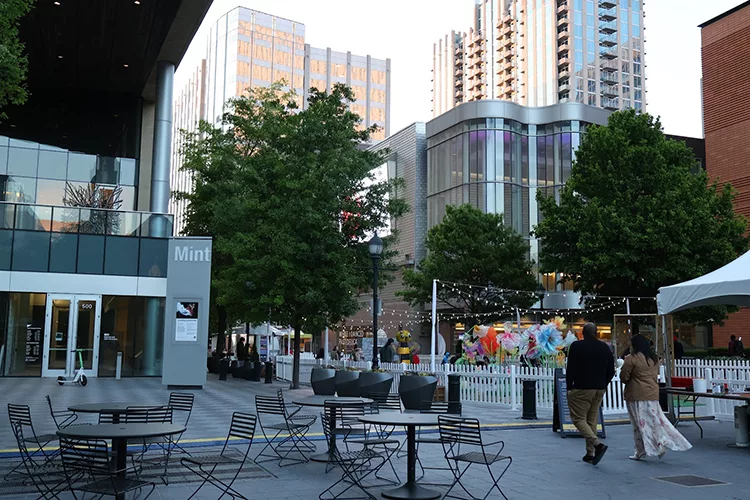
As we walked alongside the light rail from the convention center to the stadium, I couldn’t help but think about all the potential thermal energy storage our light rail and nearby airport could support, in synchrony with all the new skyscrapers. It’s exciting to see the greater Charlotte area exploring sustainability and net-zero with a new-age approach, using simple sustainable tactics and the help of GBI (www.thegbi.org).
The language in the room was that of infrastructure and utilities. The sessions covered topics from energy baselines, carbon modeling, life-cycle costing, district-scale thermal planning, and even financing mechanisms designed around performance and results. These conversations were rooted in real Charlotte building plans and operations. The buildings demonstrated real capital investments, real maintenance budgets and real utility bills, reflecting the engineered models.
For those of us who have spent years learning and advancing within the pipe trades through organizations such as the Radiant Professionals Alliance, the experience was humbling in the best possible way. Not because Charlotte is following a trend, but because the city is independently arriving at the same conclusion the plumbing and mechanical industry is now converging around.
That is the future of energy being thermal, the future of distribution being liquid, and the future of cities being built on shared and independently owned infrastructure.
When sustainability stops being a slogan
Sustainability and net-zero, in my opinion, become real when it enters the mechanical room or the state house floor. That is what GBI understands better than most organizations operating in this space. Its work is about measuring performance, establishing baselines, modeling reductions, verifying outcomes and providing building owners with fun tools to make decisions that stand up to both engineering scrutiny and financial reality.
What Charlotte has done is embed that framework directly into its municipal strategy. Fire stations are being built as emissions-free facilities with rooftop solar panels and geothermal systems (https://bit.ly/3ZDo2oI). Police buildings are pursuing net-zero operations as well. Airport terminals are being evaluated on carbon and energy performance across massive expansion projects. Public facilities are being benchmarked and retrofitted with life-cycle economics in mind and not short-term optics.
This is what happens when a city stops treating energy as an operating expense and starts re-imagining it as a public utility. Once that shift occurs, the logic becomes unavoidable. Legislative frameworks for these systems are being proposed more often, such as Vermont’s bill VT H.0609 (https://bit.ly/3ZIKKvz), which seeks to define thermal energy networks and proposes a fire district as a model, similar to Charlotte.
North Carolina has been here before
North Carolina knows what a resource boom looks like. Long before Silicon Valley and Wall Street emerged, this state had already lived through a gold rush. In the early 1800s, the first gold rush in America happened right here, not in California. It was in the Carolina Piedmont, a unique area with its foothills between the coastal plain and the mountain regions.
Its name comes from Italy: “pied” means “foot” and “monte” means “hill.” The land is high and flat, with rocky streams, hard rock and red clay. It was the farmers here who discovered veins of gold running beneath their land and through their streams, when a quiet acreage suddenly became generational wealth.
What most people don’t realize is that we are standing on a similar earthly resource. Only this time, the resource is not metal; it’s heat energy. The ground beneath our feet holds a massive, stable, renewable energy reserve.
When that energy is accessed through geothermal loop fields and distributed through hydronic piping networks, landowners are no longer only property owners; they become energy producers for their own heating and cooling needs. The piping in the earth becomes a thermal battery, and the building becomes an energy asset.
Owning the rights to the energy below your land will turn out to be one of the great windfalls of the next century. The difference is that this resource doesn’t get depleted. This is the next Carolina gold rush, and most people don’t even know they’re standing on it. Let’s leave the energy production below the ground to preserve the beauty and function we have above.
The earth beneath the city is a power plant
Every building in Charlotte is sitting on top of a stable, renewable, inexhaustible energy source. The ground beneath our feet holds thermal energy that can be harvested, stored, moved and reused through geothermal loop fields and hydronic distribution networks. When that energy is shared between buildings, neighborhoods stop functioning as isolated energy consumers and begin operating as connected thermal ecosystems.
This is the future of American cities
Thermal energy networks allow rejected heat from one building to be used by another. Data centers become energy providers, hospitals become thermal anchors, airports become stabilizing load centers, arenas become seasonal batteries. Schools, housing, libraries and commercial buildings connect to a shared liquid-based grid that moves energy rather than wasting it.
What I witnessed in Charlotte was a city laying the groundwork for exactly this kind of system, even if the full scale of that transformation is still coming into focus. High-emission producers are being designed out. It’s why municipalities across the country are now adding geothermal into local codes, federal incentives are aligning around thermal infrastructure and lenders are developing financing instruments specifically for high-performance buildings.
The trades are the energy transition
True sustainability is about building systems that will still be working long after today’s equipment has been scrapped and replaced. A geothermal loop field is not a piece of mechanical equipment; it is buried infrastructure. It will still be there 100 years from now if the hydronic distribution system is used correctly. With that said, properly designed thermal plants become assets and equity, not a liability.
These systems are expensive up front because they require real engineering and precision craftsmanship. They demand skilled designers, qualified installers, commissioning and performance verification. They require people who understand heat transfer, flow dynamics, pressure balancing, control strategies and water as an energy carrier.
Right now, in North Carolina, an HVAC contractor licensed by the State Board of Examiners of Plumbing, Heating and Fire Sprinkler Contractors can install heat-exchange tubing in a well or borehole and obtain the required permits.
One of the most encouraging signals from the GBI net-zero learning lab was how clearly the role of the trades was understood. There is no energy transition without plumbers, pipefitters, hydronic technicians, geothermal drillers, controls specialists and professional engineers. The future of sustainability is being built with pipe.
What I saw in Charlotte was a city starting to align policy, engineering, finance and construction around a long-term vision for energy that prioritizes performance, resilience and taxpayer value. GBI is providing the framework, the city is providing the leadership, the building owners are providing momentum — and the trades are ready to build it.