Few mechanical contractors have sustained a legacy quite like E.M. Duggan. Founded 134 years ago, the Canton, Massachusetts–based firm, has seen its markets change many times over. Yet it’s the company’s ability to embrace change that continues to define it. Under the current leadership of Principal Len Monfredo and his executive team, including Rick Dorci, Kevin Walsh, John Kulibaba and several division heads, the organization has continued to strengthen its performance and strategic direction.
E.M. Duggan remains a family-owned operation that has expanded far beyond some of the typical “integrated” mechanical contractor offerings of plumbing, piping, HVAC, fire protection, to include, more recently, electrical and water treatment services, as well as a technology consulting division to help other contractors.
The combination of heritage and innovation has taken E.M. Duggan from a one-man plumbing shop on Shawmut Avenue in Boston to 450-person mechanical contracting powerhouse well-known for its pioneering work in prefabrication and its people-first culture. It’s also what earned them recognition as PHC News’ 2025 Contractor of the Year.
“We’re proud of where we came from,” Monfredo says. “But what really defines us is how we keep pushing forward, how we innovate, how we take care of our people and how we deliver for our clients.”
Built on determination
The E.M. Duggan story begins in 1891, when Edward M. Duggan, a 27-year-old plumber, opened a plumbing repair shop in Boston’s South End catering to the residential market. At the time, the city was a boom town, and Edward quickly earned a reputation for quality work.
After Edward’s death in 1942, his sons William and Edward II carried the business forward. Edward II, a World War II veteran, became the company’s driving force for the next four decades, transitioning the company from residential plumbing to commercial and institutional work.
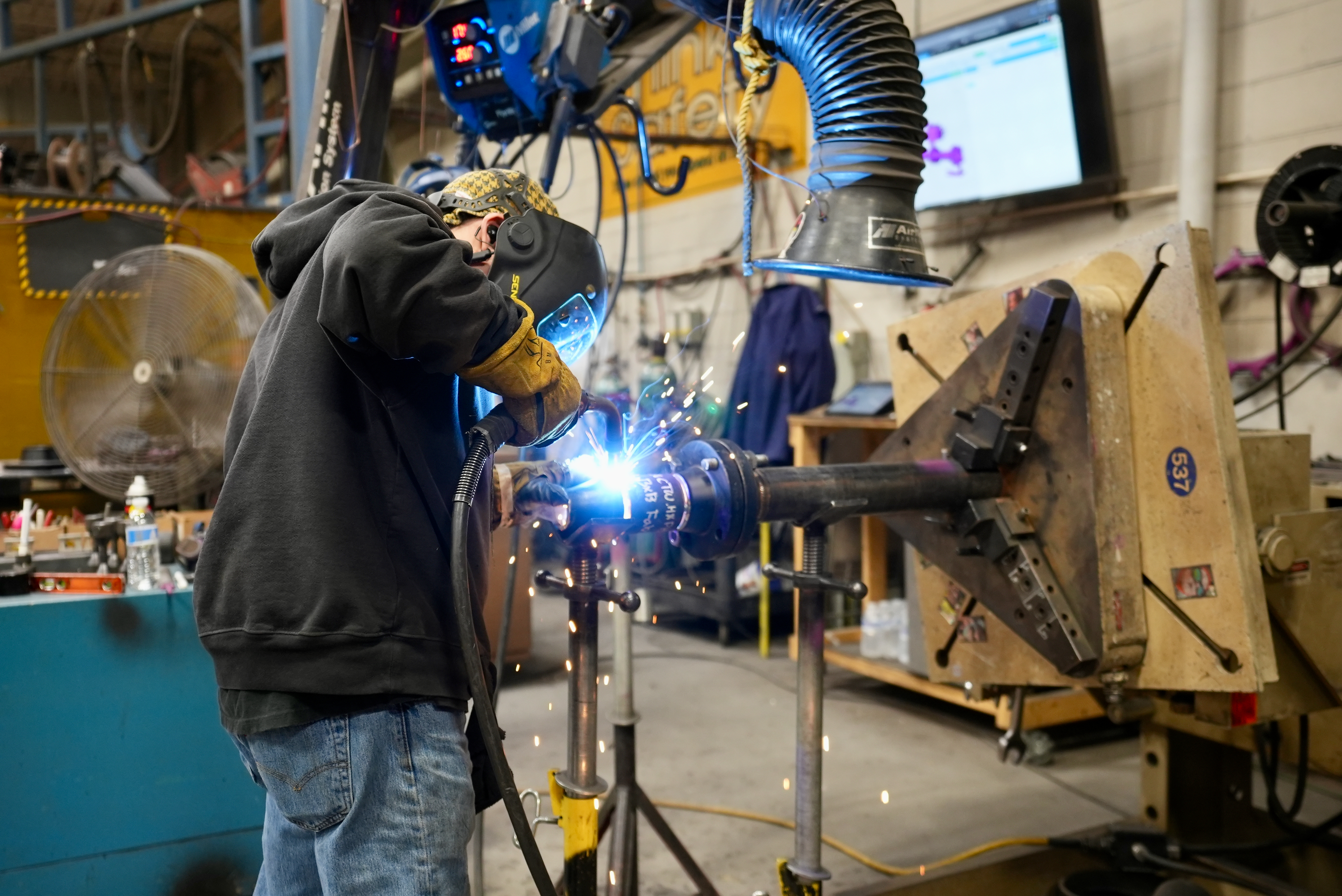
Edward II also pushed innovation early. The company was one of the first mechanical contractors to implement rudimentary prefabrication way back in the 1940s. By 1967, the company built one of the nation’s first prefabrication shops that allowed its crews to assemble plumbing and piping systems indoors, improving quality, safety and productivity. It’s a concept that would revolutionize construction in the decades to come.
“We’ve been doing prefab since before prefab had a name,” Monfredo adds.
The Canton headquarters now includes two prefab facilities across three buildings totaling more than 125,000 square feet, where HVAC, plumbing and fire protection systems are modeled, fabricated and tagged for seamless field installation.
“Our prefab process today is almost like a Lego assembly,” Monfredo adds. “Every part is intelligent, every connection is planned. When it reaches the field, it just clicks together.”
Edward II served as company president until 1991. At that point, he sold the firm to son-in-law Vincent Petroni, and his wife, Maureen Duggan Petroni, as well as some other key executives. (Edward II passed away in 2011.)
Under Petroni’s leadership, the contractor expanded into HVAC, fire protection and service. And in 2014, E.M. Duggan opened its Special Projects Division. Strategically located in Boston, this division was created to bring the company’s expertise to smaller scale building projects, highlighting the contractor’s versatility and commitment to meeting diverse client needs.
Len and his wife, Karin Monfredo purchased the company from his in-laws, Vincent and Maureen. Together, the Monfredos represent the fifth generation owners of E.M. Duggan.
Technology with a human touch
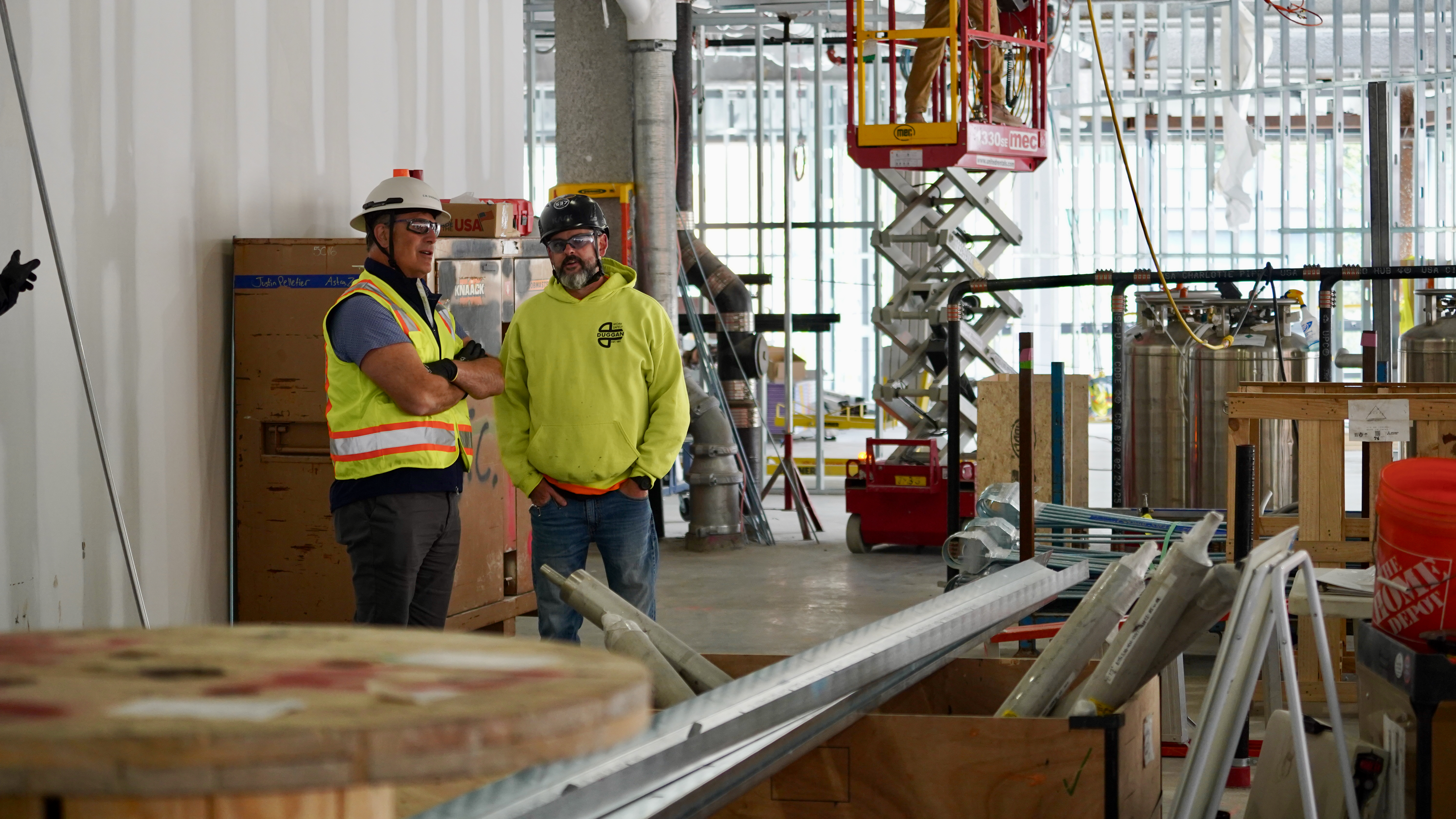
If the company’s early years were defined by skilled trades craftsmanship, its current chapter is defined by technology. The driving force behind that shift is Jeff Elwell, a former fabricator who joined E.M. Duggan in 2014 and now serves as chief technology officer.
“When I came on board, most contractors treated technology as an add-on,” Elwell recalls. “Len and his executive team saw it differently. They believed tech should be part of how we build, not just something we bolt on later.”
Elwell’s initial efforts were internal. The company’s Revit custom toolsets and automation scripts are among its achievements, shaving hours off repetitive design tasks.
“We’ve built plug-ins that automate design sequences,” Elwell explains. “Something that used to take an hour might now take 10 minutes. Those efficiencies add up to real money.”
But what started as a way to streamline E.M. Duggan’s own operations has grown into a consulting service for other contractors nationwide. Duggan Innovative Solutions (DIS) is a standalone technology division dedicated to software development, digital coordination and construction innovation.
“Our mission is to empower construction firms with real-world tested technology solutions that drive efficiency and long-term success,” Elwell adds. “Our primary clients are specialty contractors, engineering companies and real estate developers who need technology to scale operations, but may lack the internal resources to develop and maintain such solutions.”
This positions E.M. Duggan not just as a mechanical contractor, but as a technology partner advancing the entire trade.
“Technology doesn’t replace craftsmanship,” Elwell explains. “It amplifies it.”
By leveraging E.M. Duggan’s technology, DIS offers a comprehensive range of services, including:
• BIM Services: Coordination, project management, gatekeeping, add-in development.
• Custom Integrations: Solutions using existing APIs for cloud and desktop-based applications.
• Laser Scanning & Total Station Layout: Advanced layout and scanning solutions.
• Hardware & Software Consulting: Technology consulting and recommendations tailored to construction tech.
• Proprietary Software Development: Revit add-ins, custom tools and integrations designed to meet the specific needs of construction companies.
• Technology Audits: Comprehensive, whole-company audits to assess and optimize the technology infrastructure of construction firms.
• Coordination & Design Support: Coordination, design and other essential services to support project execution.
“DIS is unique because it’s a software company that grew out of a mechanical contractor and not the other way around,” Elwell adds.
His team of 16 specialists are coders who speak the language of the trades.
“We live what we teach,” Elwell explains. “We understand the field challenges firsthand. Our tools are built by people who’ve been in the field.”
This collaborative approach has placed E.M. Duggan in the vanguard of digital transformation in construction, where data drives decisions and precision reduces waste. Every system Duggan builds is first constructed digitally, then fabricated in the shop, ensuring exact fits and fewer surprises in the field.
“Construction used to be Fort Knox,” Elwell adds, “nobody shared information. Now collaboration is the new competitive edge. The more we share, the stronger the whole industry gets.”
That credibility has made E.M. Duggan a sought-after partner far beyond Massachusetts. The DIS team now supports clients nationwide, from Texas to Colorado, helping them connect Revit, Stratus and other fabrication systems.
“We’re all in this together,” Elwell says. “Now it’s collaboration that moves the industry forward.”
Expanding the blueprint
While software and digital modeling have redefined how E.M. Duggan builds, diversification has reshaped what it builds and services.
The company has recently added four new divisions, including most recently an Electrical Division and a mechanical contracting company in New Hampshire. In addition, under the leadership of Hugh Leahy, the company launched a Water Treatment Division, and introduced a fire protection service, as well as a testing inspection fire control wiring division to meet emerging client needs and further enhance its mechanical portfolio:
• Water Treatment Division: Launched in 2024 under the Service Department, this unit provides onsite water and HVAC system treatment, including cooling tower testing, biological sampling and chemical feed calibration.
Water quality management is a fast-growing concern in the built environment, and E.M. Duggan’s move positions it at the forefront of this trend.
“Our customers were asking for all-in-one service contracts,” explains Tom Anderson, director of the division who joined E.M. Duggan in 2024 after 15 years in water treatment. “So we brought it in-house—testing, chemical management, legionella prevention, all of it.
The division already manages more than 30 active contracts, performing cooling tower testing, chemical feed calibration and biological sampling. Anderson’s team performs regular testing, chemical management and equipment maintenance. The team is expanding into potable water solutions and developing secondary disinfection systems for healthcare facilities.
Anderson’s background blends chemistry, microbiology and mechanical know-how to address system efficiency and safety.
“Everything in water treatment ties back to the mechanical systems,” he adds. “Cooling towers, boilers, heat exchangers—it’s all interconnected. When we’re talking about water quality, we’re talking about protecting both the performance of the mechanical equipment and the people that rely on that equipment to work properly and safely and last as long as it can.”
He’s also developing legionella remediation services for hospitals and long-term care facilities.
“We’re installing secondary disinfection systems that use monochloramine or chlorine dioxide,” Anderson adds. “It’s about taking ownership of water safety rather than outsourcing it.”
For Anderson, the water treatment division is a bridge between mechanical integrity and environmental responsibility.
“If we can make systems cleaner, safer and more efficient, everybody wins,” he says.
• Electrical Division: Announced only days before our interviews with the company this past September for this feature, the new division marks a strategic acquisition that gives E.M. Duggan the last piece of the puzzle to become a true full-service mechanical contractor.
The Electrical Division, launched after E.M. Duggan acquired Stalker Electric, a family-run firm. Shawn Stalker, vice president of the division, sees it as a natural extension of E.M Duggan’s integrated approach.
With the addition of electrical, the company now offers a full suite of mechanical, electrical, plumbing, HVAC and fire protection under one roof.
“The more we move into the future, the more the trades are connected,” Stalker says. “Electrical touches everything—controls, security, fire alarms, automation. Having all those systems in-house lets us identify and solve issues before they ever hit the field.”
For clients, integration means fewer change orders, better coordination and one point of accountability.
“That’s a huge advantage for general contractors,” he says. “It makes projects smoother and more efficient.”
This integration, he adds, is a game-changer in an era of tight schedules and complex coordination.
“Electrical and mechanical are joined at the hip in modern construction,” Stalker explains. “With BIM and model-based fabrication, coordination is everything. Having our own electrical division means we can resolve conflicts early and deliver a cleaner, faster project.”
Developers increasingly want single-source partners who can coordinate multiple trades without friction. By integrating electrical expertise, E.M. Duggan not only broadened its capabilities but also strengthened its preconstruction and prefab offerings.
Like its other business units, electrical is led by professionals who blend deep field experience with a collaborative spirit.
“It’s not about empire-building,” Stalker says. “It’s about synergy. The best projects are the ones where everyone works like one team.”
Stalker’s father started the business in 1992, a family-run electrical contracting firm with roots in Boston’s construction community.
“It’s funny how things come full circle,” Stalker says. “My dad’s first job with Duggan was over 30 years ago. Now, we’re part of the same company.”
When Shawn took over the business in 2012, he and his brother grew it from a seven-person shop to more than 50 employees, working on major hospitals, universities and commercial projects across Massachusetts and New Hampshire.
But running an independent company had limits.
“We had the knowledge and the people,” he says, “but there’s only so far you can go before you hit a ceiling.”
That ceiling lifted when long-standing partnerships with E.M. Duggan on fire alarm and control work led to conversations about something bigger.
“We’d worked together for decades,” Stalker says. “The more we talked, the more we realized our companies operated the same way—family-driven, quality-focused and built on relationships.”
By mid-2024, the Stalker brothers and E.M. Duggan leadership agreed to merge. About 50 Stalker employees joined E.M. Duggan, forming the foundation of its new electrical division.
“I was worried at first about joining a big corporation,” Stalker admits. “But everyone I talked to said the same thing—Duggan takes care of its people. It’s still a family business, just bigger.”
One of the biggest opportunities for the company’s Electrical Division lies in prefabrication.
“As a smaller electrical contractor, prefab wasn’t something we could do,” Stalker says. “Now, I’m learning what’s possible.”
Electrical prefab can include prewired panels, prebuilt walls, or “electrical kitting,” where all materials for identical rooms, such as patient suites or dorm units, are packaged and tagged in advance.
“We’re already seeing it in action at Mass General’s new hospital tower,” he notes. “Plumbers, electricians and carpenters are building entire walls together in the prefab shop before they’re shipped to the site.”
For Stalker, the real power behind the merger is cultural.
“We’ve always been a family company,” he says. “My father, my brother and I built Stalker Electric on taking care of our people. Duggan operates the same way. When I saw that, I knew this was the right move.”
His brother remains active in the division, while their father—now retired—still visits the shop, proud to see the Stalker legacy continue under E.M. Duggan’s banner.
“We didn’t lose something,” Stalker says. “We gained a family.”
Finally, E.M. Duggan recently expanded its family once again. Just weeks after our interviews, the company finalized its acquisition of RTH Mechanical Contractor in Dover, New Hampshire, strengthening its presence in the New England region. This move enables the team to broaden its services across both New Hampshire and Maine.
Founded in 1986 by Richard Hansell, RTH began as RTH Plumbing & Heating and has grown into a trusted leader in mechanical contracting. For nearly four decades, the company has built its reputation on outstanding workmanship, integrity, and reliable service across New Hampshire.
“After many years of building RTH, I’m proud to see the company become part of the Duggan family,” Hansell states. “E.M. Duggan shares our dedication to craftsmanship and customer service, and I’m confident this partnership will create new opportunities for both our employees and our clients.”
Safety renaissance
When Bill Shea talks about safety, he doesn’t sound like an enforcer, he sounds like a coach. As safety champion at E.M. Duggan, Shea has helped drive what he calls a “renaissance” in safety practices at the century-old Massachusetts mechanical contractor.
“Safety used to be a checked box,” Shea says. “You wrote an email, checked a box, and covered your butt and moved on. Now it’s collaboration—between the trades, the general contractor and our people. We all own safety.”
That shift from compliance to empowerment is central to its approach. Today, every employee has the authority to stop work if something doesn’t look right. The company’s safety program is built around three key principles: empowerment, proactivity, and consistency.
“No matter if you’re a first-year apprentice or a 30-year journeyman, you get the same message and the same respect,” Shea says. “That’s how you build trust.”
E.M. Duggan’s safety education blends traditional training with new, hands-on experiences. Field leaders receive weekly “micro-learning” sessions—5-minute lessons on common risks and corrective actions. The company maintains a library of more than 120 safety topics that crews can access anytime, from fall protection to lift operation.
Then there’s the Apprentice Boot Camp, an eight-hour immersive training day focused on both fundamentals and mindset.
“We take them out of the noise of the job site and put them in a classroom,” Shea says. “We want them to feel comfortable asking questions, saying, ‘I don’t know how to do this.’ That’s a culture shift in itself.”
E.M. Duggan is experimenting with AI and other analytics to sharpen its safety performance. Shea uses data from the past eight years to identify trends—when and how injuries occur—and anticipate high-risk phases in projects.
“AI helps point us toward things we might not see day to day,” he says. “If injuries spike around 40 percent project completion, we know to focus on fatigue, sequencing and heavy lifts at that stage.”
But Shea is quick to add that technology is only as effective as the people using it.
“You can’t automate safety,” he says. “You can have every data point in the world, but it comes down to people looking out for each other.”
One of the most notable changes at E.M. Duggan is the company’s willingness to listen to workers’ feedback. From tool choices to hard hat styles, employees have a say in shaping how safety looks and feels.
“When we switched to Type II hard hats that offer better protection, we let people pick their color and brand,” Shea says. “It seems small, but it showed that we value their input. No one fought it.”
That same listening extends to jobsite hazards.
“If a guy says, ‘I’m not working under that,’ he’s supported,” Shea adds. “We’ll stop work, get a hard deck installed and protect our people. It’s not negotiable.”
Perhaps the most profound evolution in E.M. Duggan’s safety culture has been its integration of mental health into the definition of safety.
“You can’t separate mental safety from physical safety,” Shea says. “They go hand in hand.”
The company recently partnered with Wellness Workdays, a Massachusetts-based firm specializing in construction wellness programs, to train all supervisors in mental health first aid.
The catalyst, Shea admits, was personal.
“At my last company, we lost someone to suicide,” he says. “I saw what it did to the people around him. It was preventable. We can’t ignore that part of safety anymore.”
Through the partnership, every supervisor completed a full-day course focused on recognizing signs of psychological distress, having difficult conversations and connecting workers to professional help.
“It’s not about turning foremen into therapists,” Shea says. “It’s about recognizing when someone isn’t themselves, checking in as a human being and helping them find the right resources.”
Supervisors now keep a manual on-hand as a reference and a list of mental health and addiction resources through the company’s insurance providers and union EAPs.
Since implementing the program, E.M. Duggan has already helped several employees access support.
“Some of the strongest, happiest people can be struggling,” Shea says. “That check-in could make the difference.”
In an industry known for toughness and long hours, mental health remains one of the toughest topics to tackle. This approach aims to normalize the conversation.
“We’ve also done three toolbox talks on mental health so far,” Shea says. “One was triggered by an incident on a job site where we were able to get someone help. I didn’t use names, just told the story. It lets people know this stuff is real, and that we care.”
For Shea, the key is equipping leaders to notice and act.
“If you’ve worked with someone 10 years, you know when they’re off,” he says. “Our job is to make sure supervisors feel confident pulling that person aside and saying, ‘Hey, are you OK?’”
The training emphasizes recognition, empathy and connection, not diagnosis.
“You’re not there to treat them,” Shea says. “You’re there to make sure they’re safe and get them to the right help.”
At E.M. Duggan, safety isn’t a department—it’s a shared value. The company tracks “good catches” as closely as injuries, celebrating proactive behavior with recognition and gift cards.
“The more our people tell us what’s happening, the better we can protect them,” Shea says. “We’d rather hear about 30 small incidents than miss the one big one.”
It’s a culture of openness that extends from jobsite to office.
“We say it all the time: everyone goes home safe—physically and mentally,” Shea adds. “That’s the new safety.”