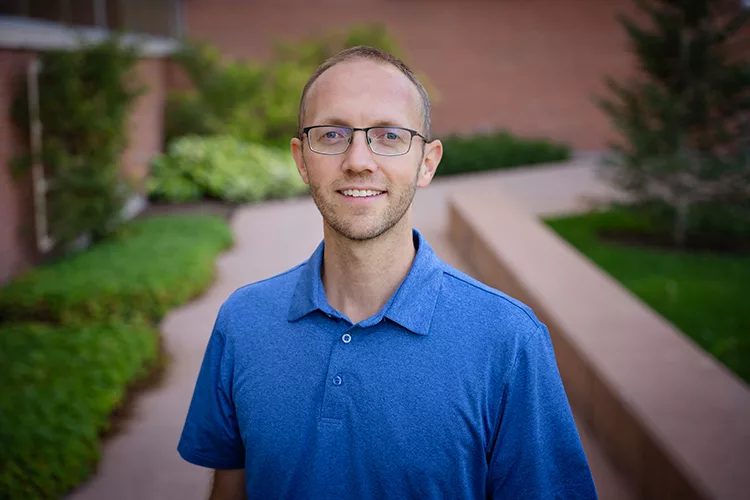
Thomas Hicken originally thought he’d have a career as a teacher and, in an around about way, that’s exactly where he ended up. Hicken, who’s also known as “Plumber-Tom,” for both his plumbing business and more recently his YouTube channel, recently wrapped up the first year teaching an innovative hybrid four-year apprenticeship program launched at Utah State University.
Hicken ended up becoming a plumber after a neighbor offered him a summer job while he was still in high school. He soon realized that he loved plumbing, but always kept teaching in mind as he went through the learning process himself to become a journeyman and then master plumber.
“Sometimes, my plumbing classes were a little too informal,” Hicken says. “Between classroom lectures and reading, students were kind of left on their own to figure out too much by themselves. I knew I could do better.”
After a couple of decades of working for other plumbing companies and running his own business, he decided to make teaching a career when he first started instructing plumbing apprenticeship classes at a local technical college, which eventually made him a prime candidate to help Utah State University build its program from the ground up.
“It’s funny since I started out thinking that plumbing would be a great thing to do in the summer when I wouldn’t be teaching,” he adds.
In his new USU role, Hicken will also host classes for plumbers in the area who need continuing education credits to keep their licenses active. He hopes to build relationships and connect students with local tradespeople who need apprentices.
“We are excited to offer this plumbing apprenticeship program in southeastern Utah,” said Brian Warnick, head of the Department of Technology, Design and Technical Education in USU’s College of Agriculture and Applied Sciences. “There is a critical shortage of skilled tradespeople, and this program will help address that gap while providing participants with the opportunity to earn a good living.”
PHCPPros: Why don’t you start by telling us about the plumbing apprenticeship program at Utah State University.
Hicken: The USU Plumbing Apprenticeship is unique compared to most other plumbing apprenticeships. I am pioneering a new way of presenting the information.
Typical apprenticeships meet twice per week in-person in a classroom setting. This model has worked for years. However, the area where we are located in Price, Utah, and the surrounding region that participates in the program is a vast geography of hundreds of miles.
As a result, many students are not able to meet in-person. I’m developing an improved format for presenting, which enables the participants from remote locations greater accessibility and flexibility.
The program is more accessible because we are able to meet over Zoom and include students from Moab, Blanding and other areas. However, the better part of the program is the flexibility. Much of the content is presented through prerecorded lectures in combination with relevant YouTube videos, which the students are able to watch at their convenience. Quizzes are used to assess student understanding, and then in class meetings I can teach to the classes specific needs, addressing the gaps in their understanding based on quiz results.
We still meet once a week for an hour and a half to connect, create community and so that I can give the class members personal attention. This technology-enabled hybrid form of education is new, and I feel it is more effective and more convenient for the students.
PHCPPros: We’ll get to your experience as a plumber, but how did you end up teaching at USU?
Hicken: I actually started teaching plumbing apprenticeship classes at Bridgerland Technical College back in 2008 part-time while I was still either working for other plumbing companies or running my own shop.
At the time, I felt like I had a pretty good view of what’s out there between commercial, residential service and repair, and wanted to teach. Back in high school my original career plans were to go to college to become a teacher.
And that’s the thing about teaching plumbing. It’s a difficult position to find someone who’s suitable for the role. You have to be a plumber to teach plumbing, but not every plumber wants to be a teacher. And even if you do find a plumber willing to teach, are they passionate and capable teachers?
So I actually just walked into Bridgerland one day and asked if they needed anyone to teach plumbing. Well, as it turned out they did need somebody and they give me a shot right away. I was able to improve upon how the apprenticeship materials were presented. I handed out regular assignments, started making PowerPoint presentations, really digging into the code and trying to make it understandable. Plus, I had plenty of field experience so I knew what worked and what didn’t.
By 2020, I sold part of my plumbing business and took on a full-time role at Bridgerland to be the head of the apprenticeship department, which also included electrical.
I enjoyed helping the students progress. I had a plaque on the wall of the classroom for all the people I taught who made it to their journeymen license. And that really got the new students motivated. I think the whole process of testing and licensure can be challenging for people who are good with their hands, but don’t necessarily like to sit in class and study math. By spring of 2024, almost all of the students who were in my fourth-year class were journeymen plumbers – up from about half when I began teaching.
At some point I was just poking around Indeed and saw that USU had obtained a grant to build a new plumbing program, and I thought I’d be the perfect person to do it. I started working full-time at USU in the fall of 2024. I was just ready to take on something bigger, something new. My wife and I also have 10 kids so the health and retirement benefits were really great for a big family.
And I’m also back to doing some service plumbing work, too. Once people know you’re a plumber, you’ll never get away from people asking you to help them. I also work with a GC for new construction and take my son whose 17 along with me to a jobsite since I have him licensed as an apprentice. He’s been coming along with me for years to jobsites. I also have another son who’s 10. And I have a bunch of daughters and I invite them to come, too. All I get now is the eye rolls from them and ‘yeah right, Dad.’ But it is an open door for them. I’m not going to be exclusive.
PHCPPros: So tell us how you first got into the trades.
Hicken: Well, it wasn’t ever something I’d planned to do. In high school, I was involved in a church youth group and one of our neighbors was one of the volunteer leaders. He and his brother had a plumbing company, and they invited me to work for them during the summer.
As I mentioned, I was planning to go to college to become a teacher so at first plumbing seemed like it would be a great summer job to make some money for college. This was in 2001. But as it turned out, I had so much fun that summer working with my hands and being out on jobsite that it really made me start to think this is something I could do for a living.
PHCPPros: Do you have any family members in the trades?
Hicken: I do have an uncle that does siding, soffit and fascia work. He also opened my mind to a career in the skilled trades. My uncle had a lot of fun doing his work, plus he was successful with a nice house and boat and other things he wanted.
I did end up going to community college to earn an associate’s degree in education, but I spent those summers doing plumbing work for my neighbor. After that, however, I just stuck with plumbing and went to work full-time for my neighbor before working for a few other plumbing companies.
I guess I had to wait another 20 years or so to actually be a teacher, and I never stopped learning either. At one point, I was working during the day, taking apprenticeship classes at night and also taking an online bachelor’s degree program in business management.
PHCPPros: A lot of hard work.
Hicken: But in the end it opened a lot of doors for me. Eventually, I had my masters license and decades of solid work experience in residential and commercial work. At that point, after having to travel far away for work and being away from my family, I was like, well, why not just try this on my own.
And that’s when I started to first became Plumber-Tom in 2010. I won’t say it was easy starting my own business, and I was literally knocking on doors and cold calling looking for work from anyone. One day I was at a supply house and one of the guys behind the counter told me about a plumber who wanted to retire. We ended up working out a deal and it was one of the best things that I ever did. Once I took over the business, my phone was ringing nonstop.
But when COVID hit on top of the regular everyday stress of running your own business, I started to feel that while the business was profitable, I just wasn’t satisfied so that’s when I started to focus on making a career on the education side of plumbing.
PHCPPros: You’re also known as Plumber-Tom on YouTube. Tell us about how you got started on YouTube.
Hicken: So for me, YouTube is just another way to teach plumbing. I first started posting a few years ago. My first videos were DIY tips. I just started creating those types of videos, throwing it up on YouTube and seeing what happens. It was just an experiment. But it didn’t take too long to figure that these types of DIY tips are oversaturated – although my video on how to winterize your outside hose faucet still gets a lot of views, particularly when it’s freezing outside. [EDITOR’S NOTE: When we checked, that video had 64,000 views.]
Then I thought about my own experience studying for plumbing exams and how there weren’t many videos to look at on your own time. And there’s a real vacuum on YouTube to explain the code book from start to finish. Who’s going to be crazy enough to do that, right?
So now if you go to my YouTube site most of my recent videos are going chapter by chapter through plumbing, mechanical and fuel gas code books.
While in most places, the journeyman exam is an open book test, you still have to know the book if you’re going to pass. And the hardest part for a lot of people is making sense out of all those words on a page.
I do regret I didn’t start this earlier because I could be further along. The comments that I get on my YouTube videos have been so rewarding as many people thank me for helping them pass their exams. I’m still doing that in a classroom of 10 to 20 students, of course, but with YouTube my reach is national.
And on a related note, I’ve also written several books on the International Plumbing Code and the Uniform Plumbing Code, plus other books and a study guide to help pass the journeyman exam.
PHCPPros: So you’ve had the best of both worlds for yourself with teaching and plumbing. If you had to, however, could you decide to only do one and not the other?
Hicken: That’s an impossible question to answer. Since many of your readers started out as plumbers and are happy just being plumbers, let me answer from the perspective of someone who first thought about becoming a teacher and never planned to be a plumber: Anyone in the trades knows that at the end of the day, they can step back and look at what they did and there’s a great feeling of accomplishment. It’s real. It’s tangible. Well, that’s what I feel about teaching and plumbing.