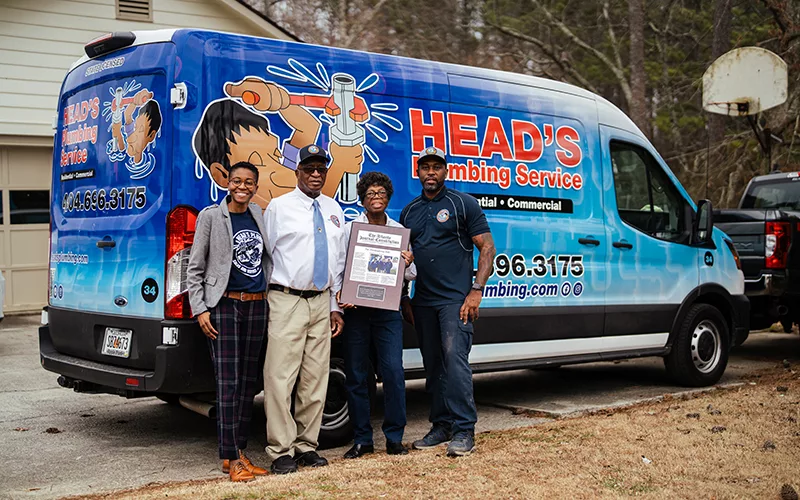
Stories about “family legacy” and “plumbing business” run like a cast-iron drain line through these pages. And for good reasons. Traditional. Reliable. Built to last for decades. Plenty of hard work. Case in point: Head’s Plumbing Sales & Service, Inc., Atlanta, and Georgia’s oldest Black-owned plumbing contractor. Founded 44 years ago by Phenus and Sheila Head, the company is now led by their children, Khadija and Odari, the third generation to guide the business.
“We’re not just running a business,” Khadija says. “We’re continuing a legacy built on sacrifice, resilience and pride.”
Strong foundation
You may have only counted two generations so far, but that’s because the legacy of sacrifice, resilience and pride Khadija mentions actually runs one generation deeper than the company’s official founding.
When their grandfather, Phenus Head Sr., was a young man, he was robbed of his opportunity to be recognized for his skillset as a plumber because of the color of his skin.
“He filled out the paperwork and the licensing office tore it up in his face,” Khadija adds. “My grandfather had the skills and experience, but he wasn’t allowed to be certified.”
Still, Phenus Sr. passed down every bit of knowledge to his son. A skilled tradesman by any other measure, Phenus Sr. gained solid experience while working with Herman J. Russell, a legendary entrepreneur who turned a small plastering firm into H. J. Russell & Co., one of the most successful minority-owned real estate development and construction companies in America.
Eventually, Phenus Sr. was able to call himself a plumber in Georgia as discriminatory laws, regulations and customs changed during the Civil Rights era.
“To us,” Khadija says, “he always was and always will be a master plumber.”
Head’s Plumbing got its start in 1981 when Phenus Jr. went to his job of 15 years at a railroad company one morning to find the front gates locked.
“There were chains on the gate,” Odari recalls. “That’s when he decided he’d never be surprised like that again.”
Out of work but not defeated, Phenus Jr. decided to forge his own path. What he might have lacked in capital, he more than made up for in determination he learned from his father.
Phenus Jr. with help from Phenus Sr. launched the business with a single truck, a stack of flyers and a whole lot of faith Shelia managed the finances while working full-time as a clinical social worker. And the siblings’ grandmother, Lucy Beckum, was the first voice of the business coordinating calls with a rotary dial phone and a pager from the kitchen table.
Family affair
As with most family businesses, Khadija and Odari did what they could to help out even as kids.
Odari still remembers when he was around 10, pointing a flashlight for his father while under a crawlspace on a Christmas Day.
“My first job was keeping the light steady,” Odari says. “And I took it seriously. I think that’s how I first learned how to do plumbing because I had to watch them the whole time.”
The business grew steadily through word of mouth, community referrals and tireless work building a strong local reputation throughout the 1990s and early-2000s.
 Service Titan Atlanta - Heads Plumbing | Adam Bove
Next generation
Odari joined the family business full-time in 2001 after double majoring in business administration and marketing at Tuskegee University. That same year, he became a journeyman plumber, and by 2004, he earned his master plumber certification.
Over the next two decades, he modernized financial operations and other back office tasks and built the company’s technical backbone—expanding its capabilities, mentoring junior technicians and cultivating a reputation for excellence and professionalism.
“Our guiding principles have always been the same going back to my daddy and granddaddy’s time,” Odari adds. “As long as we do great quality work for any job we take on and give the customer the utmost respect, the business will steamroll from there.”
Meanwhile, Khadija took a decidedly different route that led back to joining the family business in 2021.
“Basketball has always been my center,” she explains. “I started playing in the front yard with the guys. I was the only girl growing up in the neighborhood, but my brother, he always made sure I got picked for a team. And then eventually when I got good, I made sure that when I was picked for the team that I could carry my load.”
She attended Woodward Academy and won two state championships before going on to a standout college career at Division 1 Murray State University. She graduated in 2003 with a degree in organizational communications, then earned a master’s degree in sports management in 2004 from Slippery Rock University, where she also spent one year as a graduate assistant coach.
She went on to coach at other top Division 1 basketball programs including the University of Arkansas, Middle Tennessee State University and University of Pittsburgh, before taking the head coaching position at Kennesaw State University.
Despite the distance and years, Khadija stayed involved with the family company from afar, designing flyers and consulting on social media. But the COVID-19 pandemic offered a new perspective.
“I gained a greater understanding of the business and just how unique and special it is,” Khadija says. “It was my first opportunity to fully contribute to the legacy that’s provided for my family for so many years.”
Her move from NCAA sidelines after 15 years to a plumbing office may seem like a career shift, but for her, coaching and running a business are fundamentally aligned.
“I know greatness when I see it,” she says. “And I saw it in my brother. My job now is to support our team like I would a championship roster.”
The sibling dynamic works because each brings a distinct strength with Odari handling field operations, technical training and customer service, while Khadija leads business development, partnerships and long-term strategy.
“He’s the calm, and I’m the storm,” Khadija adds. “But we meet in the middle with shared vision and deep respect.”
Workforce challenges
As the plumbing industry faces a growing shortage of skilled labor, the Heads are responding by training the next generation themselves.
Their apprentice model is hands-on with a personal touch. Apprentices start by shadowing experienced technicians on jobs—learning in real time what books can’t teach.
“You can’t learn plumbing from a textbook,” Odari adds. “You learn it in a crawlspace, with your knees in the mud, figuring it out.”
Two current apprentices are moving through the system now, with one of them the son of a longtime tech.
The company also partners with local trade schools, neighborhood programs and youth nonprofits to identify and recruit promising talent, particularly young people of color who often lack exposure to the skilled trades as a viable, lucrative path.
“Plumbing is one of the few careers where you can earn six figures without college debt,” Khadija says. “We need to talk about that more especially in Black communities. This field isn’t just toilets and tools. It’s dignity. It’s stability. It’s ownership. And it’s yours, if you want it.”
According to her research, out of the 600,000-plus plumbers in the country, only 8% are Black. And women plumbers, regardless of race? About 2.6%
“I’m not a plumber,” Khadija says, “but I guess I’m still a unicorn.”
Meanwhile, family legacy at Head’s Plumbing is an active plan with the fourth generation already involved.
Odari’s sons, Cameron, 18, and Jayden, 16, have grown up immersed in the business like their father and aunt.
Cameron plans to attend Alabama A&M University this fall and then head to trade school. Jayden tends to lean toward marketing and office administration at the moment.
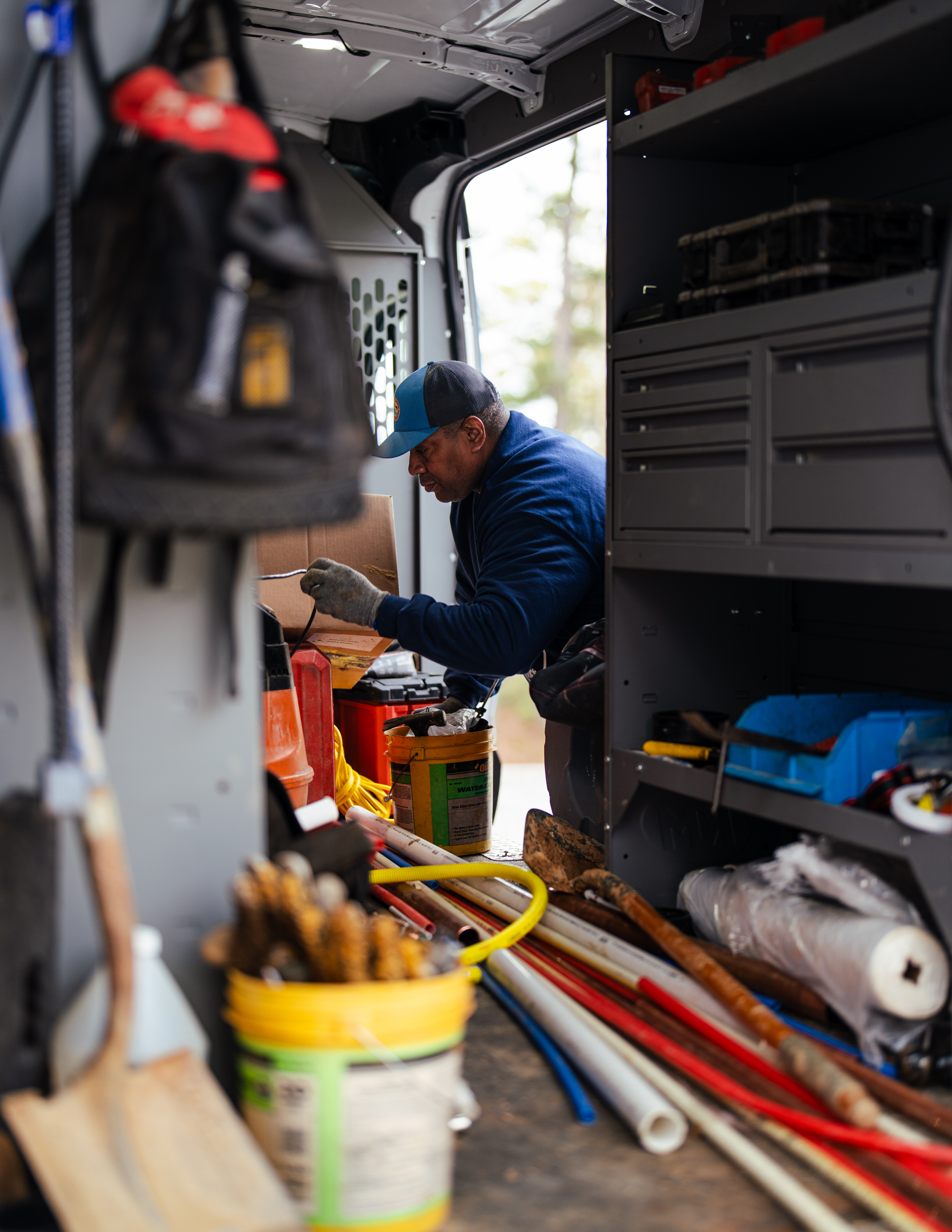
“In the summer time,” Odari says, “Cameron works with me on calls so he can see how we price our jobs, see how we talk to customers and navigate all the proper steps to get supplies and finish our work.”
And like his father, Cameron started out holding a flashlight steady.
“It was a surreal moment for me,” Odari adds, “seeing he was doing the same thing with me that I used to do.”
Father’s bet pay off
Phenus Jr.’s entrepreneurial gamble (along with his father’s help) has paid off.
As of 2025, Head’s Plumbing is poised to exceed $2 million in annual revenue – a considerable distance from the half million in revenue earned in the early-2000s before Odari took over. Most of the company’s work is in residential service and repair. And over the years, the company’s also added septic services, trenchless pipe replacement, backflow prevention and underground leak detection.
“We’re not trying to be everything to everybody,” Odari explains. “We just want to be the best at what we do.”
Today, Head’s Plumbing employs a diverse team of 12, operates a fleet of eight trucks and services some of Atlanta’s historic neighborhoods and institutions, including Zoo Atlanta and the Martin Luther King Jr. Birth Home.
“Yes, people come to us now because they Google ‘Black-owned plumbing companies’ and we are the top of the board,” Khadija adds. “But we’re also on the top of the board when they Google ‘plumbers near me,’ too. The most important reason people come to us is they understand our body of work. We just happen to be Black.”
Though Phenus Jr. and Shelia are now retired, their presence still guides the business.
“Our dad still pops in to check on things,” Odari says. “He’ll look at the trucks, the tools, the uniforms and smile.”
The company’s also active in giving back the community.
“We do a lot of work for nonprofits,” Odari says. “I really like working with them because we in the neighborhoods we came from so it feels good to give back.”
Head’s Plumbing regularly donates services through such partnerships as Meals on Wheels, HouseProud Atlanta and other organizations serving seniors, veterans and low-income homeowners.
Earlier this year, the company renovated outdated water heating facilities along with plumbing and drainage issues at Nicholas House, a local shelter to help families dealing with homelessness.
“My wish is that there was a future technician in there,” Khadija says, “a child who may not even know what a plumber is, but still saw us fix what was broken. Maybe they thought that they could be a plumber, too. I want to be able to have that influence. We’re not just fixing leaks. We’re building confidence, careers and community.”