Sizing a water distribution pipe seems easy enough: simply select a pipe large enough to carry the required flow rate. Obviously, if a pipe is too small, the pressure drop can be too high, but are there impacts of a pipe being too large? In fact, selecting appropriate pipe sizes or diameters can be a multifaceted challenge.
Undersized piping can lead to excessive pressure drop and insufficient pressure at distal outlets. It can also result in excessive water velocities that could lead to erosion corrosion in metallic piping, as well as a higher probability of surge pressures and water hammer due to fast-closing valves. On the other hand, oversized piping results in wasted energy and water, as it may take longer to flush hot water through larger piping to fixtures, leading to reduced customer satisfaction.
Oversized piping can result in stagnant water in which disinfectants decay, creating the possibility of growth of opportunistic pathogens such as Legionella. Oversized piping also reduces the velocity of water within the pipe, potentially allowing for greater biofilm growth. Finally, oversized piping can increase installation costs of the pipe, fittings, valves and labor.
Designers are often seeking the Goldilocks solution for pipes: not too small, not too large. The Plastics Pipe Institute’s (PPI) Plastic Pipe Design Calculator can be used to select optimal pipe diameters to manage pressure drop and velocity in pipe. This free online tool also assists with thermal expansion/contraction, standing water column pressure, and more.
The calculator includes data on CPVC, HDPE, PEX, PE-RT and PP piping systems, selected through simple drop-down menus, and is intended to assist designers using these materials for applications such as plumbing, water service, fire protection, hydronics, geothermal ground loops, district heating, and more. It uses dimensional data from ASTM and CSA piping standards, so it knows exact pipe dimensions.
This article focuses on the most important functions for plumbing design.
1. Pressure drop and velocity
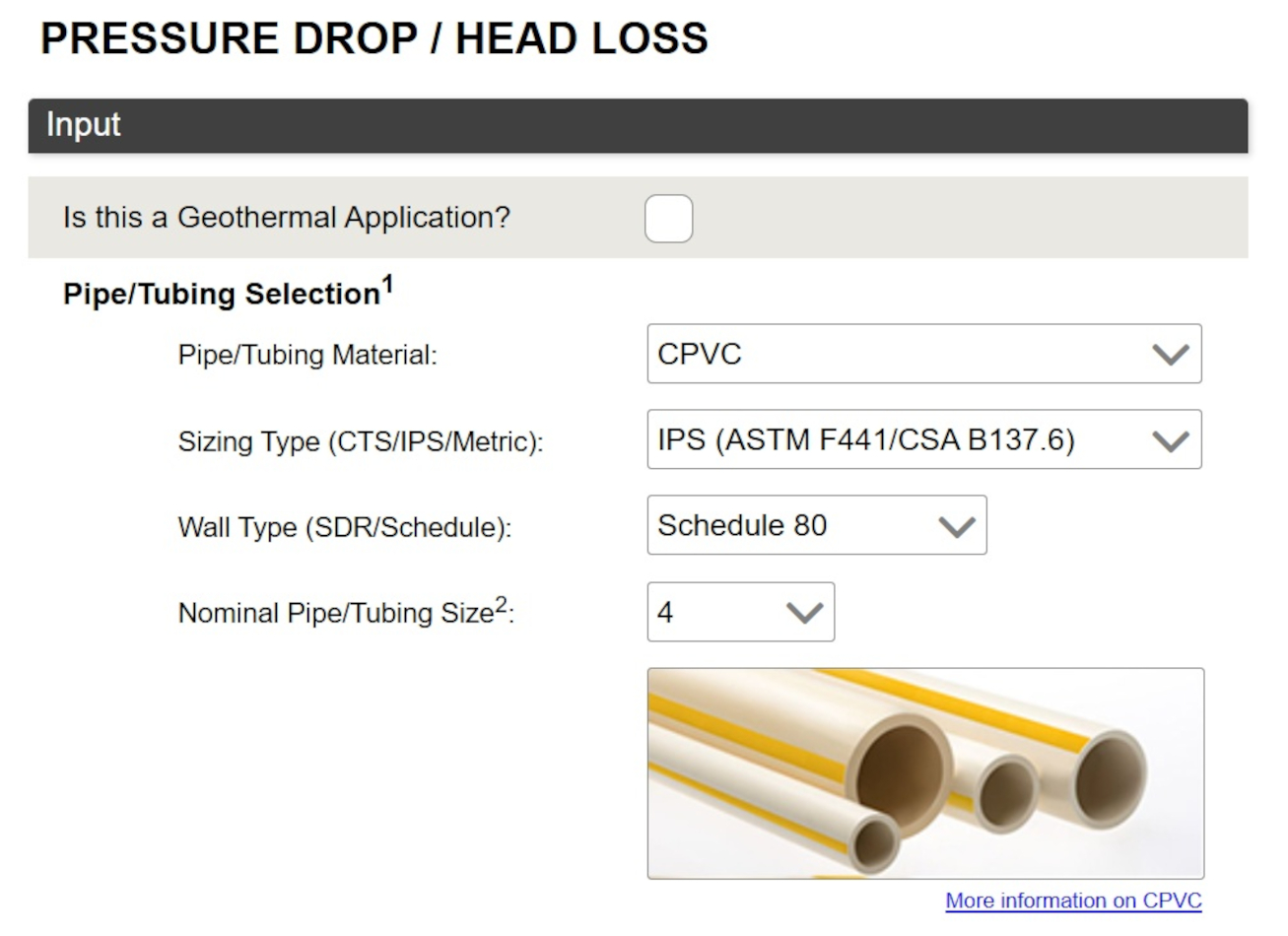
The first step in using the Plastic Pipe Design Calculator is selecting a specific type of pipe or tubing. Keep in mind that certain materials are available as both “tubing,” with the outside diameter (OD) matching that of copper tubing for the same size (also known as nominal tubing size or NTS), and “pipe,” with the OD matching iron or steel pipe of the same size (also known as iron pipe size or IPS).
The user can also select the wall type, which refers to the wall thickness required for a specific pressure rating (e.g., SDR9, Schedule 80). An example of selecting an IPS 4 Schedule 80 CPVC pipe for a commercial plumbing system is shown in Figure 1.
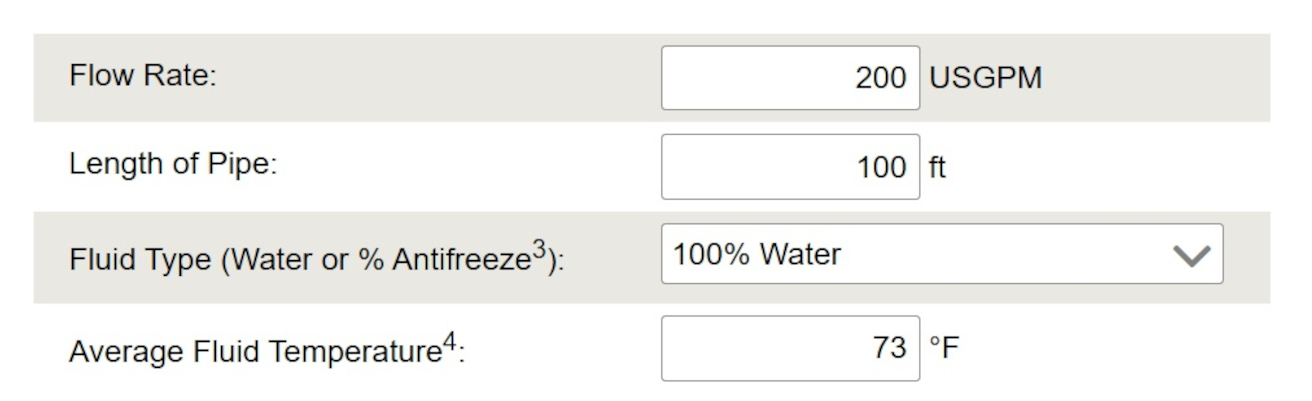
Next, the user enters the required flow rate, pipe length and water temperature (see Figure 2). Selecting an accurate fluid temperature is an important step because water viscosity and density vary significantly with temperature. If this is a hydronic or geothermal system with an antifreeze mixture, those fluid choices are also available.
For fittings, characteristic pressure drop data is often published by fitting suppliers as the “equivalent length” of pipe. This data is not built into the calculator due to the wide variety of fitting designs available. However, the user can manually enter this data for the selected fittings, and the pressure drop through fittings will be added to the calculated pressure loss through piping.
In this example, we are adding six couplings, four elbows and two tees in the pipeline, using the manufacturer’s data for the equivalent lengths, which will be added to the total pipe length (see Figure 3).
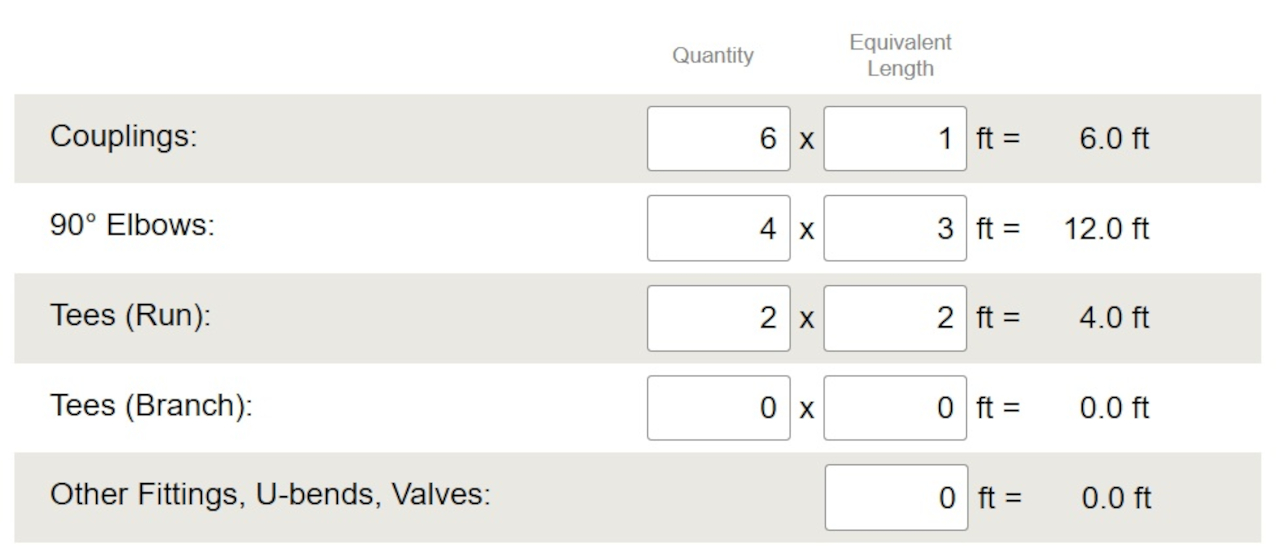
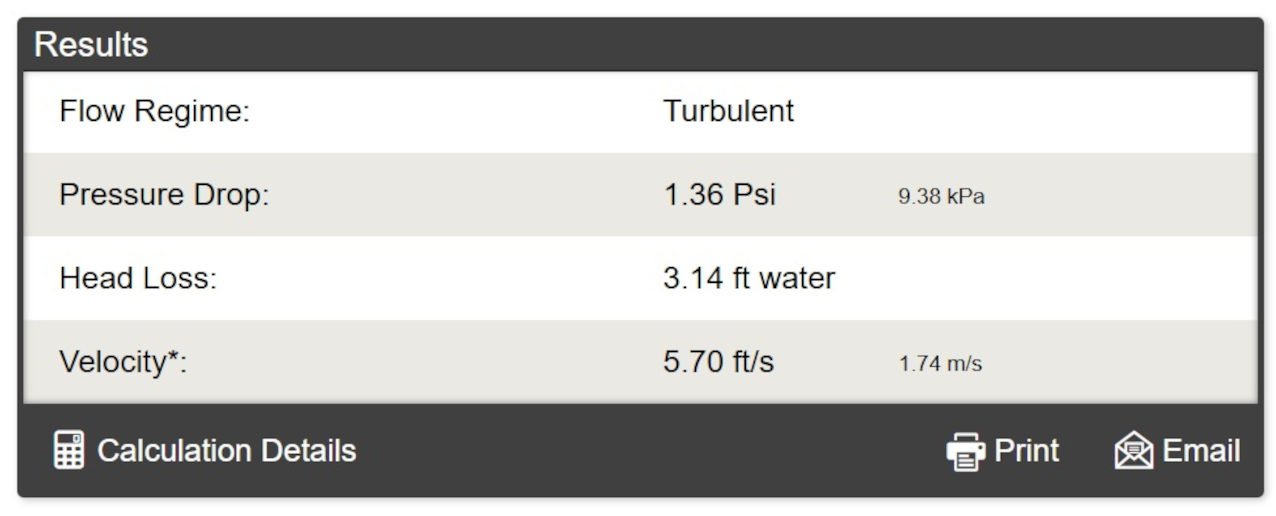
Figure 4 shows our results for pressure drop and head loss values, as well as the velocity through the pipe. A Reynolds’ number calculation is also performed to indicate if the flow will be laminar, turbulent or in the transition range.
2. Calculation details
Each function of the calculator allows users to see the math that was used. For pressure drop, it uses the Darcy-Weisbach equation and assumes that all pipe has the nominal (i.e., average) outside diameter and average wall thickness, per the applicable pipe standard.
For calculations with turbulent flow, the friction factor is determined using an iterative method to solve the implicit Colebrook-White equation. This is considered to be one of the most accurate methods for pressure-drop calculations in pipes.
3. Pipe weight/volume
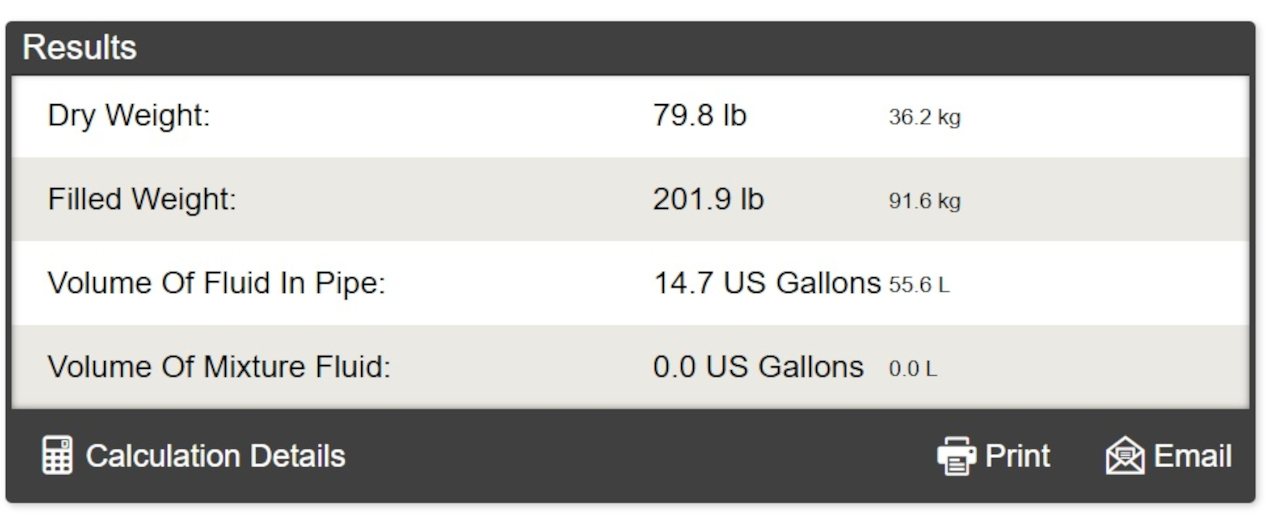
For optimal piping design, it is essential to review the pipe volume for each design. Installers may also be interested in knowing the weight of each pipe, both empty and filled. For an example of 100 feet of SDR 9 DN 63 PP-RCT piping, Figure 5 shows sample results.
4. Expansion arms and loops
When pipe experiences significant changes in temperature, it will expand or contract longitudinally. If the pipe is fixed rigidly such that this movement cannot take place in a controlled manner, excessive stress may build up in the pipe and fittings, potentially reducing the service life of the piping networks. This applies to all piping materials.
Thermal expansion and contraction can be managed through the integration of expansion arms or loops. The calculator also helps with this design function, following equations found in the “ASHRAE Handbook – Fundamentals,” Chapter 22, Pipe Design.
The example in Figure 6 uses PE-RT tubing installed as a 100-foot length at 75 F, and then heated by 50 F up to an operating temperature of 125 F.
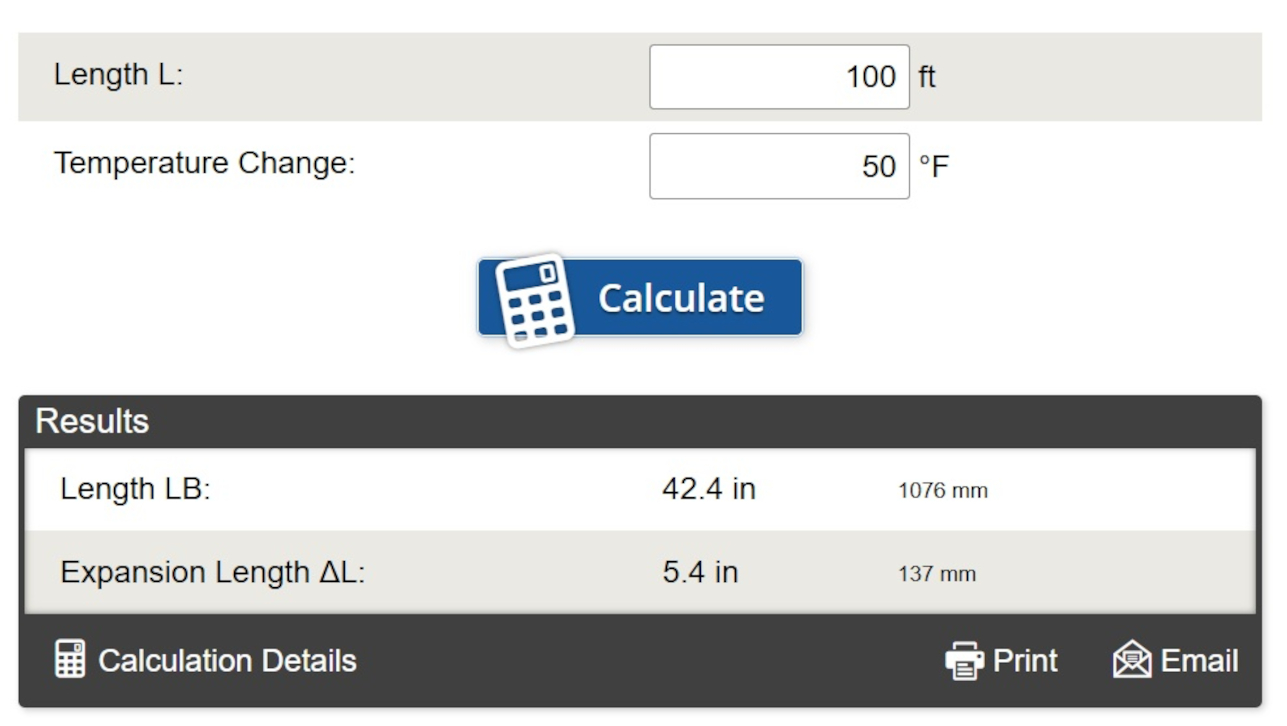
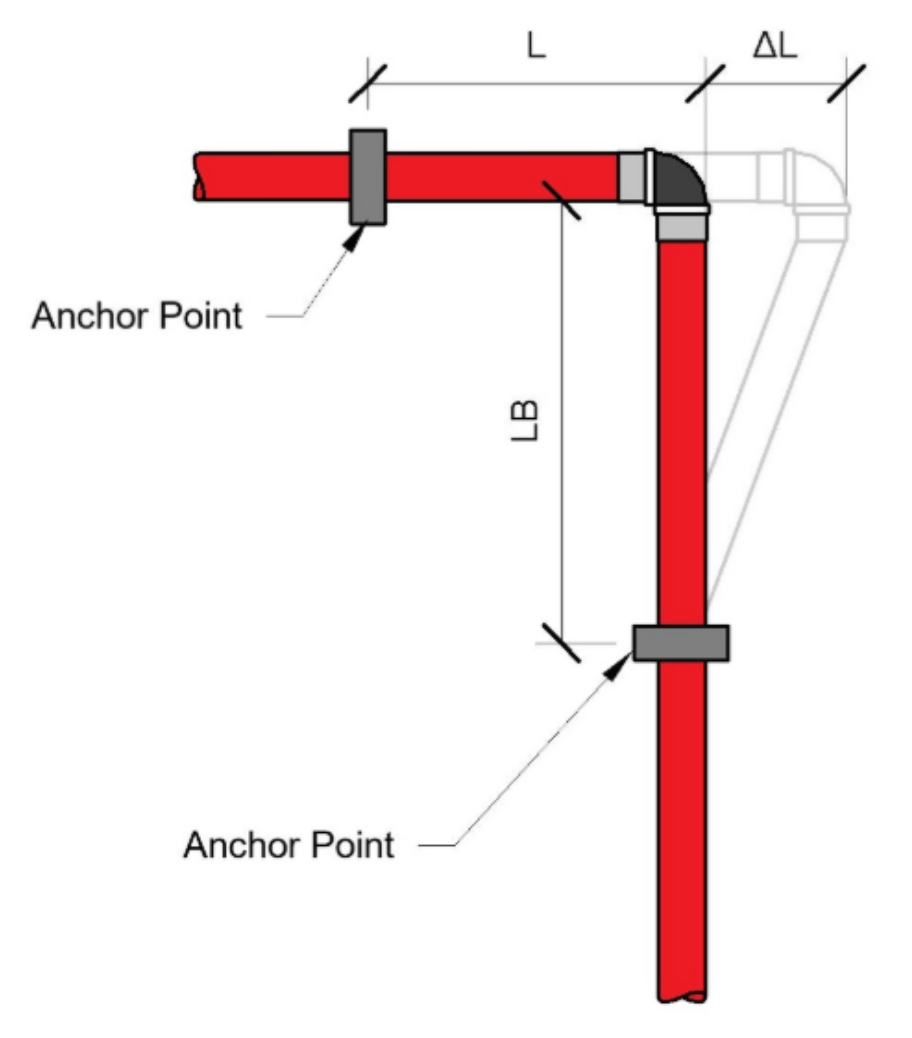
The results indicate that this pipe will expand 5.4 inches in length due to the temperature change and that an expansion arm requires a minimum LB length of 42.4 inches between a fixed anchor and the adjacent piece of pipe, as shown in Figure 7. This expansion design is also known as an “L bend” or “guided cantilever beam.”
5. Standing water column pressure
This function of the calculator helps designers to determine a potentially overlooked aspect of piping design: the internal pipe pressure created by the column of fluid in a tall vertical pipe. With water at 73 F, this pressure is 4.3 pounds/square inch (psi) for every 10 feet of elevation, but other fluids have different densities, and the temperature of the fluid also changes its density.
Every pipe material has a maximum pressure rating at various temperatures, so this function helps designers to prevent exposing pipe to excessive pressure caused by the static water column in a multistory plumbing, fire protection or hydronic system.
In the example of a 150-foot-tall building with 130 F water in the piping and a minimum pressure at the top of the system of 25 psi, the calculator shows an internal pipe pressure of 89 pounds/square inch gauge (psig). The designer of this system must ensure that the pipe, fittings and valves are rated for at least this much pressure at this operating temperature.
Fortunately, most plastic pressure pipe materials have a hydrostatic pressure rating of 100 psig at 180 F and should be able to handle this situation with no issues.
The importance of accurately sizing pipe based on realistic and practical flow rates is becoming far more obvious these days. The PPI Calculator allows designers to evaluate the suitability of multiple plastic pressure pipe materials for a wide range of plumbing and mechanical applications.
Designers are invited to try it out and share their feedback: www.plasticpipecalculator.com.