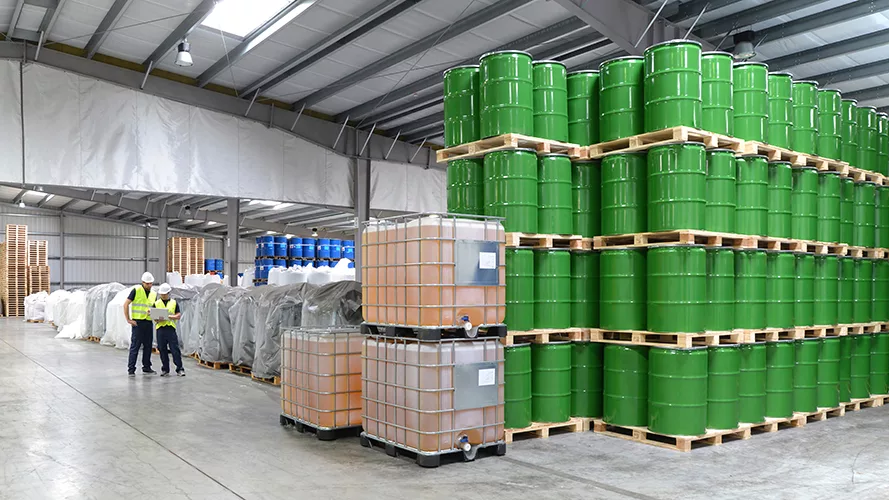
High-hazard “H” occupancy rooms contain materials that pose significant risks to both the building and its occupants. If a spillage occurs or a fire sprinkler is activated in an H occupancy room, the spillage or the sprinkler discharge from the H room can mix with the chemicals stored and become hazardous. This makes a well-designed drainage system not only a technical requirement but also a crucial safety measure.
There are various occupancy classifications under the H occupancies, with the most common being H-2 and H-3 rooms, which this article will focus on.
Group H-2 rooms are spaces containing materials capable of deflagration or accelerated burning. Examples include facilities that store flammable gases or highly volatile liquids, such as a research laboratory with compressed gas cylinders or a chemical storage facility containing reactive substances.
Group H-3 rooms are designed for materials supporting combustion or pose physical hazards. This includes spaces with combustible fibers or flammable solids, such as a textile manufacturing plant with significant amounts of synthetic materials or a woodworking facility with a substantial accumulation of sawdust.
Both classifications require stringent safety standards that exceed typical building design considerations.
The role of drainage in high-hazard spaces
Section [F] 415.9.1 of the California Building Code provides clear guidelines for managing flammable and combustible liquids in H-2 and H-3 rooms.
The primary objectives of a drainage system in these spaces include:
Containing potential liquid spills;
Managing fire suppression water runoff;
Preventing cross-contamination; and
Safe removal of hazardous materials.
Drainage system design
1. Calculating drainage volume: A technical deep dive
The first step in the design is to come up with the drainage volume that the room can produce.
Determining the drainage volume requires a systematic approach that considers multiple factors. The process involves the calculation of potential water runoff from fire suppression systems.
Here is a detailed example:
An H-3 room with an area of 200 square feet is equipped with two sprinkler heads, each with a K-factor of 11.2. The K-factor represents the sprinkler’s discharge characteristics, a critical parameter in understanding water flow.
To calculate the sprinkler discharge, engineers use a specific formula:
Q = K × √P
Where:
Q represents the flow rate in gallons per minute (gpm)
K is the sprinkler’s K-factor
P represents the pressure at the sprinkler head in pounds per square inch (psi)
Assume a pressure requirement of 13 psi for each sprinkler head.
Substituting the values:
Q = 11.2 x √13 = 11.2 x 3.6 ≈ 40.4 gpm/sprinkler
For two sprinklers: Total gpm = 40.4 x 2 = 80.8 gpm
To calculate total runoff volume, assume the fire suppression system operates for 30 minutes. The total volume is:
Volume (gallons) = Total gpm x run time (minutes)
Substituting the values:
Volume = 80.8 gpm x 30 minutes = 2,424 gallons
2. Pipe material and fixture selection
All pipes, fittings and drain bodies used in H occupancy drainage systems must be acid-resistant. While double-contained pipe is preferred, it is not a code requirement in most jurisdictions.
Plumbing fixtures such as trench drains and floor drains specified in the H occupancy room differ from the materials and trims typically specified for general use. These fixtures must be resistant to the chemicals they will be exposed to and convey. Material selection should prioritize acid resistance and durability.
3. Pipe sizing and routing
Drainage pipe from the H occupancy room, under most jurisdictions, can be combined, and sizing can be based on the highest flow from the largest room. For instance, if there are six H occupancy rooms and the largest runoff is 4,000 gallons, the system can be sized on the 4,000 gallons. If the pipe is routed to the storage tank then the tank size can be 4,000 gallons.
When routing the pipe from the H occupancy room to the storage or neutralization tank, gravity drainage systems are preferred because they reduce complexity and minimize the risk of pump failures.
Additionally, pipe routing must prioritize easy maintenance access and visibility for regular inspections.
4. Disposal of the drainage
Directing drainage to a holding tank, which is then emptied by waste disposal services, allows for an independent system separate from the city sewer line.
However, if you choose to route drainage to the city sewer system, it must be treated at the neutralization tank before being sent to the city sewer.
Below, we will explore these two options in more detail.
• Holding tank. The code mandates that holding tanks be constructed from noncombustible materials and protected against physical damage.
Liquid containment is important. A storage tank must include a liquid-tight containment system compatible with the stored materials. Double-wall storage tanks, even though not required by the code, add an additional layer of protection, providing a backup containment mechanism should the primary wall fail.
Leak detection is another important aspect of tank design. Automatic alarm systems must be installed to provide immediate notification of any potential leakage. Clear signage must accompany these systems, ensuring that personnel can quickly identify and respond to potential hazards.
When locating the holding tank, ensure that it can be easily accessed for draining by waste disposal services and the pump-out ports are within 25 to 30 feet of truck access. This design eliminates the need for a pump inside the holding tank. Additionally, it is preferable to have the pump-out port located outside or near the service yard so that when the tank needs to be drained, it has minimal impact on building operations.
• Neutralization tank. If the drainage is to be connected to the city sewer system, then drainage from the H occupancy room shall first be treated. Neutralization tanks serve this critical function by:
a. Treating hazardous liquids;
b. Ensuring compliance with municipal wastewater
regulations;
c. Preventing environmental contamination.
The neutralization tank can be sized based on the gpm or the drainage fixture unit.
• Monitoring of the tanks. Both tank options should be equipped with floats and leak detection systems that connect to the building automation system, providing real-time tracking of liquid levels and immediate alerts for potential issues.
5. Ventilation and safety measures
All plumbing fixtures that are part of the H occupancy drainage need to be vented separately from the general plumbing fixtures. The vent shall be terminated no less than 10 feet, or as required by the local authority having jurisdiction, from any openings or air intake. Vent from the holding tank and the neutralization tank shall also be vented and terminated at the roof level.
• Exhaust of the H-2 and H-3 room. Proper ventilation becomes a critical component of safety in H-2 and H-3 rooms. The California Mechanical Code and California Fire Code provide detailed guidelines for mechanical ventilation systems. These systems must:
a. Remove potentially hazardous vapors;
b. Prevent gas accumulation;
c. Maintain air quality;
d. Support emergency response capabilities.
Explosion venting represents another critical safety feature, particularly for Class I liquids. These systems allow for the controlled release of pressure during potential explosive scenarios, reducing the risk of catastrophic failure.
Best practices for installation and maintenance
Successful drainage system design extends beyond initial construction. Continuous maintenance and safety adherence protocols are important.
Key considerations include:
Ensuring component accessibility;
Installing clear, visible signage;
Implementing robust alarm systems;
Conducting regular system testing;
Maintaining compliance with fire and mechanical codes.
Designing drainage systems for H occupancy rooms is a complex engineering challenge that demands technical expertise and careful planning. Each component is vital in protecting people and property.
Engineers need to approach these designs with a holistic view, understanding that a drainage system is more than piping and tanks. Following rigorous code requirements and adopting advanced technologies enables professionals to create drainage systems that set new standards in safety and reliability.
Maung Winn, CPD, LEED AP BD+C, is a principal at Stantec, bringing more than 15 years of experience designing plumbing and fire protection systems for buildings. He is also experienced in building HVAC designs. Winn has worked on a wide range of projects: education, laboratories, high-performance building designs, civic public safety, high-rise apartments, retail, restaurants and other commercial-type projects.


