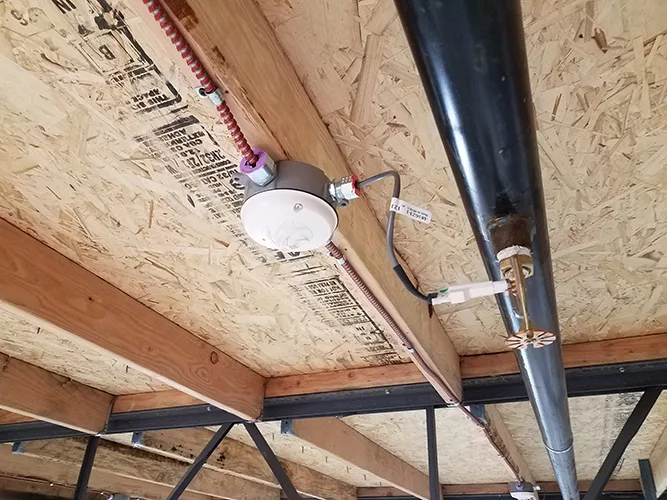
Since the early 1900s, automatic sprinklers have operated primarily using one of two methods: either a glass bulb or a fusible element. Both operating elements are designed to activate at set temperatures. Within the last decade or so, a new technology has emerged as a means to operate sprinklers that uses a combination of addressable detection and an electrical signal sent to operate specific sprinklers. These have been defined by the National Fire Protection Association (NFPA) as electrically operated sprinklers (EOS).
The detection method is monitored by a panel capable of running an algorithm to pinpoint the exact location of a fire in the space protected and open the sprinklers that will be most effective in controlling the fire. The means of detection could be a variety of things, from an increase in temperature at a specific rate or the detection of smoke or other byproducts of a fire.
Using EOS allows greater flexibility around which sprinklers can be operated. Where traditional automatic sprinklers require sufficient heat at each individual sprinkler to operate, EOS can activate a predetermined number of sprinklers located directly over the area of the fire as detected by the specific sensing devices used.
This means activation of a group of sprinklers can occur at an earlier stage in the fire’s growth instead of waiting until the fire has grown large enough to activate the sprinklers based on their individual thresholds. This results in more effectively surrounding and controlling the fire.
Various names are used to label this technology: electrically operated sprinkler is the official NFPA definition (as previously noted) in section 3.3.223.4.6. FM Global has done research on using this technology for the protection of highly challenging fires and used the acronym SMART in its documentation, which stands for simultaneous monitoring, assessment and response technology (https://bit.ly/3GG6YYQ). One of the first commercially available sprinklers was produced by Tyco Fire Products and was labeled the electrically activated sprinkler (EAS).
Electrically operated sprinklers were added to NFPA 13 in the 2022 edition, including the definition and installation requirements in Chapter 15 for special sprinklers (Section 15.6). They are permitted to be used where they have been evaluated and listed for performance under a specific set of conditions that prove the sprinklers have been tested and meet the conditions specified in that section.
Development
The driver behind the development of this technology was to apply water to a high-challenge fire earlier in the timeline. Traditional control-mode sprinklers activate to maintain the heat release rate (HRR) at a steady state after they activate. Early suppression fast response sprinklers are designed to apply water at a high enough rate to rapidly decrease the HRR when they activate.
The goal of EOS is to apply water early enough in the fire growth phase to permit fewer sprinklers to activate, as well as ensure that the most effective group of sprinklers is discharging over the fire. This technology helps to eliminate some common issues arising in traditional systems that prevent the operation of critical sprinklers.
These issues include cooling of the air around adjacent sprinklers due to the vaporization of water, as well as the direct wetting of a sprinkler due to water droplets landing on the activation element. This phenomenon is also known as cold soldering or skipping and can hinder the performance of the sprinkler system by delaying or altogether preventing sprinklers from operating.
Additionally, in high-piled storage scenarios, once a sprinkler operates, the typical fire plume dynamics are disrupted by sprinkler-induced air movement. This can also prevent sprinklers that are closer to the fire from operating. With EOS systems, multiple sprinklers around the fire are operated simultaneously, which surround the fire more completely and help eliminate the aforementioned issues.
In terms of the development of the actual products, as with all new products used for the purposes of fire and life safety, it is critical that the individual components go through rigorous internal testing as well as third-party testing and listing similar to their standard counterparts. For instance, the sprinklers need to withstand corrosion testing, pass operational tests, as well as the other mechanical tests that traditional sprinklers are required to pass.
The detectors, as well as the control/releasing panel, both need to perform against known testing standards. This is used to ensure the reliability of the system and that it will function as intended throughout its useful life.
Possible applications
Where is it best to use this EOS technology? As in many cases, it depends on a variety of factors. Due to the inherent complexity of the system, EOS tends to be a better option in applications where no other solutions are available or where the solutions that are available are prohibitively costly.
For instance, EAS was tested at Underwriters Laboratories for protection of exposed expanded plastics in single- and double-row rack storage occupancies with up to 30 feet of storage under a 35-foot ceiling. This solution uses design criteria consisting of nine 16.8 K-factor sprinklers, each flowing 121 gallons per minute (gpm) per sprinkler.
Solutions for ceiling-only protection of this hazard are currently available when following the 2025 edition of NFPA 13, which would require 12 25.2 K-factor sprinklers flowing 195 gpm per sprinkler in addition to vertical barriers every 16.5 feet within the rack. If using FM data sheet 8-9 for this same scenario, the requirements to protect this hazard with a ceiling-only solution would be to use 20 25.2 K-factor sprinklers, flowing 218 gpm per sprinkler.
Both solutions are limited to a maximum storage height of 35 feet under a 40-foot ceiling and would also apply for a 35-foot ceiling, as no specific design criteria are provided at that lower ceiling height. The EOS solution that was tested would be able to be used without the need for any additional testing for any equivalent or lesser hazard.
Another potential benefit of using EOS in more standard hazards would be in retrofit applications where a higher hazard than the existing sprinkler system was originally designed to protect is now being stored in that facility. Using EOS could allow for the existing piping to remain and only require changing out the sprinklers and adding the detection devices.
This could be a cost savings when compared to needing to pull out all system piping or adding/upsizing a pump to accommodate a higher water demand, as the flows for EOS can be lower than traditional solutions.
Perhaps the areas where EOS could be particularly advantageous are in applications where there is currently no viable traditional sprinkler solution. As one example, automatic storage and retrieval systems (ASRS) have proven to be a challenge for the fire protection industry to provide adequate protection. ASRS are densely packed rack storage that use robots to move commodity in and out of the racking. With these systems, typically the loads of commodity are smaller than a traditional pallet and stored within boxes, bins or on trays.
Several types of ASRS have been defined by FM Property Loss Data Sheet 8-34. The two types of horizontal-loading ASRS storage arrangements are shuttle and mini-load. The shuttle-type includes horizontal supports underneath the commodity and do not significantly impact the flow of water within the flue spaces. The mini-load arrangement includes angle irons that support each individual commodity and can redirect water away from the flue spaces. Both have some resemblance to traditional double- and multi-row rack storage, but in a more densely packed arrangement.
Another common type of ASRS storage is the top-loading type. These are even more densely packed, as the robots access the commodity from the top of the ASRS array either by removing commodity from the top down or through vertical shafts throughout the array. This eliminates the need to include aisles between rows of racking.
When it comes to fire protection of these ASRS arrangements, the horizontal-loading types that resemble double- and multi-row racks can often still use in-rack sprinklers to provide adequate protection. As these systems are automated, they theoretically pose less of an impact risk of sprinklers and piping from product and forklifts.
However, in some ASRS systems, especially the top-loading type or similar dense arrangements, there is not enough space within the racks to route pipe and sprinklers easily. These systems could be better protected by EOS systems. The quicker detection and simultaneous activation of sprinklers, as well as the ability to surround the location of the fire early in the fire growth stage, could facilitate earlier suppression or even extinguishment in some cases.
Additionally, many of these storage systems have limited or no access to the inner portions of the structure, making firefighting efforts very difficult. The ability for EOS to quickly suppress or extinguish fires in these storage arrangements may allow for additional time needed by the fire department to get to the seat of the fire and perform any final extinguishment or overhaul operations.
As there are many variations between different types of ASRS, no one-size-fits-all solution exists when it comes to fire protection. This means that ASRS looking to be protected using EOS typically require full-scale fire testing in order to validate the protection scheme, unless a performance-based design can be developed by a qualified fire protection engineer based on previous testing. These fire test reports are then used to substantiate the protection scheme to the authority having jurisdiction (AHJ).
Another example of a real-world application where EOS has been used is within a boat storage facility. This facility has several levels of boats that are stored on open racks. EOS was used at the ceiling in combination with in-rack sprinklers to protect the obstructed areas beneath the boats. This particular building had a limited water supply and, therefore, was well-suited for an EOS solution.
The EOS system will activate early in a fire’s development and help to mitigate the chances of a fire spreading to adjacent boats. The in-rack sprinklers nearest the fire would also likely activate, further suppressing the seat of the fire. In this case, the engineer of record determined that the existing testing represented a higher hazard than what was being protected but added additional in-rack sprinklers to mitigate the obstruction hazards.
Barriers to entry
As with all new and innovative solutions, limitations often need to be considered. As EOS is a relatively new concept, it is not a widely known technology. This can present an issue when gaining approval from the AHJ. There may be hesitance due to the fact that it has yet to be extensively used or that it is more complicated than a traditional sprinkler system. Engaging with the AHJ early on in a project where this technology is contemplated and providing them with sufficient background on the technology and testing can help to facilitate approval.
Current EOS technologies require some level of electrical power and communication between detectors, sprinklers and releasing panels. This can add additional cost to system installation since, along with the installation of piping and sprinklers, additional wiring and detectors must be installed. The detection and electrical components will require collaboration with fire alarm installers, which can also add complexity to the installation.
Looking at it from the inspection, testing and maintenance side of things, EOS systems require more frequent testing due to being a new technology. As an example, the previously mentioned EAS technology requires a representative number of sprinklers and detectors to be tested every five years for the first 10 years, and annually after that. This helps to ensure that the system remains functional but creates additional cost due to testing and needing access to the sprinklers and detectors.
EOS technology is not a one-size-fits-all solution to every fire protection problem. It certainly provides an interesting new approach to the protection of goods in high-challenge fires and is an exciting new entry to the fire sprinkler world that has operated with the same type of automatic sprinkler technology for more than a hundred years.
As with any potential solution, it is important to consider the benefits and tradeoffs for the specific application in question. With advancements in the technology and wider awareness of the products, EOS can be a beneficial addition to the choices in the fire protection industry to protect life and property.
Ian Jutras is the lead fire protection engineer at Johnson Controls. He has a bachelor’s degree in mechanical engineering and a master’s degree in fire protection engineering. Ian is a licensed fire protection engineer with more than 10 years of experience in new product development and application support for sprinklers and water mist. He is a principal member of the NFPA 232 and 770 technical committees.
Melisa Rodriguez is the vertical business development leader for storage with Johnson Controls. She is a licensed fire protection professional engineer with 20 years of industry experience and is also NICET-certified Level IV in water-based systems layout. Rodriguez is president of the Society of Fire Protection Engineers Minnesota Chapter, vice-chair of the Minnesota Governor’s Council for Fire Prevention and Control, and a member of various fire protection industry committees.




