Compressed air systems can come in all shapes and sizes, each with its own level of sophistication. The portable air compressor attached to a hose and an air chuck in my garage is rather simple. A maintenance garage or paint shop gets more complex. A university laboratory or professional research center can be elaborate, expansive and downright intimidating.
Designing a compressed air system with some amount of sophistication involves a blend of technical skill application and coordination with your client. The level of sophistication of your project determines the ratio of that mixture. The bigger and more complex the system gets, the more reliant on client input you will need to be.
A maintenance garage, small paint shop, classroom laboratory or similar application can be somewhat straightforward. In these cases, I recommend using the ASPE Plumbing Engineering Design Handbook – Volume 3, Chapter 9, Compressed Air Systems or Chapter 12, Laboratory Gases, to help guide you through the design.
In addition to some of the fundamentals of compressed air, these chapters describe all the necessary system components included in a good design. They give information on how to select those components properly. The chapters explain how to lay out a system and size the piping network. I highly recommend reading these chapters as a building block to any compressed air design. Even in a more complex design, the principles given here will still hold true.
With that in mind, let’s walk through a more complicated scenario where client input becomes just as important as your design expertise.
Let’s look at the example of a large university laboratory or professional research and development center, which requires an in-depth approach to provide a quality design. I prefer to break the process into three parts. The first part is an investigation. It’s a fact-finding mission. You can determine how the system should operate by delving into the system parameters and extracting the usage data.
The next part involves building the system. The investigation will provide you with all the necessary data to create a robust system design that meets all the needs of the client. The third part is validating the system design through a feedback loop with the client.
Here is a breakdown of that process and some strategies to consider as you dive into these tasks.
Investigate
Work directly with the client, not only the facility management team but also the users of the spaces. Facilitate recurring meetings with the appropriate people so you get the right answers to your questions. To give your client the best system, you need to speak with the people who are most knowledgeable about the processes and requirements.
Create a list of all facility usage points and equipment types. This could be general outlets, hose reels, air guns, inflators, hoists, pneumatic doors, paint booths, etc. The list is virtually endless. Tally those quantities and group them for each area of the building or each building on the campus.
Work with the client to assign demand flow rates for each usage point. Some of this can be found using manufacturer cutsheets. Some equipment could be custom, requiring an assessment of its capabilities to determine flow rate. Also, determine the minimum pressure needed for each of these system outlets/equipment types.
As you gather and discuss this data with your client, start dissecting the information. Determine if usage factors or applied diversity are appropriate; they may not be suitable for all system sections. Evaluate a potential load profile for the use of the spaces. Are there heavier use times of the day where diversity factors are different for the various equipment types? You will need to rely heavily on the client’s staff expertise and knowledge of employee functions.
See Figure 1 (usage data) and Figure 2 (load profile) for a fictitious project’s data.
 Figure 1
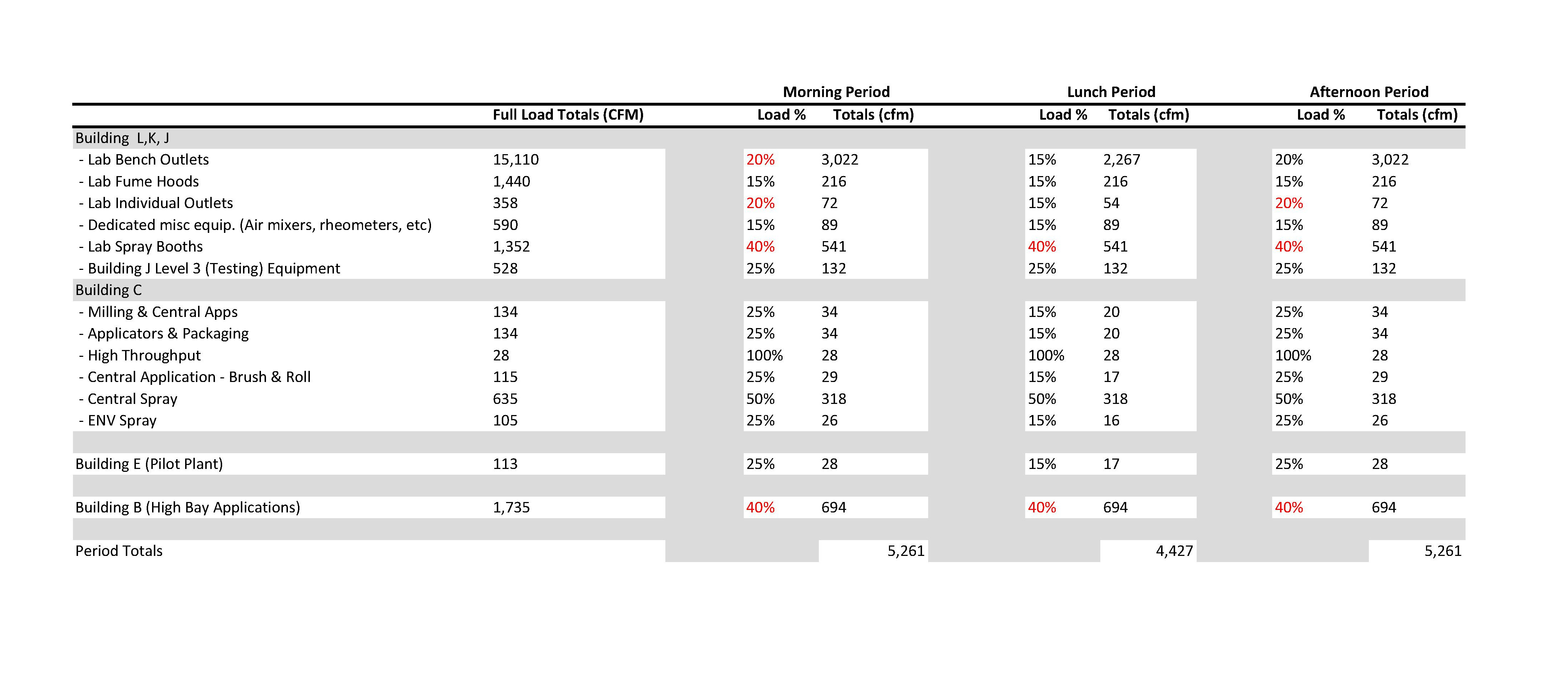 Figure 2
Gathering and tabulating all that information will help create a clear picture of your system. Adding together the diversified flow rates at the heaviest use timeframe from the load profile will provide your peak system flow rate demand.
Build
Design and arrange the piping distribution system next. Carefully consider how it operates and what accommodations should be made for different parts of the system. In-line buffer tanks may be a good idea for pieces of equipment with large individual flow requirements. Oversizing some of the piping network may be beneficial so it can handle unforeseen demand fluctuations. It also could assist the design by offering future flexibility of the spaces.
The usage factors you and the client developed could change over time. It’s best to set your client up with the ability to manipulate its operations.
The approach to the piping system’s serviceability should also be considered. An interconnected piping system built like a ladder has more than one direction that the air can flow to reach its use point. It gives superior flexibility. Proper valve placement allows for airflow diversion when needed. Service and shutdown valve placement is crucial; allow for accessible valves that can properly isolate sections of floors or rooms.
Once the piping system is laid out, the peak system pressure losses can be determined. In this example, Chapter 12 of the ASPE Plumbing Engineering Design Handbook – Volume 3 is a good reference. It gives a suggested procedure for sizing a compressed air piping system. It also provides a pressure loss table that can be modified to fit your system design.
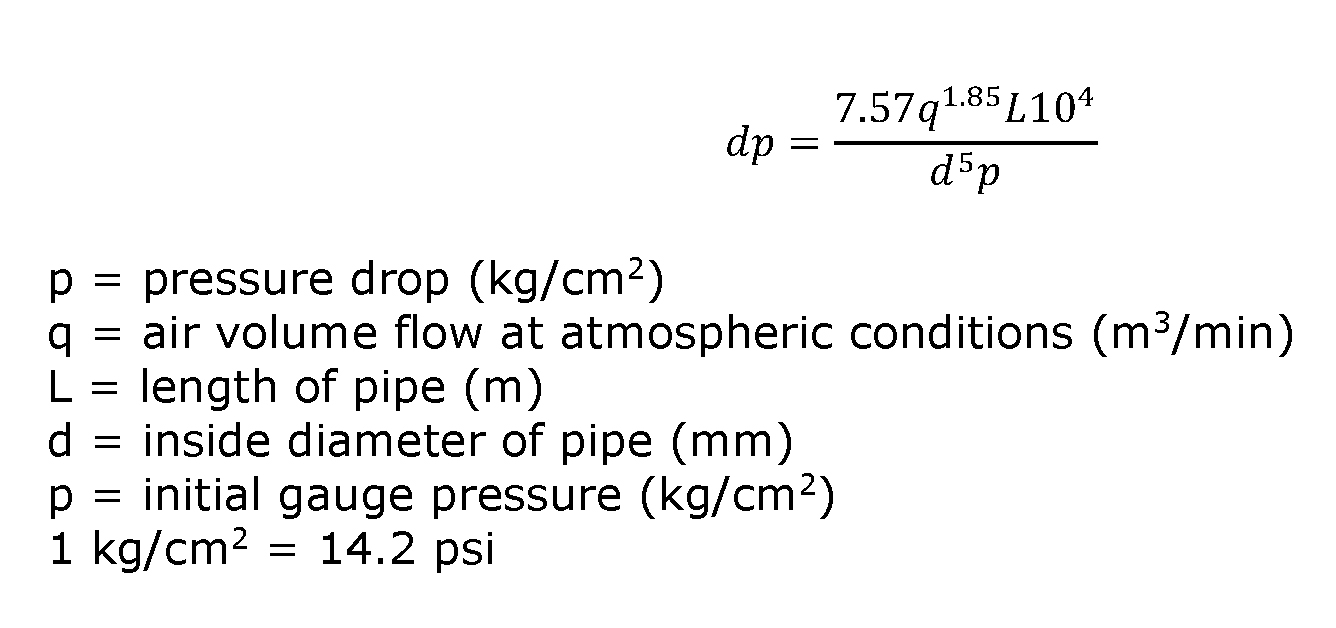
If your project parameters exceed the limits of that table, you can use this widely used empirical formula specifically for compressed air. I suggest making your own pressure drop spreadsheet so you can manage it much easier.
Now that you know the system flow demand and the pressure losses in the piping distribution system, you can begin looking at source equipment. These are the primary pieces of information to help make a compressor selection, but there are some other things to consider.
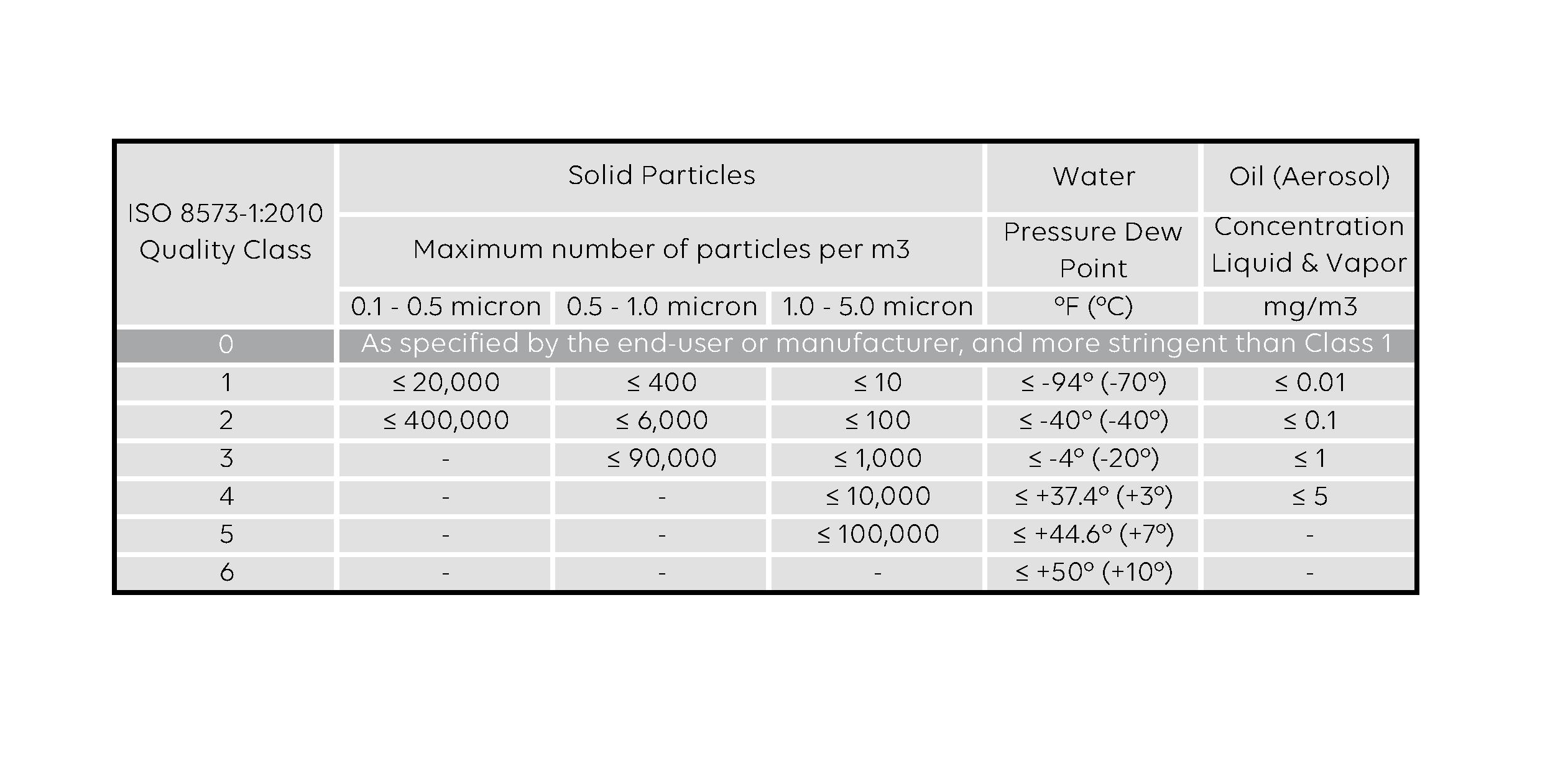
Find out what air quality the client requires in their system. The International Organization of Standardization (ISO) gives standard ISO 8573-1:2010. It provides classes for compressed air based on contaminant levels of solid particles, water and oil in the air stream. The lower a class designation is listed, the higher the purity of the air. A proper use of the standard is to list each contaminant class separately.
For example, it’s acceptable to have ISO 8573-1:2010 Class 1:2:2 air. The solid particles are filtered to the Class 1 thresholds, while the water and oil meet the Class 2 levels (see Figure 3).
Particulates and oil are typically removed from the airstream using coalescing filters in varying degrees. Water is removed by using dryers; the specified pressure dew point will dictate the required dryer technology.
There may be isolated locations in the facility where a piece of equipment or process requires a higher purity class of air. You can work with the owner to identify these areas and decide if local filtration/drying is an appropriate solution.
For a large-scale project like our example, I suggest working with an air compressor manufacturer’s sales representative to choose the compressor equipment that will best fit the project’s needs. The client may provide valuable insight into what they are willing to use in their facility. You may be able to facilitate conversations directly with the compressor manufacturer’s design engineers. They are typically excellent sources for explanations of proper system components that should be included with their equipment.
The compressor manufacturer can help you determine the best compressor technology to use, such as reciprocating, centrifugal or rotary screw compressors. Based on the system characteristics, it can help you determine if the compressors should be constant or variable speed. In some cases, multiple constant-speed compressors can stage on as needed to meet the demand. In other cases, a variable-speed compressor can be used to trim the output to meet the demand and conserve energy.
The manufacturer knows its equipment better than you. It’s OK to tap into that knowledge and use it to your benefit.
After your source equipment is sized and selected, you need to provide a home for it inside the mechanical room. A good design will not only include appropriate access around the equipment, but also repair and replacement pathways. In some cases, that could include forklift routes or overhead cranes.
Validate
Throughout the entire design process, it’s important to document your calculations, decisions and meeting minutes. That valuable information is a reference for you. It will serve as a tool to allow you to compare your theoretical calculations with the actual system operation.
Through the commissioning process, there may be an opportunity to adjust and tweak the calculations to better represent how the system truly functions. You’ll be able to see where some of your assumptions were potentially incorrect. A thorough validation of the system after construction will give the client a properly functioning system and provide you with confidence and proven data for your next project.
While the design of a complex, large-scale compressed air system can be somewhat intimidating, breaking it down into manageable pieces will help. There are some clear milestones in the process. Rely on your client where needed to give you valuable insights and information. By documenting your progress and reviewing it often, you will be able to methodically complete the design.
Compressed air system design can be challenging. The reward for your effort is a properly functioning system and a satisfied client.
Ray Schwalbe, PE, ASSE 6060, is a mechanical engineer at HGA in Milwaukee. He has more than 10 years of experience specializing in plumbing, medical gas and specialty gas design for multiple market sectors.