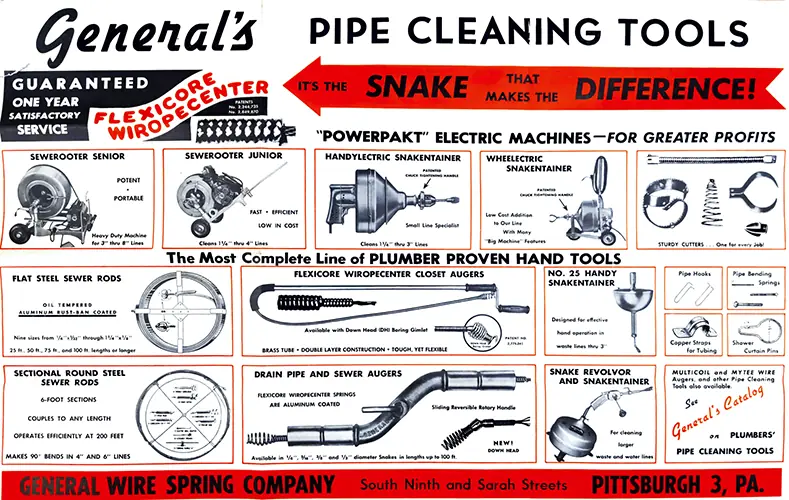
General Pipe Cleaners, a division of General Wire Spring Co., is celebrating its 95th year in the business of supplying American-made drain-cleaning equipment to PHCPPros, as well as facilities managers and the rental industry.
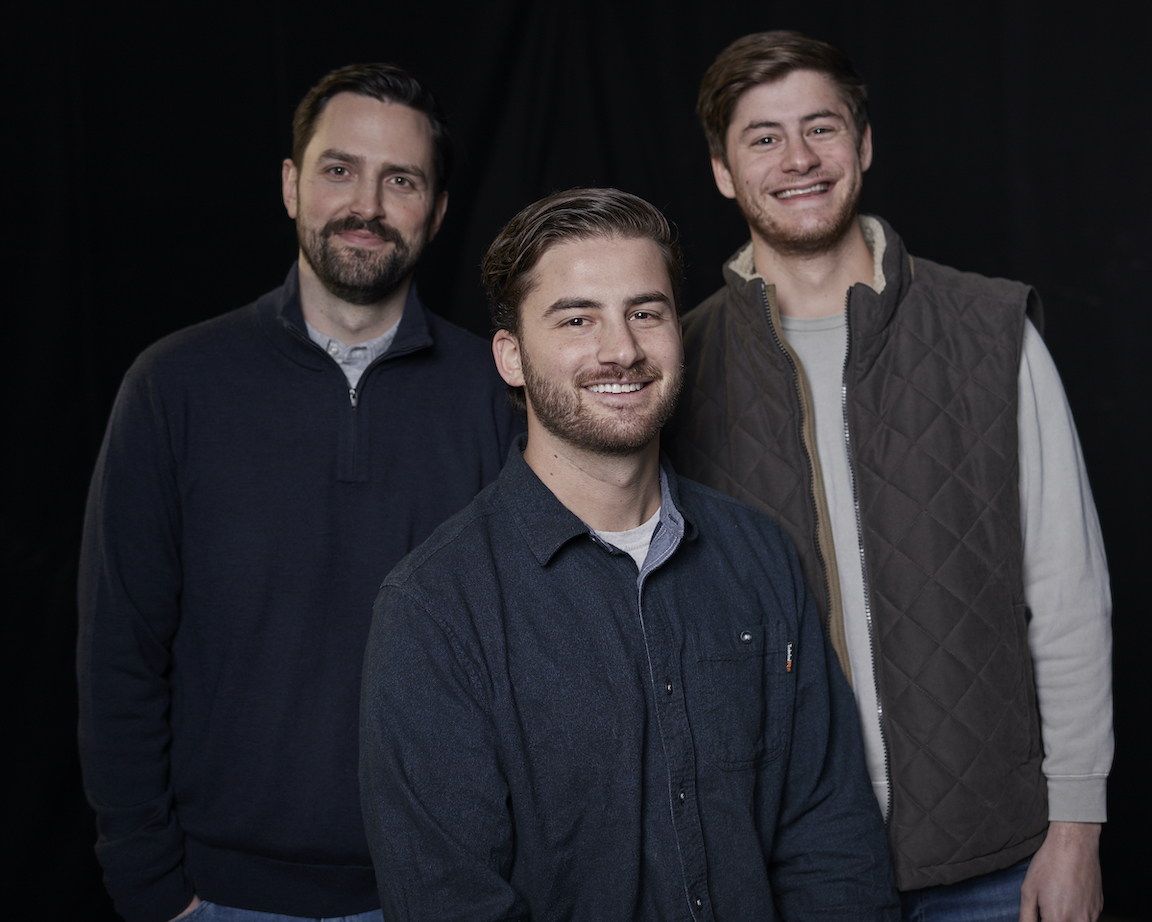
The well-known family-owned manufacturer can now count on members of its fourth generation in critical roles in sales and manufacturing working out of its McKees Rocks, Pennsylvania, headquarters.
Abe Silverman started the venture after first working for his uncle, Frank Magidson, who owned the Rapid Wire Spring Co. in Pittsburgh. Magidson, a prolific inventor, created a machine for making wire hangers and also an automatic rocking baby cradle.
Abe eventually opened his company in 1930 in the first floor of a downtown Pittsburgh building naming it the General Wire Spring Co. after his brother-in-law suggested that “What’s good for General Motors should be good for you.”
Abe set out to make custom industrial springs. One of his first big sales was for the country’s original mechanical voting machines, but he also made springs ranging in size for oven doors, elevators and highway construction signs.
Birth of Flexicore
“One day a plumber came into the office and asked if the company could make a drain-cleaning snake,” says Marty Silverman, the company’s vice president of marketing and Abe’s grandson. “It was a natural progression from producing springs made for other applications.”
At the time, drain-cleaning cables were hollow and easily prone to breaking. Abe figured out a way to make them much more durable by wrapping spring wire tightly around a braided wire rope core, much like, Marty adds, engineers use to design and build suspension bridges.
Abe’s patented 1940s innovation became known as the “Flexicore” cable, which to this day remains the backbone of much of the company’s drain-cleaning equipment. Nowadays, a Flexicore cable starts with 49-strand aircraft quality wire rope wrapped around with coil spring steel for the right amount of strength and flexibility.
“The reason that we do this is to change the way the cable reacts to torque when in use,” Marty explains. “When our machines are rotating in the forward direction and they encounter a blockage down the drain, torque is produced. This torque causes the outer spring of the Flexicore cable to contract. However, because the wire rope is already in the way, it has nowhere to go.”
As a result, the cable reacts mechanically to this situation by stiffening and strengthening, just exactly when a drain-cleaning professional needs it the most.
“Flexicore gets stronger as more torque is applied,” Marty adds. “This allows it to clear tough blockages with less kinking, breakage and downtime. In fact, it’s the only cable on the market that comes with a one-year warranty on defects.”
With Flexicore cables gaining a reputation, General Wire Spring Co., which still makes custom compression; torsion springs; and extension springs, set up its General Pipe Cleaners division to begin manufacturing drain-cleaning equipment.
“We have a major advantage since of all the manufacturers making drain-cleaning machinery,” Marty adds, “we’re the only ones that are cable manufacturers first. And since the cable does all the work, it’s the heart of any drain-cleaning machine. It’s pretty good expertise to have. The Flexicore design truly helped build our excellent name. Even today, it’s widely considered the industry standard for drain-cleaning cables.”

First machines
The company’s original drain-cleaning machines were the Sewerooter and the Handylectric.
“My grandfather had a knack for dropping a letter from two words to form one word to name his products,” Marty says.
The Sewerooter, the company’s first power-driven drain cleaner, was designed to clear 3- to 10-inch drain lines; later the company introduced the Sewerooter Junior for use on 2- to 4-inch lines. Meanwhile, the Handylectric was a hand-held power sink machine that’s the ancestor to the Super-Vee, which used a slide action chuck to make jobs safer and faster, and the Power-Vee, which uses an automatic feed system.
Chances are a General Pipe Cleaners machine that was groundbreaking decades ago is still around in a new and improved form today thanks to advances in motors, feed systems and other technology.
A couple of decades into Abe’s venture with an increased demand for and expanding lineup of its drain-cleaning products, the company moved to its current McKees Rocks, facility in 1968.
Today, General Pipe Cleaners boasts a full line of advanced drain-cleaning tools, including reliable drum-type and sectional drain-cleaning machines, gas- and electric-powered water jets, sewer inspection cameras and pipe location systems, acoustical water leak location equipment, pipe freezers, thawing machines and other accessories.
Family leadership
When Abe, who lived to be 91, began the company, his brothers-in-law were in the business, too. Eventually, Abe’s two sons, Lee and Art, went on to represent the second generation.
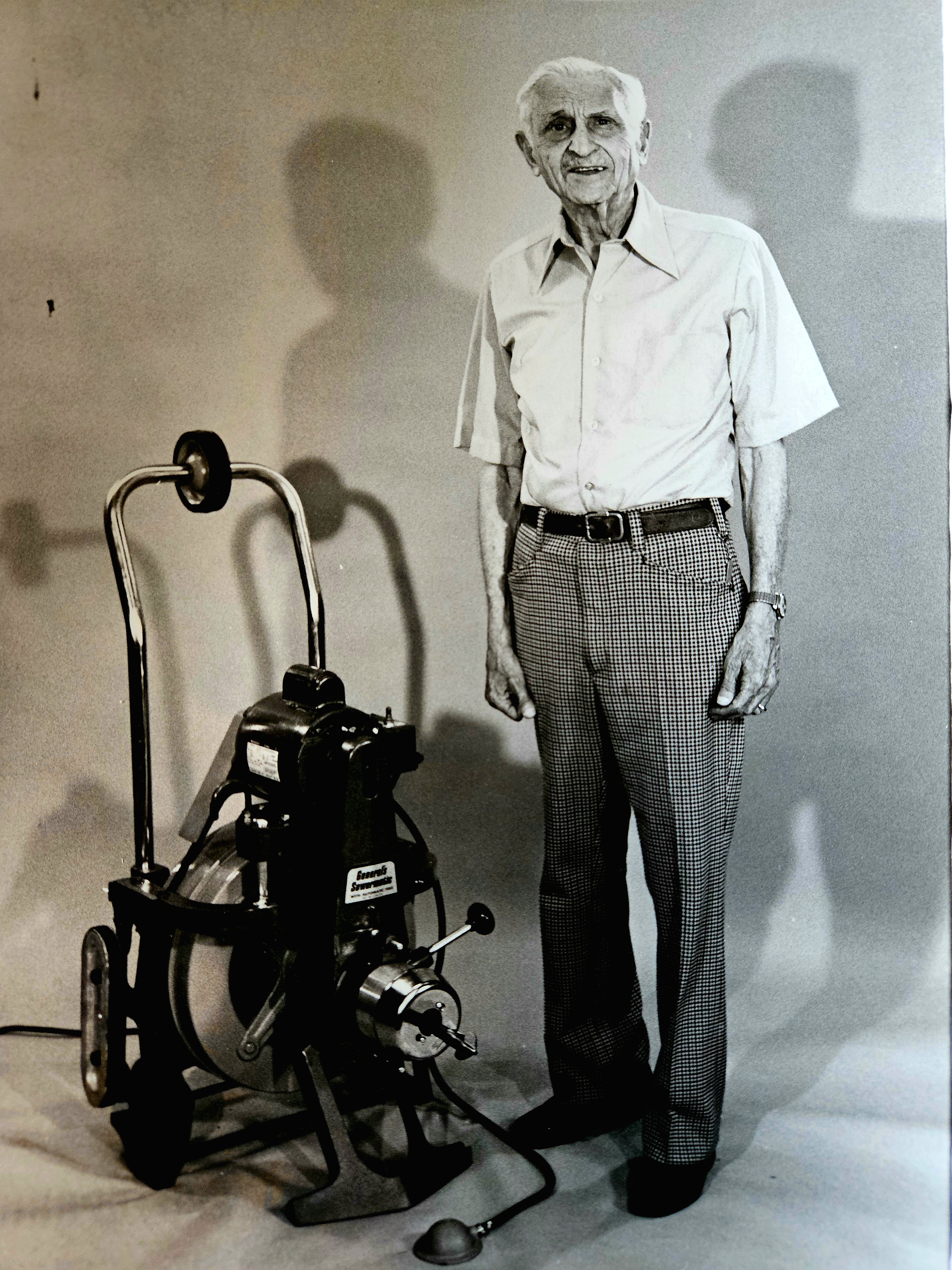
Lee, Marty’s father, oversaw sales and marketing and Art was in charge of operations and manufacturing. Marty also credits his father and uncle, who both worked into their 90s, with introducing the Feed-O-Matic and the Sewermatic, the company’s first automatic feed machines.
In the meantime, Marty, brother Steve and their four cousins, Bob, David, Jeff and Michael worked summers during high school and college in various departments at the factory learning the business from the ground up. This third generation eventually joined the company full-time in the 1970s and 1980s.
“My grandfather didn’t think there would be enough room for all of us in the business,” Marty adds, “but we all found our niche and work well together.”
Marty held various jobs within the company until he headed up the marketing/advertising department – a solid role for him since he worked at an ad agency for three years to gain experience prior to joining the family business. Steve is vice president and controller with Bob, vice president, spring division; David, vice president, global sales; Jeff, vice president, human resources; and Michael, vice president, operations.
More new products
As for adding new products to the company lineup, water jets became the third generation’s first forte.
“We just continued to find other ways of cleaning drains,” Marty explains. “It’s not like you just have one golf club in your bag; you need a variety. Jets, for example, do a great job of clearing grease off the walls of pipe whereas a cable would just go straight through the pipe and leave the grease stuck to the walls. Meanwhile, jets can’t cut out roots so there are other applications with cables to take care of that.”
Thanks to his background in video production from his ad agency days, Marty also turned his attention to camera inspection systems.
“In the late-1980s, video inspection cameras were big and heavy and miniaturization hadn’t really caught on yet,” Marty says. “When we introduced our portable video inspection camera in the early-1990s, it was a black and white picture, and we were the first to include a recording device — a VCR, remember those?”
Back then, even a “portable” system weighed 50 pounds. Nowadays, the monitor weighs a few pounds and can record onto a flash drive. And camera optics have become much more sophisticated with models featuring Wi-Fi that allows contractors to use their own smart phones to record an inspection and send it right to a customer on the spot. Then, after identifying a problem area, contractors can easily pinpoint location and depth with a digital locator.
“Before cameras, a seasoned plumber might have a pretty good idea of what and where the problem was, but it was still guesswork,” Marty adds. “The camera was a great equalizer, and now everyone can go in and diagnose problems and provide more accurate quotes. Plus, customers can see for themselves what needs to be done.”
Over the last couple of years, the company has been touting flexible shaft technology. For example, its Flexi-Rooter 100 drain cleaner incorporates a swiftly rotating wire coil, much like a car’s speedometer cable. The rod is safely protected inside a sheath so it’s easy to handle with no spinning drums.
According to the company, flexible shaft technology is faster and more thorough than traditional drain cleaners. The flexible shaft spins more than 10 times faster than drum machines. At speeds of 2,000 RPM or more, the chain cutters quickly grind up stoppages and scour the walls of the pipe.




