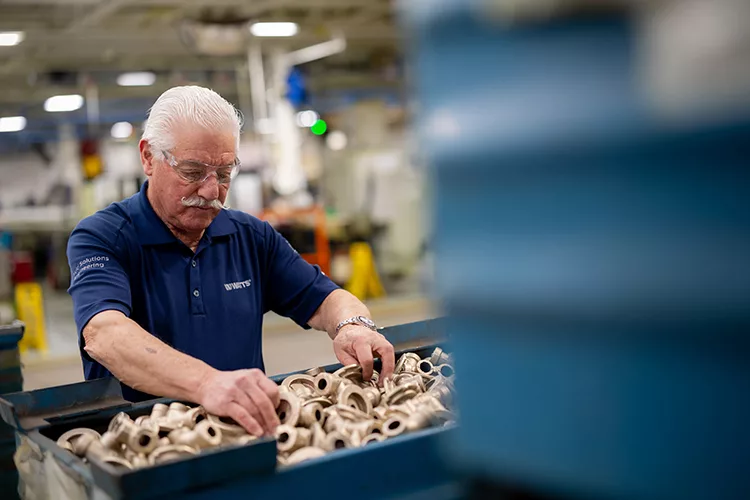
James P. Jalbert’s first day at Watts Water Technologies’ Webster Valve plant in Franklin, New Hampshire, was Feb. 22, 1965, and he still hasn’t said when his last day will be.
Although he technically retired in 2011, Jalbert, 80, engineering manager, still puts in close to 30 hours on Mondays through Thursdays.
“I take Fridays off,” he adds.
Since then, Jalbert has seen plenty of improvements at the Franklin plant, which opened in 1959, and has undergone 16 expansions in that time and more than tripled in square footage making it the company’s largest plant in North America.
“Jim is an institution up at our Franklin manufacturing facility,” says Michael Gaulin, director, marketing and communications, Watts. “He knows that place inside and out and is one of our most popular tour guides when groups come in to visit due to his in-depth knowledge.”
Jalbert’s experience has also helped guide other Watts initiatives over the years at other facilities, too.
We wanted to know more about Jalbert and his 60-year-long career after first hearing about him during last year’s Watts’ 150th celebration at its corporate headquarters in North Andover, Massachusetts.
PHCPPros: How exactly did you first start working at Watts.
Jalbert: I’m originally from Teaneck, New Jersey, and after graduating from high school I decided I wanted to get out of the New York metro area and decided New Hampshire was where I wanted to be. That was in 1963, and I worked a couple of years as a mechanic repairing outboard motors before getting the job at Watts on Feb. 22, 1965. I started out as an assembler and quickly moved up to lead for regulators. My supervisor saw some potential in me and sent me to night school through the tuition reimbursement program at Watts.
I was happily working during the day and going to school a couple of nights a week. However, I was also serving in the New Hampshire National Guard and our battalion was activated and sent to Vietnam from 1968-1969. While on duty, I was a radio telephone operator for the forward observer.
PHCPPros: We understand you had a mentor in high places at Watts who helped you once your tour with the National Guard ended.
Jalbert: I came back to Franklin and had an audience with Tim Horne. [EDITOR’S NOTE: At that time, Horne was the vice president and assistant general manager of Watts. In 1976, Horne became president of the company, and in 1978, when father George Horne retired, Horne became both president and chief executive officer.] I wanted to get into the engineering department since that was what I was studying at night school.
At that time, the company was revamping a lot of its manufacturing capabilities, and once I began working for the new engineering manager, one of my first big jobs was going to our fluid air division in Kittery, Maine. [EDITOR’S NOTE: Watts sold its fluid air division in 1986, which is now a division of Parker Hannifin] I worked at that plant for about three years setting up new cells and using methodology learned through our other incentive programs that looked at work, motion and time studies.
And it was also at this plant that we filled a major order to build two 4-inch 900 Backflow Prevention Valves for a large 735-room hotel in Philadelphia after an incident of Legionnaires’ disease was identified. I was asked to build those on a Saturday and we shipped them out on that same day. That was a pretty good accomplishment.
PHCPPros: And from there, what are some other career highlights?
Jalbert: Thanks to my experience at Kittery, I came back to the Franklin facility as the industrial engineering manager and put in place manufacturing standards and processes in much the same way we did at Kittery.
Afterward, I worked with our R&D department in North Andover, Massachusetts, to introduce new products and make sure we were also incorporating the best manufacturing practices to make them. Design engineers don’t always design their new products for manufacturing so we have to go back and forth between design and manufacturing to make sure that we can effectively make and market the product. We introduced several new products a year, every year I was there so, it was quite an intensive education.
By 1986, Tim Horne asked me to take over our quality department because I had in-depth knowledge of the products we were making.
This started us down the path to get all the Watts plants to be ISO 9001 certified. I traveled to every Watts site setting up a template to follow, so all the plants would have a manual that would be similar in structure.
Because we were also making industrial ball valves at that time, our customer base was different than the average plumbing market. Industrial companies needed evidence that our manufacturing process was in control, so I went to the University of Tennessee to study statistical process control (SPC).
SPC is about being able to monitor the manufacturing process while that process is actually happening. After my time at the university, I introduced SPC to the shop floor. We set up control charts to monitor the process in real time – all to make sure that workmanship and quality went hand in hand. In other words, with SPC everybody in the plant becomes a quality inspector.
PHCPPros: And from what we do know about you, once you mastered quality processes for making products, you turned to improving other processes at Watts. Tell us about that.
Jalbert: After much of the ISO 9001 work had been implemented, Tim Horne asked me to come to the North Andover headquarters to work with a consultant to improve office processes.
For example, consider our returns process. A return would come back to North Andover, but we had no way of efficiently getting that product back from a sales rep to the factory that made it so it could be examined, and we could determine the reason for the return. So we worked out a system to get the product directly back to the factory and learn what had happened. We also improved our credit process. This was very intriguing to walk through the processes that were used at the time and make improvements to streamline them. I was there for 18 months working with our corporate staff.
From there, I went back to the Franklin factory where I took over the engineering department along with the quality department.
We made many improvements at the factory over the next 12 years until I guess I “retired.” I was able to adjust how we did things and keep the workmanship at the highest level. The Blue Box initiative was probably the most rewarding. Working with our sourcing manager Christine Runnels we changed our plain cardboard boxes to blue branded boxes with color labels that really stood out and have now become iconic for the Watts brand.
PHCPPros: You’ve talked a lot about working closely with Tim Horn throughout the years. What can you tell us about him?
Jalbert: He was always very involved with the Franklin factory. Early on in his career he actually ran the plant so he was very knowledgeable and knew the products inside and out.
We always had a great working relationship with him; he knew every single person in the plant. He’d walk through the plant and shake hands and knew everyone’s names. To this day, there are people who are still here who were here with him. Not just me! Some have 45 years with the company.
Tim gave us the ability to make changes, and we were always looking to make our processes better. And if you tried something and failed, it was part of the learning process. So he always gave us that opportunity.
When we were getting ready to go public in 1986, he would bring investors to the plant and asked me to come along with him for his presentations. But one day he called and said since I knew the products and processes so well that he wanted me to be the tour guide. He said he was sure I would do a good job. So I did.
And after going public, Watts invested in many acquisitions to grow the company. Watts was looking at acquisitions that would have synergy with what we manufactured. Some of the smaller niche products we brought into the plant, and I was involved into the plant operating systems and setting up the processes at the Franklin facility.
And we definitely were growing. We went from 75,000 square feet when I started to 360,000 square feet. We went from 50 employees in 1965 to a high of 750 at one time. And I’ve been here watching it, helping it grow and moving it along. And it’s been very rewarding because Tim allowed us the ability to try and improve whatever we were doing, and he afforded us the opportunity to do that.
And as a matter of fact, I’m still giving tours. I continue to take customers through the plant to show them how all the products are made with the highest quality and workmanship. We’re teaching customers and sales reps at our training center in North Andover and then they will come up here to the Franklin plant, and I’ll show them around.
PHCPPros: So at 80, we guess our last question is what are your plans to retire a second time?
Jalbert: There has never been a dull day in this company, and there’s been something new to learn every day. Projects and helping the new engineers are what I’m doing now.
When I did retire in 2011, I asked Tim if I could stay on. And the reason I wanted to do that is because I wanted to transfer a lot of my knowledge and experience to the next generation. I just didn’t want to leave the place without doing that. I’ve got a lot of knowledge, done a lot of things over the years. So he said, you can stay on as long as you like. So here I am.
A lot of people I work with are always coming into my office and asking why we made this product with this feature back in 1986. And I can answer that because I was ultimately involved with research and development, design and process control.
There is a lot of things that still need hands-on experience and instructions to accomplish the tasks, so I advise our new engineers on making sure we dot the “i’s” and cross the “t’s.”




