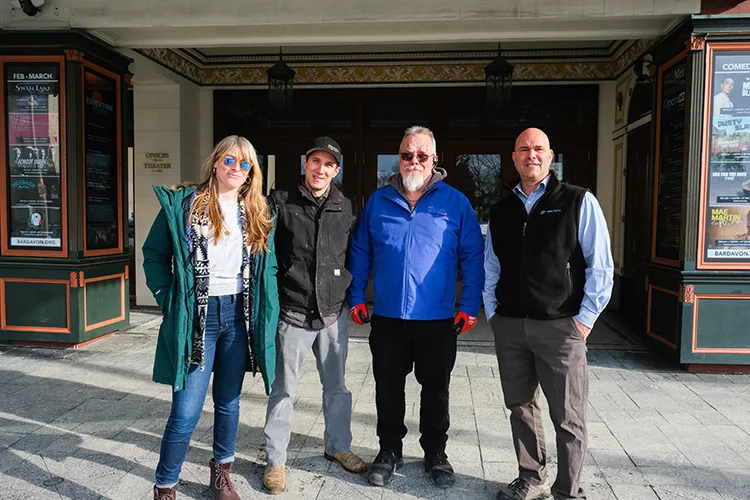
The Bardavon 1869 Opera House, in Poughkeepsie, New York, is the oldest continuously operating theater in the state. Since opening in 1869, the theater has evolved into a venue for various performing arts, including opera, cinema, theater, dance, concerts and films. What hadn’t evolved at the Bardavon, or at least not well, was the climate control system within the Italian Renaissance-style venue. By the mid-1970s, the Bardavon faced potential demolition but was saved and restored by the community.
This restoration, conducted while the hit singles, “Don’t Go Breaking My Heart”, “December, 1963”, and “Play That Funky Music,” were topping the Billboard Hot 100 chart didn’t include significant changes to the mechanical systems. The theater still lacked air conditioning and the original steam heating system was left in place.
First attempt at cooling
The first major improvement to the facility’s indoor comfort came in early 2004 with the installation of a massive, chilled water fan coil in the basement. This unit also included steam reheat coils to condition makeup air.
In Poughkeepsie, utility chilled water is available to certain commercial customers. With the addition of the chilled water air handler at the theater, this water service was used to cool the 944-seat theater, excluding other areas of the building.
Unfortunately, chilled water was only available when management at The Bardavon scheduled it months in advance. Events planned on short notice went without cooling. Other areas of the building were either uncooled or poorly cooled by independent systems.
“The auditorium’s cooling system served us well when chilled water was available,” says Jess Kelly, Bardavon’s facilities manager. “That said, the setup limited how many events we could schedule.”
In addition, the system required manual control at the air handler, meaning maintenance staff had to access it through the dressing room floor.
In 2023, long after theater management and clientele had grown weary of the sweltering temperatures throughout the lobby, office and concession areas, two things occurred that ushered in a new era of cooling at The Bardavon.
The city notified chilled water customers that the utility chilled water supply was about to become even less available. The straw that broke the camel’s back, though, came during one of the theater’s largest events of 2023.
“To make a long story short, we couldn’t get chilled water for a sold-out event,” Kelly says. “We experienced an unusual high of 88 degrees in mid-April, and it was extremely hot and humid in the theater,” explained Kelly.
Two commercial portable AC units were rented and placed in the parking lot, with ductwork running into the theater. Two hours before the show was about to start, one of the units broke.
“We gave out free bottled water and, luckily, our long-time HVAC contractor, Anthony Winslow, fixed the rental AC unit,” Kelly adds.
The potential embarrassment of this event tipped the scales in favor of a new AC system. Winslow, who owns WinTech HVAC LLC, Hyde Park, New York, was asked to propose a cooling solution for the entire building.
Design collaboration
“I know the building very well,” Winslow says, who serviced the HVAC components at The Bardavon long before he started his own company six years ago. “Based on the mechanical space and budget available, I knew the only way to cool the building was to retrofit the existing air handler with a VRF DX kit, while serving the rest of the building with single- and multi-zone systems.”
The air handler is 20 years old, but it’s a top-of-the-line custom Huntair unit with four, 7.5 HP, VFD-powered fans that move up to 24,000 CFM through the auditorium’s ductwork. Winslow planned to use Fujitsu’s DX (direct exchange) kit to pair new, custom-made DX coils with dedicated VRF outdoor units, but he knew he’d need help with the design.
“My first call was to John Resso, at rep firm Wales Darby,” Winslow adds. “He walked the site with me, helping develop a plan to install Fujitsu AIRSTAGE VU-V heat pumps.”
Winslow and Resso sketched a design to retrofit the existing air handler with the DX kit and coils to provide heating and cooling to the auditorium via the circa-2004 ductwork. Sizing of the four new DX coils was based on the previous engineered load of the chilled water coils. The retrofit of the auditorium alone required 56 tons of cooling capacity.
An economizer in the air handler, which can provide up to 100% outdoor air, was also considered while sizing the new AIRSTAGE equipment.
A different approach was planned for other areas of the building, to include more VU-V capacity, J-series light commercial VRF equipment, and H-series heat pumps.
Resso and Winslow also received design assistance from Mike Teixeira and Noel Ramirez, of GENERAL HVAC Solutions America, Inc. (formerly Fujitsu General America Inc.), Pine Brook, New Jersey, as well as TJ Markowitz at Security Plumbing and Heating Supply of Poughkeepsie (a Winsupply company).
“I just turned 41, and I’ve been punching sheet metal since I was 12,” Winslow adds. “I’ve been building relationships before I was aware how critical that was. If not for that support network, I couldn’t have taken on a project like this.”
Winsupply’s Poughkeepsie branch agreed to bring in the material five weeks in advance, holding it until The Bardavon’s chaotic schedule would permit the project to begin. This dramatically helped the planning process.
Phase 1 on time
The project was broken into three phases, starting with the auditorium, which needed to be complete before the 2024 Fundraising Gala on May 7.
Phase one began in January 2024. The work went smoothly, thanks to front-end planning. That’s not to say it was easy.
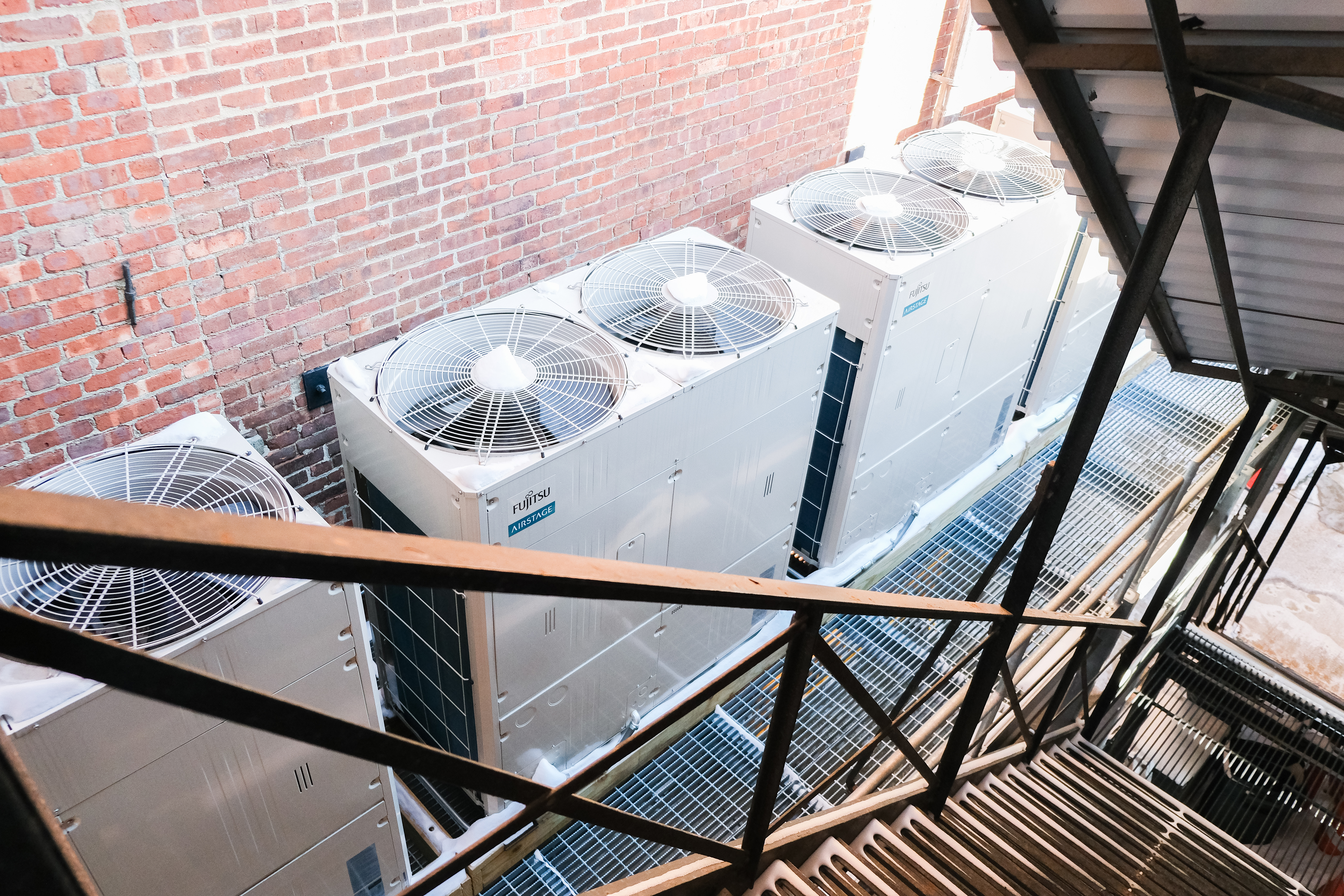
“Anthony and his team spent a lot of time running line sets in the crawlspace, and he hired a structural engineer and metal subcontractor to build a support structure next to the fire escape to mount the outdoor units,” Resso says. “Integration of the new DX coil in the air handler was easier than we thought, though. The AIRSTAGE DX solution offers tremendous flexibility in a retrofit application. There’d simply have been no other way to accomplish this project without it.”
Line set lengths of 150 feet were needed, with 30 feet of height differential. The four chilled water coils were removed and replaced with four new, custom-made VRF coils; one per blower on the fan wall in the big air handler, which was then outfitted with the DX control kit. This allows third-party components to communicate directly with the AIRSTAGE equipment.
All components of the auditorium VRF system were operational by early April. Equipment was integrated with a temporary BMS.
“The BACnet system was set up to control phase one alone until phases two and three were complete,” Resso explains. “We have DC voltage going from the fan wall to the VU-V outdoor units, which allows the condensing units to ramp up according to fan speed. The plan was to install Fujitsu’s Central Remote Controller and expand the BACnet system after the last two phases came online.”
Resso and Winslow were joined onsite by Ramirez for commissioning of phase one, and the auditorium system was fully functional well ahead of the Gala.
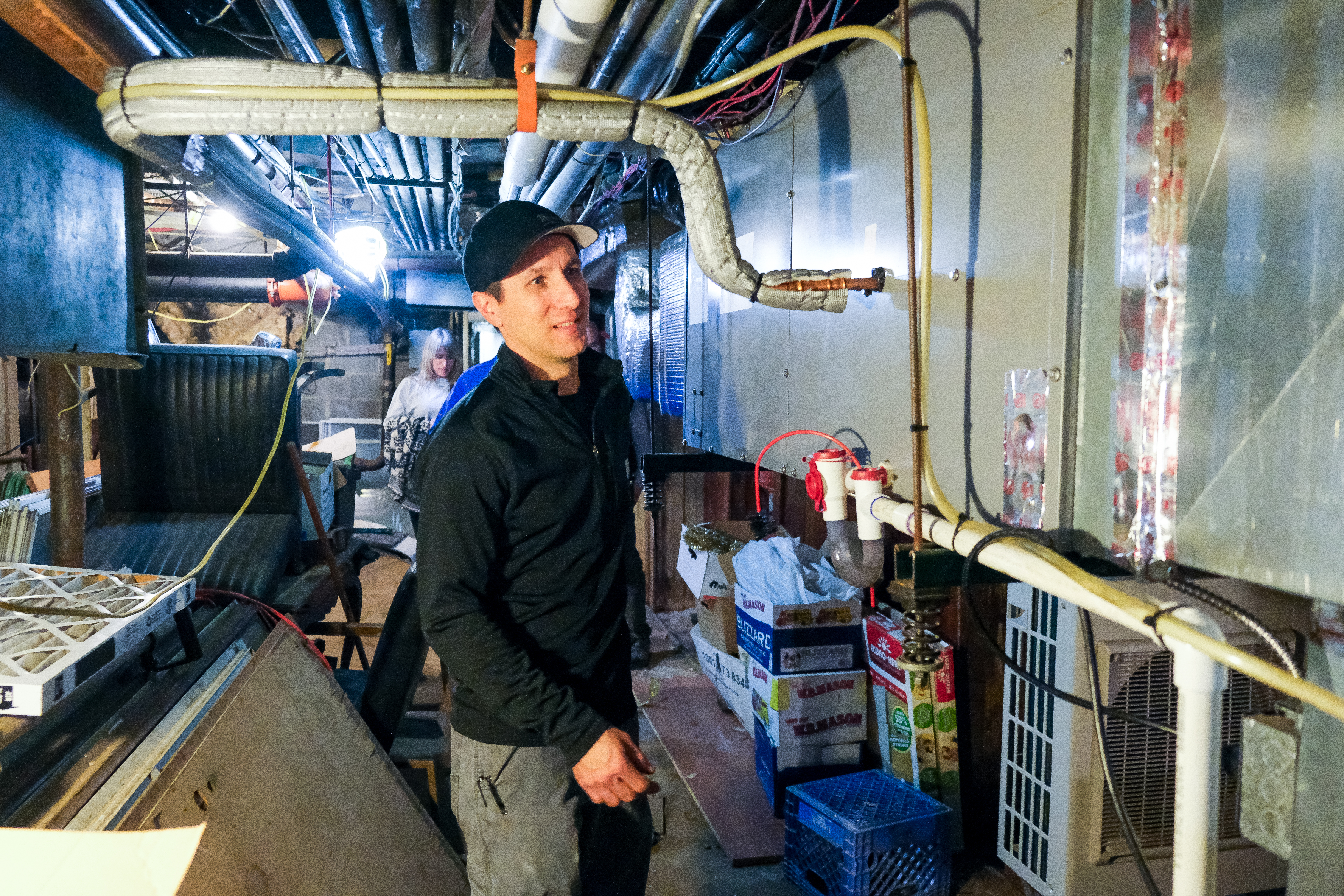
“Anthony executed everything flawlessly,” said Kelly. “The Bardavon is not an office building. We’re busy seven days a week, and Anthony had so many things to work around. What he accomplished during phase one was nothing short of magical, and guests at the Gala commented on the stunning improvement from 2023 to 2024.”
When phase one ended and the comfort level in the auditorium exceeded expectations, it redoubled the support and excitement for phases two and three.
Final phases
“I’ve installed Fujitsu systems for 20 years,” Winslow says, who grew up in the trade. “I’ve remained loyal due to the quality of the product and outstanding support I get from Wales Darby.”
“Phases two and three put me back in my comfort zone, with the H-Series and J-Series AIRSTAGE equipment,” he continued. “By that point, I had already installed VU-V in the auditorium, so the learning curve was over and the remaining VRF installations weren’t daunting.”
Installation of phase two included 5 tons of single-phase J-Series VRF capacity delivered through an ARUX multi-position air handler. This conditions the lobby, which was previously unconditioned. An 18,000 BTUh H-Series AIRSTAGE unit was also installed for the box office.
Phase three consisted of the final, 14-ton VU-V system. WinTech installed seven zones throughout the bar, consisting of wall-mount and floor-mount units.
“There’s a little over 80 tons of VRF capacity here in all, but the largest single unit is 14 tons,” Winslow adds. “The modularity of these units allows a small company like mine to handle a job this large. Without more manpower, we never could’ve done this with conventional equipment.”
The entire system was operational in June 2025. WinTech plans to install a Fujitsu Central Remote Controller so all systems can be controlled from a single location.
Improvement to the makeup air system alone is saving the theater a great deal of energy. Before the retrofit, six ACH was provided regardless of occupancy. Now, CO2 sensors in the system dictate the volume of fresh air provided.
“I’m glad to have been part of this,” Markowitz says. “I’ve been in the industry for about 40 years locally and it’s one of my favorite projects to date. Anthony represents the type of young person our industry needs, and John Resso at Wales Darby sets the bar high for rep agencies.”
“Comfort was our number one concern,” Kelly adds. “User-friendliness and energy efficiency followed. Anthony and his unbelievable support team delivered a solution far beyond our expectations. Every time I step into the building during the summer, I’m reminded how transformative a well-designed HVAC system can be!”



