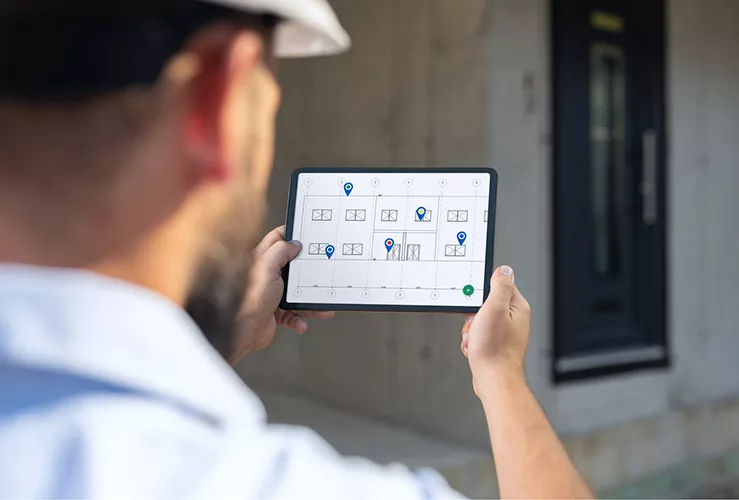
A growing share of building envelope risk stems from inspection complexity. Requirements shift, inspections get interpreted locally, and the evidence of what actually happened—installation details, responsible parties, approvals—ends up scattered across email threads and camera rolls. When an AHJ or a client comes looking for traceable records, field teams find themselves piecing together history they should already have.
The gaps compound quickly. When photos, markups and approvals live in inboxes or camera rolls, rework risk rises and compliance documentation becomes difficult and sometimes impossible to reconstruct. Digital platforms address this by linking photos, markups, tests and approvals directly to plan locations, creating a traceable record built during the work itself rather than assembled after the fact.
Three requirements
Effective visual documentation comes down to three issues:
Photos tied to specific plan locations: Site teams record conditions directly on digital plans using mobile devices. Each photo, note and status update connects to a specific location rather than filing into generic folders sorted by date. When someone needs to verify what was installed at a particular penetration—whether for coordination, inspections or compliance documentation—they pull up that spot on the plan and see everything related to it.
One system for field and office teams: Digital platforms centralize information that previously lived in emails, camera rolls and separate tracking systems. Field crews photograph conditions and flag issues on digital plans. Office teams review progress, assign follow-ups and generate compliance reports from the same dataset.
Consistent tagging for compliance-ready records: Standardized fields ensure that what gets documented can be retrieved later and satisfies compliance requirements from the start. Status, responsible party, trade, observation type—when these follow a consistent format, teams can filter by location, trade or issue type during inspections rather than scrolling through unlabeled photos. During audits or client reviews, that structure means generating compliance reports in minutes rather than days.
Many platforms let teams tailor workflows and data collection to their specific processes. For PHCP contractors conducting inspections across multiple crews and subcontractors, this approach can cut post-site reporting time significantly—often from days to hours—while improving oversight where trades interact at the envelope.
From photos to proof
Once visual capture is consistent, documentation becomes verifiable. Reports draw from the same dataset rather than requiring someone to rebuild context from scattered sources. Questions that previously required a site visit can be answered with a photo tied to a plan location.
The efficiency gains show up most clearly in compliance and inspection reporting. When field documentation feeds directly into client deliverables and compliance reports, the time between observation and action shrinks considerably.
ACE Building Envelope Design, a California-based firm managing envelope design and quality assurance, offers a concrete example. Before standardizing its documentation approach, inspection reports could take up to 60 days to complete. Engineers conducted thorough site inspections but then spent days compiling notes, organizing photos and formatting deliverables by hand. That delay created a second problem: issues couldn’t wait 60 days for a formal report, so the team built workaround systems of emails and spreadsheets just to keep work moving.
When the firm integrated PlanRadar (www.planradar.com/us) into its workflow—using the platform to record observations directly on plans during inspections—the math changed quickly. An inspection that previously required eight hours on site plus days of follow-up now takes roughly five hours total, with project managers reviewing and finalizing from the same system. Report completion time fell from 60 days to a few days.
What’s more, issues could be tracked and addressed while trades were still on site rather than surfacing weeks later in a formal report. The time saved let the firm take on additional projects without adding staff.
When documentation happens once and reports generate from that same data, less time goes to administrative work. For inspection teams managing multiple active projects, that difference adds up fast.
Beyond photos linked to plan locations, 360-degree reality capture provides comprehensive site documentation through a straightforward field process. With PlanRadar’s SiteView, teams can conduct site walks with a helmet-mounted camera; AI algorithms then automatically map captured imagery to digital floor plans, complete with location data and timestamps.
The visual record allows office teams to review spaces remotely, compare conditions across dates and verify behind-the-wall installations after finishes are complete. The technology handles mapping in the background, so field teams stay focused on inspections rather than file management.
At closeout, the 360-degree documentation provides verification without requiring assemblies to be opened. Where remote stakeholders need visibility or where conditions behind finishes become disputed, the timestamped visual history provides objective evidence of what was installed, where and when.
Practical AI
Clean, structured visual data also creates the foundation for AI to improve common workflows. When photos, tickets and plan locations carry consistent tags, models can identify patterns across projects and over time. Practical applications include the following:
Summarize information: AI can sift large documents and datasets to surface quick summaries. Instead of reading a 100-page project file to confirm installation specifications during a visual quality check, users can prompt AI to pull the relevant instruction and move on.
Search and retrieval: As visual documentation accumulates, filters alone may not surface what’s needed. AI can bring the right items forward with plain-language prompts.
Automate processes: AI can be configured to verify that required visual documentation fields are complete, reducing administrative overhead across construction workflows.
Firms that adopt standardized tagging and required fields will be able to apply new AI tools immewithout having to clean up years of inconsistent records. A well-organized dataset can create a six- to 12-month head start while peers reconcile fragmented information.
Verifiable documentation
To summarize, visual documentation platforms address the core problem by linking photos to plan locations, standardizing tagging and centralizing access so field and office teams work from the same records.
When envelope conditions are documented consistently, coordination gaps surface earlier, while corrections are still manageable. At scale, that approach improves both design quality and project delivery—not through longer hours, but through clearer records that reduce ambiguity and speed decisions.
For firms managing multiple projects and conducting regular inspections, these documentation standards create immediate efficiency gains in reporting and coordination. They also establish the data foundation that emerging AI tools will require, positioning teams to apply predictive capabilities as those tools mature—without retrofitting years of inconsistent records.
The shift from fragmented documentation to structured visual records is practical and measurable. It supports better envelope performance today while preparing teams for the tools that will shape project delivery tomorrow.
David Homola is the U.S. general manager for PlanRadar, a field management platform serving construction, facility management and real estate projects. He leads the company’s growth strategy and market expansion in North America.