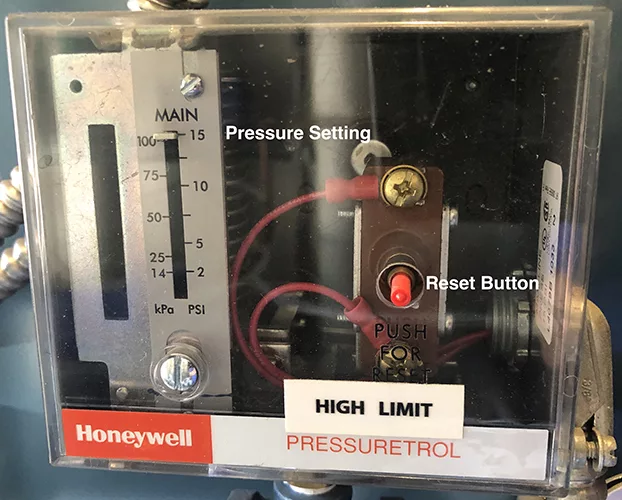
Walk into any mechanical room with a steam boiler and you’ll spot them right away: steam pressure controls perched on curly piping called pigtails. These devices have been standard equipment for decades, yet they remain one of the most misunderstood and misadjusted safety controls in the industry. Get them wrong, and you risk short-cycling, banging or, worst case, dangerous overpressure. This column covers the essentials every PHC technician needs to know.
Why low-pressure became the standard
Low-pressure steam systems for comfort heating were designed to operate at 2 psi and below, a standard tracing back to December 1899. Before that, many residential and commercial systems ran at 75 to 80 psi or higher, pressures that turned boilers into ticking time bombs. The Perkins system operated between 200 and 800 psi. I know, right? Between 1879 and 1891, the United States suffered catastrophic boiler explosions on average every 48 hours.
Nationwide, more than 2,000 explosions occurred between 1880 and 1890 alone, killing and injuring thousands.
Today, most low-pressure steam boilers serving homes, offices, churches, and schools run between 1/2 and 2 psi. This narrow band provides gentle, even heat distribution while minimizing stress on piping, radiators and the boiler itself. Industrial users such as breweries or hospitals may run higher, but for comfort heating, the rule is simple: keep it low.
Pressure control types: Subtractive vs. additive
Boiler pressure controls come in two basic operating designs, subtractive and additive. Identifying which one you’re working with prevents short-cycling and unhappy customers.
1. Subtractive controls (Honeywell L404 Series)
Look at the lower-left corner of a typical L404: “DIFF. IS SUBTRACTIVE.” That tells you the control is subtractive. You’ll see two vertical slides — one labeled DIFF. (left) and one labeled MAIN (right), plus two adjustment screws on top.
The MAIN setpoint is your cut-out pressure, the point where the burner shuts off on a call for heat. For the desired 1/2-to-2-psi operating span, set the MAIN to 2 psi. The DIFF. setpoint slide subtracts from that value to establish cut-in; it’s how many pounds you want the boiler to drop before restarting. Set DIFF. to 1 1/2 psi, and the burner will fire again when the pressure drops 1 1/2 pounds to 1/2 psi.
The DIFF. scale numbers often stop at 2 psi, so fine-tuning is done by turning the adjustment screw clockwise while watching a trusted pressure gauge. Stop when the boiler cycles across your desired span.
2. Additive controls (Honeywell PA404 Series)
The PA404 looks different — only one visible slide on the front labeled CUT IN and one adjustment screw on top. “CUT IN” printed prominently confirms it’s additive. The differential is set on a white dial under the cover.
To achieve the same 1/2-to-2-psi span, set CUT IN to 0.5 psi (visible on the lower-right scale). Then dial the internal differential knob to 1 1/2 psi. The burner will now operate between 1/2 and 2 psi.
Regardless of type, never trust the control’s scale alone. Always verify actual steam pressure with a high-quality gauge. I consider the numbers a starting point and adjust to meet the proper settings.
Larger commercial installations add redundancy with two controls: an operating (cycling) control and a high-limit control. The operating control automatically cycles the burner during demand for heat. The high-limit control is manual-reset only and is set about 5 to 10 psi higher. If pressure ever reaches the limit control setpoint, the burner locks out until the pressure drops and someone physically pushes the reset button.
This manual reset requirement forces investigation before the boiler returns to service. Why did the control trip?
Mounting matters: Pigtails and water seals
Pressure controls are never piped directly to live steam. Instead, they connect through a pigtail (siphon) or water seal that protects the sensitive diaphragm and switch mechanism.
Steam entering the pigtail condenses into water, which remains trapped in the loop. Rising pressure pushes this water column (and a small air cushion) up into the control, transmitting pressure without exposing the internals to destructive heat and steam. Without this seal, controls would fail rapidly from corrosion and thermal shock.
Pigtails, however, have one major weakness: they plug easily with scale, rust and sediment. A plugged pigtail can cause the boiler to “run wild” until the high-limit trips or worse. Annual disassembly, flushing and inspection are mandatory.
Many technicians now prefer water seals, straight horizontal pipe with vertical nipples to the control, eliminating the need for pigtails. They are far less prone to blockage and easier to clean in place. Clearing a plugged pigtail is almost impossible.
Best practices, common mistakes and troubleshooting
1. Target settings for residential systems. Operate boiler between 1/2 and 2 psi, unless the system is designed for lower pressures, i.e., vapor or vacuum systems. Higher pressures waste energy, cause banging pipe and shorten component life. Settings too low may fail to heat the furthest rooms.
2. Never guess. Always adjust while using a reliable pressure gauge. I have been fooled by boiler pressure gauges that weren’t accurate.
3. Common mistakes:
• Using subtractive logic on an additive control (or vice versa) or not checking for blocked or plugged pigtails.
• Setting the differential too tight. The smaller the differential, the more the boiler cycles. The higher the differential, the longer the boiler operates and the higher the boiler efficiency.
• Pigtail in parallel with the front of the control. The control front should be perpendicular to the pigtail loop. Piping the pressure control in parallel to the siphon loop causes the boiler to operate on different pressures than the setpoint.
• Only one pigtail. As we discussed earlier, pigtails have an affinity for plugging. Be sure each pressure control is on its own pigtail. If the controls are on one pigtail and it plugs, you’ve lost control of the boiler. Better hope the pop safety valve works.
4. Troubleshooting quick checks:
• Boiler short-cycles? The differential may be too small or the pigtail may be partially blocked.
• Burner won’t fire on call? Check for a plugged sensing pipe or control failure.
• Overpressure trips? Verify operating control set-point and test high-limit.
Older, mercury-filled L404 models must be piped plumb for proper operation. They even have a plumb bob inside.
Understanding steam boiler pressure controls is critical for any boiler service. Proper adjustment keeps systems running efficiently, protects equipment, prevents unnecessary service calls and, most importantly, safeguards lives and property.
Take the extra five minutes to identify the control type, verify pressures with a good gauge and inspect the pigtail or water seal. Your customers, your company and your peace of mind will thank you.