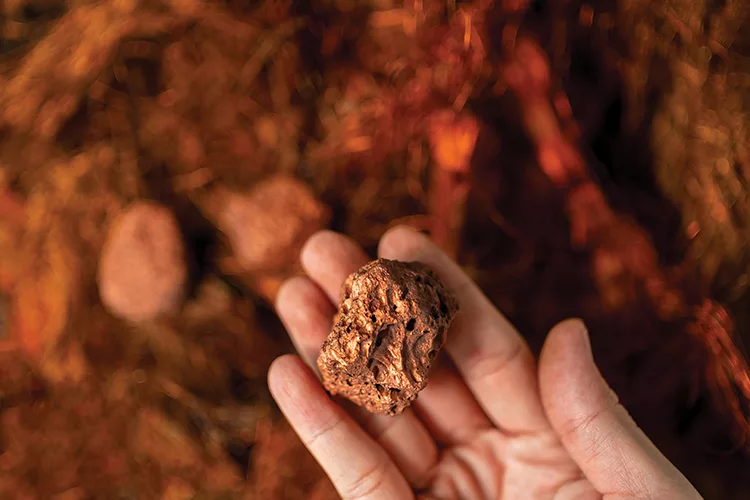
If 2026 were an ore, it would grade high in opportunity, with a few stubborn seams to work through. This year marks a pivotal shift as North America moves from mine to magnet and from ore to electrode, with policy and capital accelerating the domestic supply chain buildout. The U.S. is advancing critical mineral projects for copper, lithium, cobalt and rare earths — essential for energy storage, electric vehicles and renewable technologies. Key initiatives include Alaska’s Ambler Road corridor and Arizona’s $6 billion Resolution Copper project, which could supply a quarter of U.S. copper demand for 50 years.
The U.S. government is supporting mining and downstream refining of critical minerals through partnerships, equity buy-ins, funding/grants and permitting programs. For example, in an effort to reduce the lengthy and costly permitting and regulatory process for new mines, the Trump administration added 48 mining projects to the Fast 41 permitting program, which had only one project on the list a year earlier.
The permitting program was created several years ago to support large infrastructure projects from the Biden era’s infrastructure legislation. It has been expanded to include mining projects, such as Anfield Energy’s $15.3 million Velvet-Wood uranium-vanadium project in San Juan County, Utah.
While Fast 41 is aimed at reducing regulatory hurdles at the federal level, the realities of possible state and local delays will still come into play, some of which have already faced years of litigation
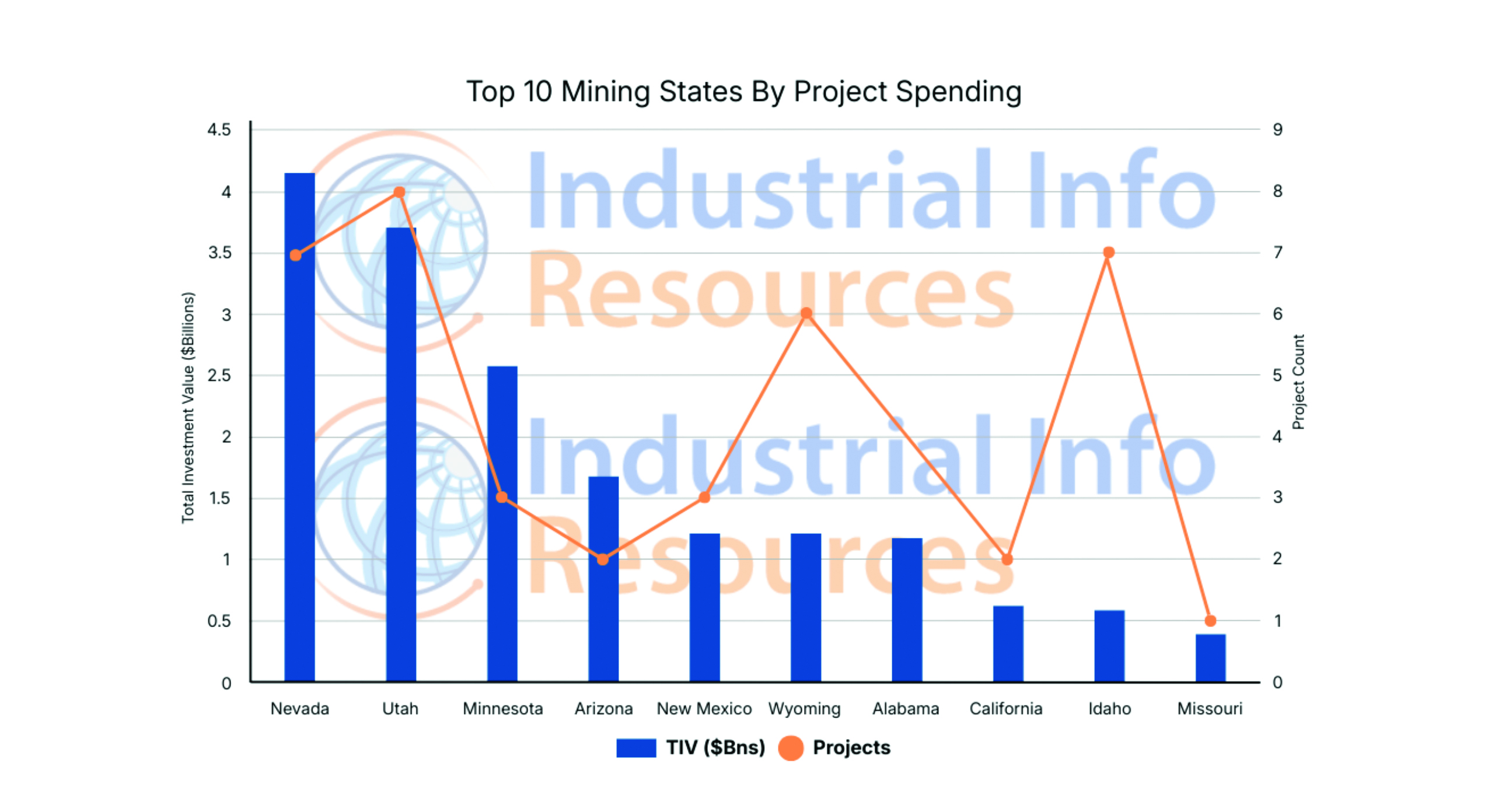
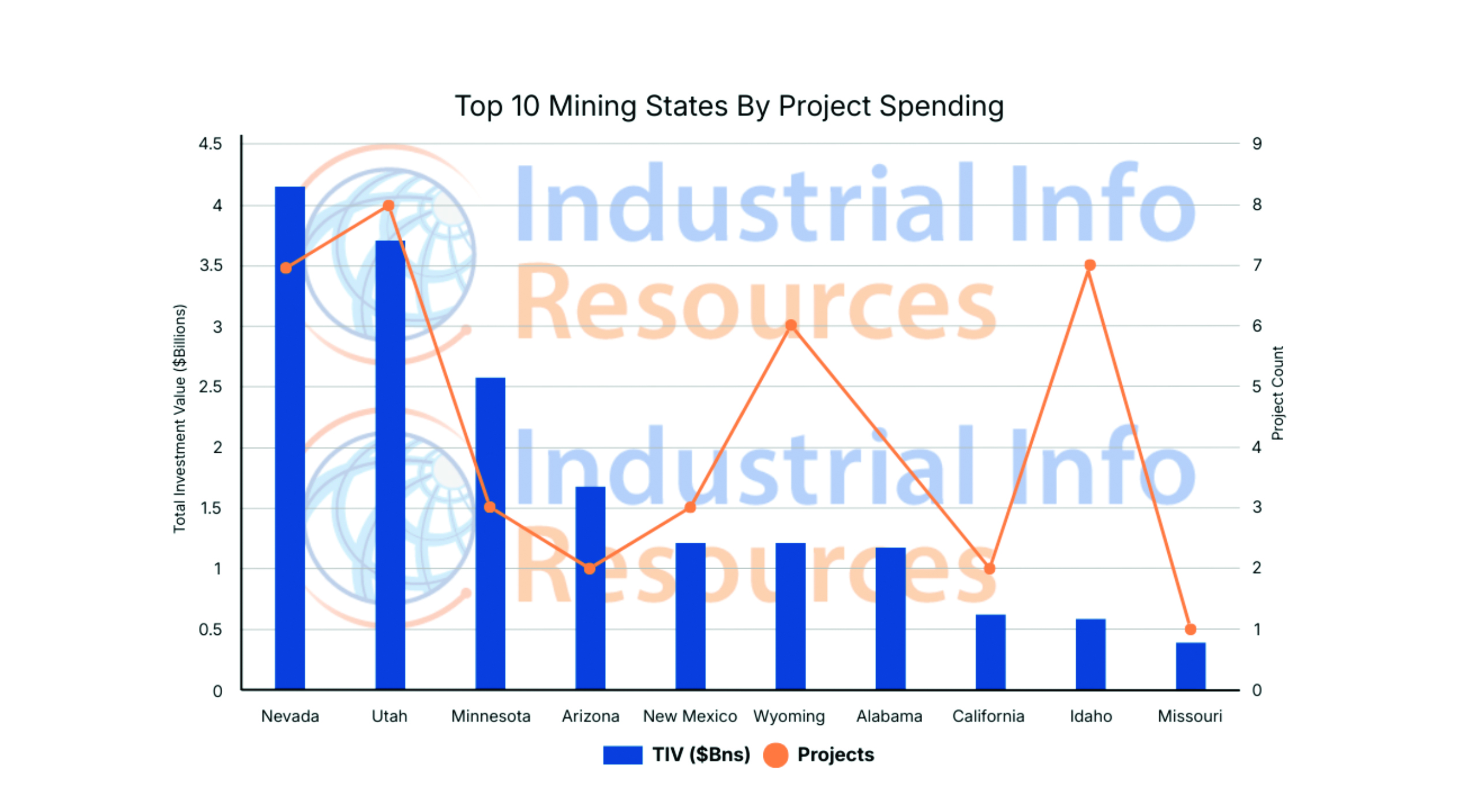
Industrial Info Resources (IIR) is tracking 75 U.S. mining projects with pipe, valve and fittings requirements under construction, with a total investment value of $18.39 billion.
Copper developments
Copper is important, particularly these days of Big Artificial Intelligence (AI). In addition to hogging power for operations and water for cooling, data centers use a lot of copper.
Shane Mullins, IIR vice president of energy market solutions, listed how much copper a data center needs, and how that has increased in recent years.
“A single 1-gigawatt AI data center can require up to 50,000 tons of copper for power distribution, grounding and cooling systems,” he explains. “While older facilities used 5,000 to 15,000 tons of copper, AI-ready campuses require roughly three to four times that amount due to higher power loads and advanced liquid cooling, which requires copper heat exchangers.”
A looming copper shortage could add to data center growth challenges. In 2025, the International Copper Study Group said it expects the global refined copper market to see a 150,000 metric-ton deficit in 2026. Mullins said stockpiling copper now could mitigate future shortages.
“On Feb. 2, 2026, the Trump administration announced Project Vault, a landmark initiative led by the Export-Import Bank (EXIM),” he says. It establishes the U.S. Strategic Critical Minerals Reserve (SCMR), which EXIM said is “backed by a $10 billion EXIM loan and nearly $2 billion in private-sector investment.”
The SCMR, an independently governed public-private partnership, will store essential raw materials, including copper, in secure U.S. facilities. The Trump administration issued several executive orders for mining to relieve “permitting bottlenecks” for domestic projects, Mullins notes.
One of the most-watched initiatives is the Resolution Copper project in Arizona; Resolution Copper is a joint venture between Rio Tinto and BHP. The project is prioritized as a “transparency project” to expedite land transfers and permitting. If completed, it could supply roughly 25% of U.S. copper demand.
In March, Resolution Copper and the United States Forest Service completed a historic land exchange, unlocking the next phase of one of the world’s largest untapped copper deposits.
Completion of the land exchange follows a decision by the U.S. Court of Appeals for the Ninth Circuit, which ruled in favor of Resolution Copper and the federal government, denying the plaintiffs’ requests to stop the exchange.
Resolution Copper placed environmentally and culturally sensitive land under protection by transferring more than 5,400 acres containing special-status species, riparian (river/stream-adjacent) areas and Native American cultural sites for inclusion in National Forests and National Conservation Areas. In return, it received more than 2,400 acres of land next to the historic Magma copper mine in Superior, Arizona.
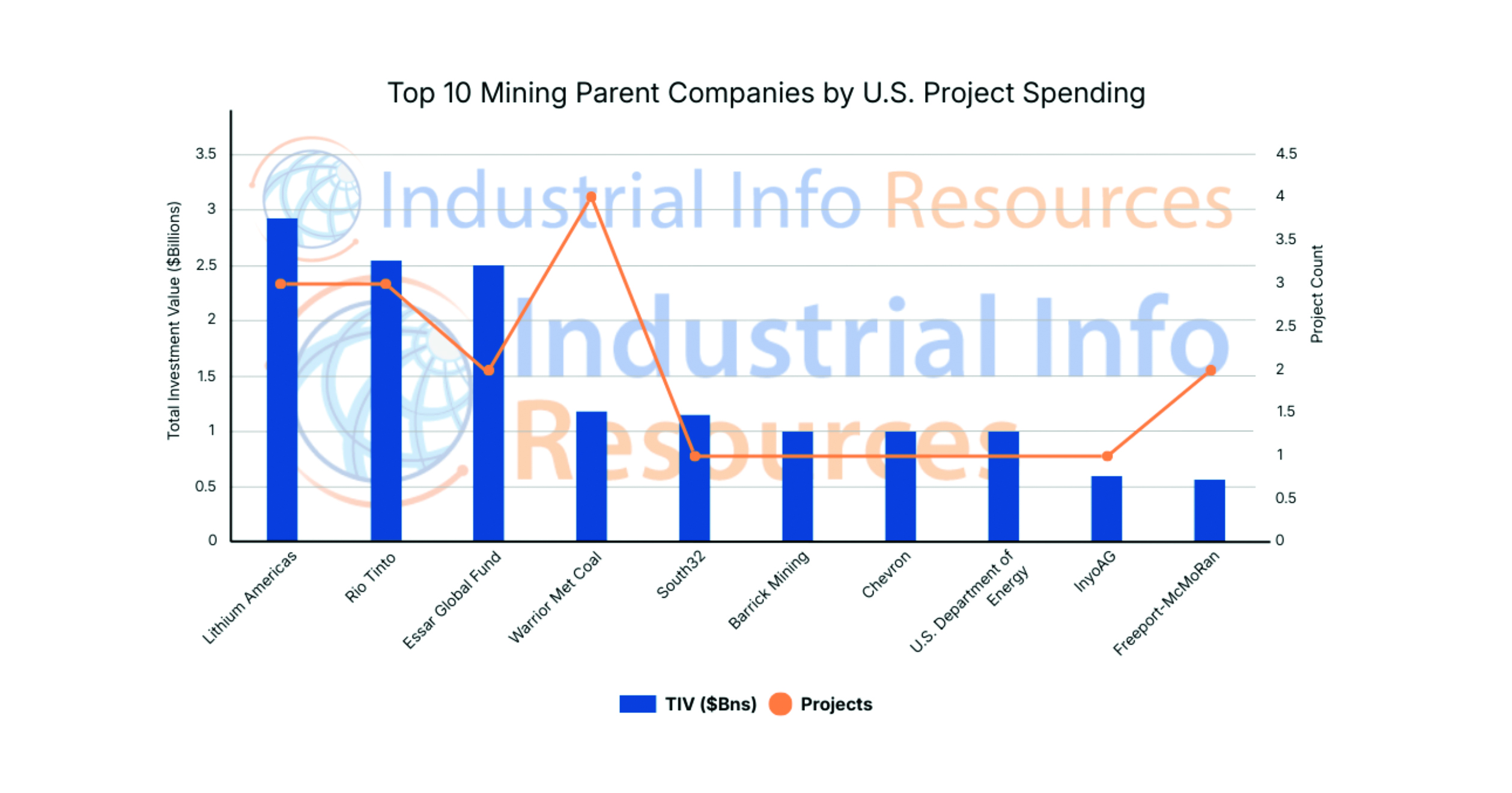
And in Bagdad, Arizona, global mining firm Freeport-McMoRan is advancing engineering and early works for the expansion of its copper and molybdenum mine. The company is working on a $170 million expansion of tailings management infrastructure. An investment decision on the mine and processing operations expansion was expected in the first half of this year.
In all, Freeport-McMoRan estimated 45% of its 2026 discretionary capital expenditure (which totals $1.6 billion) would go toward early works at Bagdad.
Also in Arizona, Freeport-McMoRan expects to complete a pre-feasibility study at its Lone Star copper mine in Safford this year. A substantial resource, the company is targeting an additional 300 million to 400 million pounds per year from the mine expansion.
Critical minerals
“Critical minerals” is an umbrella term for about 60 minerals, including aluminum, copper, lead, magnesium, nickel, phosphate, silver and zinc, which are used widely in industrial applications, according to the U.S. Geological Survey. Rare earth elements comprise a critical minerals subgroup of 16 minerals with unique magnetic, luminescent and electrochemical properties, making them essential for advanced technology, renewable energy, electric vehicles, batteries and defense technologies.
China controls the overwhelming majority of mining and processing capacity for both critical minerals and rare earth elements.
The Trump administration has made efforts to build, rebuild or strengthen domestic critical minerals supply chains, which have withered in recent years as Beijing’s have expanded significantly.
The administration announced several investments in private companies making minerals and magnets. For example, according to a report in The New York Times, the government made a $277 million direct funding commitment and up to $1.3 billion in loans to USA Rare Earth, a mining and manufacturing concern, to help develop its supply chain for rare earth elements and magnets. Last summer, the Times adds, the Pentagon took a $400 million stake in MP Materials, a rare earth mining company.
MP Materials announced plans in February to build a rare-earth magnet complex in Northlake, Texas. The Las Vegas, Nevada-based producer said it plans to spend more than $1.25 billion on the 120-acre site, which includes $200 million from Denton County, the city of Northlake and the state of Texas.
This will be “the largest and most strategic U.S. rare earth magnet manufacturing asset in history,” says the company in a statement. It will contribute to the company’s total production capacity of approximately 10,000 metric tons of neodymium-iron-boron (NdFeB) rare earth magnets per year.
NdFeB is the strongest type of rare-earth permanent magnet. Used widely in electric motors, hard drives and renewable energy, it features high magnetic strength, coercivity and energy density in compact sizes.
Coal
The International Energy Agency (IEA) estimated that global use of all types of coal was up a bit in 2025. The Paris-based agency estimated that global 2025 demand for all forms of coal was about 8.845 billion tons, up from 8.805 billion tons in 2024. However, the agency said that 2025 may represent coal’s high-water mark: It projected worldwide use of all forms of coal will drop by about 0.6% per year over the 2025-2030 period, ending at 8.579 billion tons in 2030.
The Trump administration is a big booster of coal in the United States, prolonging the lives of older coal-fired power plants and promoting coal mine expansions. The IEA estimated that the U.S. increased its use of thermal coal by about 10.3%, to 396 million tons in 2025 from 369 million tons in 2024. U.S. production of all forms of coal was estimated to be about 473 million tons in 2025, up about 2.7% from 461 million tons in 2024.
In 2025, President Donald Trump issued an executive order focused on coal, lifting barriers to coal mining on federal lands and directing the Secretary of the Interior Doug Burgum to consider designating metallurgical coal as a critical mineral, among other provisions. Metallurgical coal is a grade of coal used to produce high-quality coke, which in turn is used in the production of steel.
In addition, the administration’s One Big, Beautiful Bill Act, passed in July 2025, made metallurgical coal eligible for production tax credits.
In January, various branches of the federal government paved the way for Warrior Met Coal’s planned mine-expansion projects in Alabama, opening the door to extracting an additional 53 million tons of metallurgical coal. The U.S. Bureau of Land Management and the Department of the Interior signed off on various portions of two projects, including the expansions of Warrior Met Coal’s Blue Creek No. 1 and No. 4 mines in Tuscaloosa County.
There’s Still Gold in Them Thar Hills
Projects underway at Nevada Gold Mines (NGM), a joint venture between Barrick Mining and Newmont, include an expansion of the Carlin gold mine complex. Barrick, the mine operator, intends to extend the mine’s operational life by expanding into areas that ultimately could contribute 140,000 ounces per year of gold, allowing the mine complex to continue its output of 1.6 million ounces per year beyond 2038.
In February, there were signs of potential friction between Newmont, the world’s largest gold miner, and Barrick Mining regarding the NGM joint venture.
Tensions began in December 2025, when Barrick announced it intended to consider an initial public offering for the NGM asset. Newmont, which must formally consent to it, pushed back.
The mining sector is poised for cautious growth, driven by strategic investment and the energy transition, while inflation, permitting delays, sometimes tumultuous geopolitics and policy uncertainty keep producers focused on efficiency and selective capital spending.
Brian Ford is editor-in-chief at Industrial Info Resources and has been with IIR since 2014. With global headquarters in Sugar Land, Texas, and 18 offices worldwide, IIR is a provider of global market intelligence specializing in the industrial process, heavy manufacturing and energy markets. To contact IIR, visit www.industrialinfo.com or call 713-783-5157.