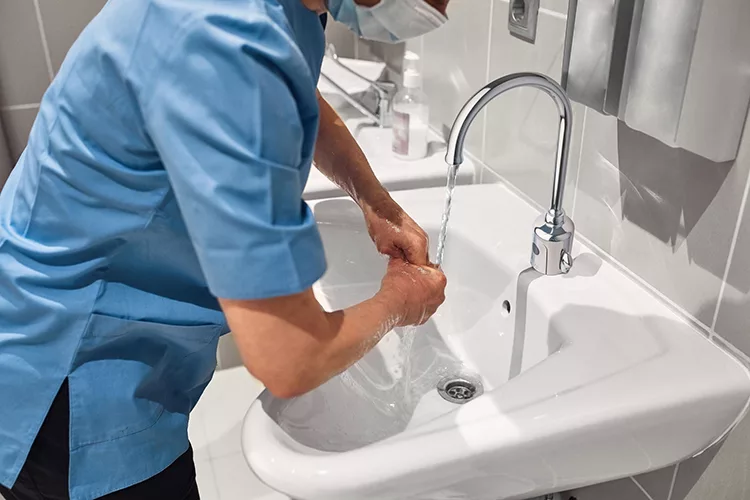
Water conservation has become a defining objective in modern building design. Across commercial and institutional projects, lower flow rates and more efficient plumbing technologies are widely promoted as key strategies for environmental sustainability. In healthcare environments, however, plumbing engineers must approach water conservation differently.
Hospitals cannot simply reduce water use without considering infection control risks. A fitting that conserves water but increases the potential for pathogen transmission ultimately undermines both patient safety and the goals of sustainable design.
As a result, sustainable plumbing design in healthcare has evolved beyond simply reducing gallons per minute (gpm). Today, organizations such as the Facility Guidelines Institute (FGI), the American Society for Health Care Engineering, and the Centers for Disease Control and Prevention (CDC) emphasize intelligent water management — design strategies that conserve water while minimizing the risk of healthcare-associated infections.
For plumbing engineers, this shift requires understanding how water behaves not only within fittings, but throughout the entire sink and plumbing system.
The hidden risk beneath healthcare sinks
Hospital sinks can become reservoirs for microbial growth, developing biofilm, a layer of microorganisms that adheres to moist surfaces within the plumbing system. These pathogens can pose serious risks to immunocompromised patients as the organisms within the biofilm are difficult to eliminate using conventional cleaning methods.
The greatest risk arises when water streams interact with contaminated drains. Research in hospital epidemiology has demonstrated that water striking the drain directly can create splash and aerosolization, dispersing microscopic droplets that may carry pathogens beyond the basin. This fundamentally changed how engineers evaluate sink and faucet design in healthcare environments.
Traditional commercial faucets are often designed so that water flows vertically into the center of the basin, directly above the drain. While this configuration works well in many commercial settings, it can increase splash risks in healthcare facilities.
Modern healthcare design guidance increasingly focuses on the geometry of the water stream.
The FGI Guidelines for Design and Construction of Hospitals require healthcare facilities to conduct a safety risk assessment during design and renovation projects (https://bit.ly/4bsmZyK). As part of this process, the interaction between the faucet, basin and drain must be evaluated as a complete system.
To minimize splash and aerosolization, faucet fittings should be positioned so the water stream does not strike the drain directly. Instead, the stream should contact the sidewall of the basin before flowing gently toward the drain.
This approach significantly reduces turbulence and limits the formation of airborne droplets.
As a result, plumbing engineers should carefully coordinate faucet height, reach, basin depth and drain placement. Many healthcare projects now specify faucet and sink combinations engineered together to reduce splash and support infection control objectives.
The low-flow paradox
While infection control concerns are influencing faucet design, sustainability initiatives continue to push for reduced water consumption.
Hospitals are among the most water-intensive buildings in the commercial sector, and many healthcare organizations pursue aggressive conservation targets as part of broader environmental initiatives. However, reducing flow rates too aggressively can create unintended consequences.
Extremely low-flow fittings may increase stream velocity and splash potential. The amount of water moving through the water system may also be reduced, creating environments for biofilm buildup and reducing remediation efforts, such as chlorination, from effectively moving throughout the facility. Low-flow fittings may also lengthen handwashing time, which can discourage compliance among healthcare staff.
For this reason, many healthcare facilities maintain flow rates between 1.0 and 1.5 gpm for clinical handwashing stations, balancing water conservation with effective rinsing performance and user acceptance.
Public restrooms, however, present a different opportunity for water savings.
Public restrooms: opportunities for greater efficiency
Unlike sinks located in patient care areas, public restroom sinks typically do not present the same infection control concerns related to drain aerosolization, allowing plumbing engineers to pursue more aggressive water conservation strategies in these spaces.
Touchless, sensor-operated faucet fittings are now widely used because they limit water flow to the duration of the handwashing event, reducing unnecessary water use. In addition, some modern systems incorporate self-powered turbine technology that generates electricity from the flow of water through the fitting.
Inside the faucet body, a small turbine converts the kinetic energy of flowing water into electrical energy, powering the electronic sensor system. Because the turbine recharges during normal operation, the fitting can operate without batteries or hardwired electrical connections. The result includes elimination of battery replacement programs, reduced electronic waste and reliable touchless operation.
These fittings are often available with flow rates as low as 0.35 to 0.5 gpm, allowing designers to significantly reduce water consumption in high-traffic restrooms.
Froedtert Hospital and the Medical College of Wisconsin, a regional healthcare network that includes multiple hospitals and more than 25 clinics, is implementing this technology.
As part of a renovation and expansion project, the facility required reliable touchless faucet fittings installed outside certain patient rooms to encourage mandatory handwashing before and after entering patient care areas.
Battery-powered faucets were initially considered but raised concerns regarding maintenance and reliability. Installing electrical wiring for each faucet was also considered impractical due to cost and installation complexity.
Instead, the project team specified touchless fittings with a self-sustaining power system. It generates electrical power from water moving through the fitting using an internal crossflow water turbine.
The installation included 53 turbine-powered fittings with 1.5 gpm laminar outlets in patient care areas and eight fittings with 0.5 gpm flow rates in public restrooms.
The turbine generates electricity during normal faucet operation, eliminating the need for batteries and avoiding extensive electrical infrastructure. The project team estimated that the hospital saved approximately $35,000 in electrical installation costs, which demonstrates that turbine-powered fittings can support both sustainability and infection-control goals in healthcare environments.
Sustainability and LEED in healthcare facilities
Many hospitals pursue LEED certification or other green building programs as part of broader sustainability initiatives to encourage water conservation strategies such as lower flow rates and efficient plumbing fittings. However, healthcare facilities must pursue these goals cautiously. Unlike commercial buildings, hospitals operate under strict infection prevention requirements and must comply with guidance from FGI, the CDC and the American Society of Heating, Refrigerating and Air-Conditioning Engineers (ASHRAE) to avoid:
• Extremely low-flow fittings, which may increase splash risk in clinical sinks from extremely low-flow fittings;
• Aerated outlets, which may introduce turbulence that increases droplet formation;
• Oversized plumbing systems combined with low demand, which may increase water age, encouraging microbial growth.
Successful healthcare projects therefore balance sustainability goals with infection prevention requirements, applying different plumbing strategies in clinical and non-clinical spaces.
Water management beyond individual fittings
For effective sustainability programs, healthcare facilities must manage the entire building water system.
The CDC notes that municipal drinking water meets strict safety standards but is not sterile. Once water enters a hospital’s plumbing system, factors such as stagnation, temperature fluctuations and low disinfectant levels can allow microorganisms to grow.
CDC guidance emphasizes intentional sink design, water management programs and minimizing exposure pathways between contaminated drains and patient care environments (https://bit.ly/3NTZBBe).
To address these risks, many healthcare organizations implement formal water management programs that monitor water quality and system performance.
These programs evaluate:
• Water age within the plumbing system;
• Potential areas of stagnation;
• Temperature control and disinfectant levels;
• Maintenance and flushing procedures.
Plumbing engineers support these programs by designing systems that minimize dead legs, maintain circulation and promote consistent water quality.
Safety as the foundation of sustainability
In healthcare plumbing design, sustainability cannot be separated from patient safety.
Water conservation strategies that ignore infection risks may create conditions that allow pathogens to spread. Conversely, plumbing systems designed to control splash, maintain appropriate flow rates and prevent stagnation often deliver long-term sustainability benefits.
Successful healthcare plumbing systems therefore align three key objectives:
Operational efficiency – reduced water and energy consumption through durable, well-engineered fittings.
Clinical safety – splash mitigation, laminar flow outlets and basin designs that reduce pathogen transmission.
Regulatory compliance – alignment with FGI guidelines, CDC water management guidance and ASHRAE standards.
By integrating these priorities, plumbing engineers can help healthcare facilities meet environmental goals while protecting the patients they serve.
In modern healthcare infrastructure, the most sustainable plumbing systems are not simply those that use less water — they are those that manage water safely and intelligently.
Designing Sustainable Healthcare Plumbing: Key Engineering Considerations
1. Treat the sink as a system. Faucet fittings, basin geometry and drain placement must be evaluated together to minimize splash and aerosolization risks.
2. Maintain adequate flow in clinical areas. Clinical handwashing stations typically perform best between 1.0 and 1.5 gpm, balancing water conservation with effective rinsing and infection control.
3. Use laminar flow outlets in patient care environments. Laminar flow reduces turbulence and airborne droplet formation compared to aerated streams.
4. Apply aggressive conservation strategies in public restrooms. Sensor-operated fittings with 0.35–0.5 gpm flow rates and water-turbine powered electronics can significantly reduce water and energy use in non-clinical spaces.
5. Support facility water management programs. CDC guidance—including the February 2026 update on reducing water risks in healthcare facilities (https://bit.ly/4bQvvHR) — emphasizes plumbing system design that minimizes stagnation, splash exposure, and microbial growth.
Greg Hunt is the commercial product manager for Chicago Faucets. In addition to product management, Hunt’s role includes strategic product direction and tactical execution to the sales, engineering and manufacturing teams. He is a member of ASHE and ASPE and has his ASSE Legionella Water Safety & Management Certification.