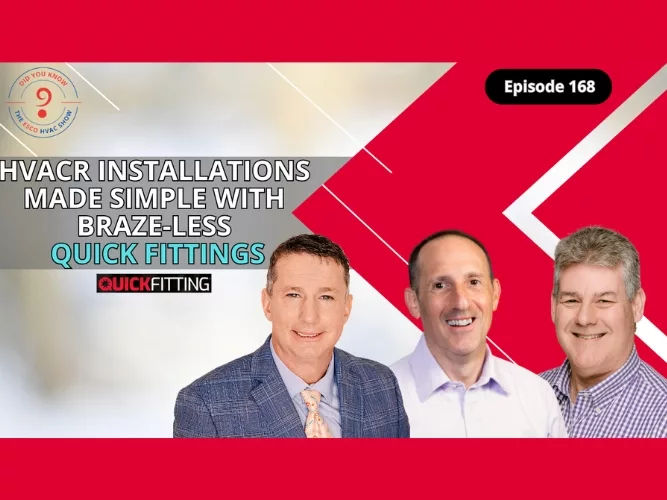
As the HVACR industry transitions to A2L mildly flammable refrigerants, QuickFitting demonstrated its push-to-connect fitting technology during ESCO Institute's weekly technical training webcast in February. The live demonstration showcased flameless installation methods that address safety concerns and installation challenges associated with next-generation refrigerants.
The program reached approximately 1,400 secondary and post-secondary HVAC training programs nationwide, with a live audience of educators, technicians, and students. ESCO Institute, which provides accreditation for HVAC programs across the country, produces weekly technical training shows designed to introduce emerging technologies and proper installation techniques to the next generation of technicians.
The demonstration addressed a critical industry need as building codes evolve to restrict open-flame work in certain applications. Chicago building officials recently considered requiring mechanical connections for all commercial A2L installations, reflecting growing safety concerns around brazing and soldering with flammable refrigerants. QuickFitting's push-to-connect fittings eliminate the need for torches, reducing fire risk while ensuring consistent, repeatable connections regardless of technician experience level.
"Many educators have never worked with mechanical fittings themselves, even though this technology is becoming essential as we transition to A2L and A3 refrigerants," said Clifton Beck of ESCO Institute. "By bringing in manufacturers to demonstrate proper techniques, we can ensure the next generation of technicians understands how to use these products correctly."
The webcast included hands-on installation demonstration, and a discussion of applications in commercial refrigeration. QuickFitting's fittings are rated to 870 PSI and certified for use with A2L refrigerants, working with both copper and aluminum linesets in sizes ranging from 1/4" to 3/4".
Adam Horwitz of QuickFitting emphasized the safety and consistency advantages during the demonstration: "With brazing and soldering, you won't have 100% the same connection each time. With a product like this, regardless of the operator, regardless of the technician, regardless of the application, you're going to get the same mechanical connection every time. That's critical, especially when working with flammable refrigerants."
The technology offers particular advantages for commercial applications where downtime must be minimized. National retailers have adopted the fittings for refrigeration repairs, where the ability to complete installations quickly without waiting for brazing operations keeps critical cooling systems operational.
Beyond safety benefits, the demonstration highlighted the repositionable nature of the fittings, which allows technicians to adjust installations without cutting tubing or making permanent connections.
Listen to the podcast here.