Ask any facility manager or plumber, and they’ll tell you that identifying and fixing crossflow issues is one of the challenges that costs them significant time and effort on the job. Crossflow causes unpredictable or inconsistent temperatures when hot and cold water mix inside a valve in an unintended fashion, requiring prompt action to address occupant complaints. If the source is not identified and repaired quickly, crossflow issues can lead to more time spent on diagnostics, repeat service calls and unpredictable workflows.
However, the negative impacts of crossflow go beyond comfort as unreliable temperatures can force closures that interrupt day-to-day operations, especially in offices, schools, healthcare facilities and other commercial buildings. And in a time of rising utility costs, another major negative impact of crossflow for facility operators is the resulting increase in energy use associated with creating hot water that is ultimately wasted. Crossflow also presents a safety issue due to increased risks of scalding, and the stakes are high when facilities house vulnerable populations like children or the elderly.
Finally, crossflow isn’t always visible at the source and rarely produces clear, consistent symptoms. As a result, it often goes unreported and undiagnosed until the problem spreads across multiple restrooms—or even entire floors.
That’s why speed matters. Contractors and facility maintenance teams must locate, diagnose and resolve issues before they compound. The longer it takes to pinpoint the source, the longer the problem persists—and the more confidence in the system erodes.
How it’s always been done
Troubleshooting crossflow isn’t rocket science; the steps are clear but are often time-consuming. The repetitive manual process of isolating lines, moving from room to room, and testing temperature changes at each fixture individually until a source is found, can be exponentially multiplied in larger facilities with dozens of point-of-use mixing valves.
With tight schedules and limited resources, sometimes facilities resort to a more costly solution of simply replacing all mixing valves in an impacted washroom. Even when contractors isolate the faulty valve, the failure usually traces back to mineral buildup, clogged strainers or worn internal components. Historically, fixing those issues meant removing and replacing the entire valve.
Without a repair option, contractors must have the correct replacement valve on hand, adding time to the job and often creating unnecessary material waste.
Visual diagnostic technology
An innovative new approach to mixing valve design is focused on addressing the two most common and impactful challenges associated with crossflow: how difficult it is to identify quickly, and the fact that a full replacement is often the only solution.
By offering simple to “read” visual diagnostic indicators, understanding if crossflow conditions are occurring in a specific valve can happen at a glance. This instant feedback eliminates the guesswork and can help streamline service calls. With an increase of young, less experienced technicians in the field today, having a clear way to confidently identify crossflow issues without needing the expertise of more tenured technicians, contractors can free up those high-value assets for more challenging service calls.
Building in repairability
With a mind toward efficiency and sustainability, more manufacturers across the industry are focusing their design choices to support the serviceability of their fixtures.
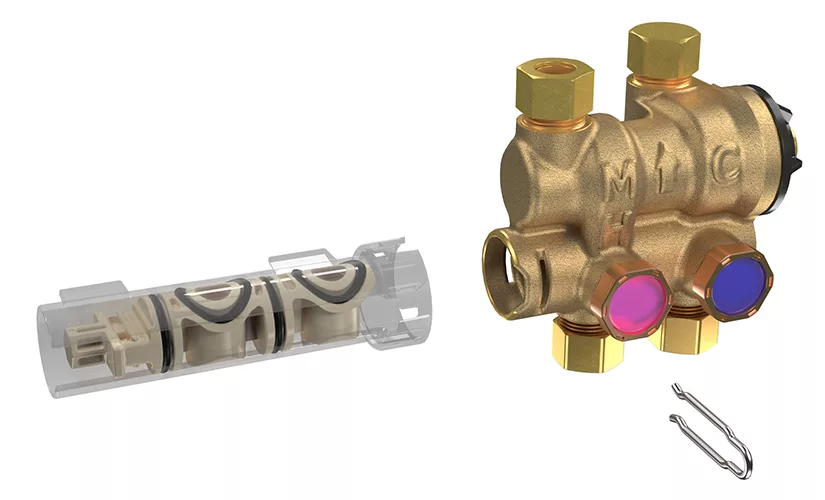
For instance, a new mixing valve features a replaceable filter cartridge that can address issues of mineral buildup or clogged screens with a simple in-line swap-out. For contractors, the option to service valves in place without disturbing surrounding plumbing is a meaningful improvement, enabling them to shift from the model of full replacement and ultimately reduce the labor time and the amount of materials they need to bring with them to solve issues. Being able to easily identify and repair mixing valves onsite also helps contractors manage their time and personnel more effectively and maintain system reliability with fewer callbacks.
With these two innovations, contractors can now enter a commercial restroom, quickly identify the mixing valve that is experiencing the crossflow issue using the visual diagnostic indicator on the valve, and either repair it quickly by inserting a new cartridge or determine, thanks to the visual indicator, that a full valve replacement is needed.
Watts recently introduced these two groundbreaking innovations in its new point-of-use mixing valve, the LFUSG-CS. Incorporating two large analog visual indicators and a replaceable internal cartridge, the LFUSG-US enables contractors to easily diagnose, service or replace the cause of a crossflow issue, reducing guesswork and the time needed to restore proper hot water delivery.
Cincinnati Public Schools
With more than 3,000 faucets across 66 buildings to maintain, the Cincinnati Public Schools maintenance team spent a lot of time tracking down and isolating problematic valves, as Ohio plumbing code requires point-of-use mixing valves under each sink to prevent scalding. In an attempt to address this cost- and manpower-intensive issue as part of its preventative maintenance program, the maintenance department decided to install the new Watts LFUSG-CS mixing valves as part of a pilot program.
To date, the reduction in time required to identify and repair crossflow issues has helped make valve maintenance faster and more dependable, enabling the facilities team to focus its time, resources and budgets on bigger, more complex challenges.
Practical innovation
As maintenance personnel and contractors face growing workloads and ongoing labor pressures, innovative new technologies can be real game changers when they effectively help address real-world challenges. Visual diagnostic indicators and in-line repairability will change how engineers and architects design systems and how contractors will approach mixing valve challenges.
Delivering safer, more energy-efficient hot water without adding complexity for technicians or end users marks a notable achievement. As some customers remain hesitant to adopt digital and connected plumbing fixtures, products like the LFUSG-CS show how thoughtful mechanical design can strengthen system reliability and improve service efficiency.
Shashwat Nath is a senior product manager at Watts Water Technologies, where he oversees the mixing, hydronics, relief valve, and HVAC product categories. Over his 18-year career spanning the HVAC, IOT, refrigeration, lighting, and plumbing industries, Nath has blended technical expertise with a strategic, customer-focused approach to product development and innovation.