Decarbonization of commercial buildings is not optional anymore – it’s a business-critical strategy. According to the U.S. Department of Energy, buildings consume 75% of the nation’s electricity and 40% of total energy (https://www.energy.gov/eere/buildings/data-and-analysis-buildings-sector-innovation).
As sustainability mandates and electrification goals accelerate, plumbing, hydronic, and mechanical professionals are pivoting toward low-emission HVAC technologies. Leading this shift are Variable Refrigerant Flow (VRF) and Hybrid VRF systems, which deliver high efficiency, reduced carbon impact, and flexible performance across diverse building types.
Weber State University leads by example
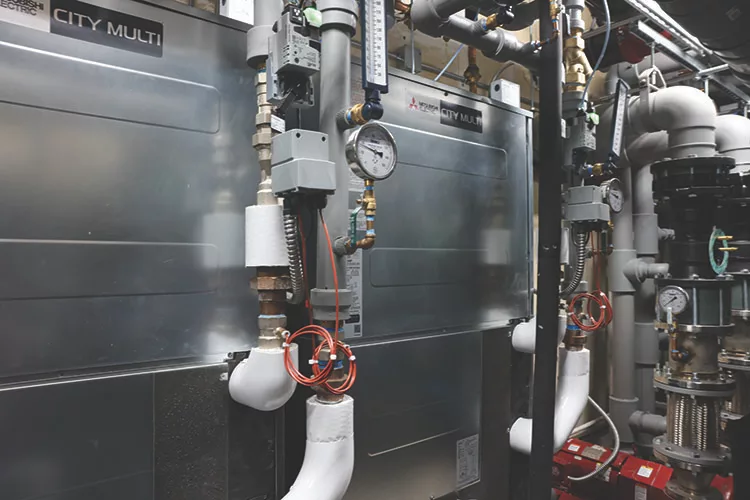
In pursuit of full campus decarbonization by 2040, Weber State University selected Mitsubishi Electric’s Hybrid VRF system to support its energy-efficient HVAC upgrades. Hybrid VRF combines the efficiency of water-source heat pumps with the comfort and control of hydronic distribution, using water instead of refrigerant to transfer heat between building zones, which makes it a smart solution for campuses focused on reducing carbon emissions.
Hybrid VRF also enhances comfort and efficiency through zoning that lets each room’s thermostat control its own temperature. Historically, campus buildings depended on chilled water and central steam plants, systems far less efficient and sustainable than today’s low-emission designs. For plumbing professionals, this design leverages familiar hydronic principles while expanding their role in low-emission HVAC projects.
Weber State’s long-term commitment to carbon neutrality has made Hybrid VRF its standard for campus HVAC upgrades. Several projects are already in design, with plans to convert the entire campus to these systems. This forward-looking approach supports the university’s decarbonization objectives and positions Weber State as a model for institutions aiming to reduce emissions, lower operating costs, and modernize its infrastructure.
The role of Hybrid VRF in reducing carbon emissions
Hybrid VRF systems are advancing building decarbonization by providing fully electric heating and cooling that eliminates on-site fossil fuel use. As carbon-reduction mandates and electrification goals intensify globally, Hybrid VRF technology offers a practical, high-efficiency solution for both new construction and retrofits. Its modular design allows phased upgrades, making it ideal for modernizing older buildings without major infrastructure disruption.
A key advantage of Hybrid VRF is its water-based heat transfer within indoor zones, which reduces refrigerant use and environmental impact while maintaining precise comfort control. The system delivers high-energy efficiency, supported by strong Coefficient of Performance (COP) depending on model and conditions, and aligns with low-Global Warming Potential (GWP) refrigerant standards. Hybrid VRF’s two-pipe design connects air- or water-source outdoor units to a Hybrid Branch Controller (HBC), allowing simultaneous heating and cooling alongside steady performance, even in extreme temperatures.
Designed for scalability and sustainability, Hybrid VRF works across diverse building types and sizes. Its efficient, flexible design and reduced refrigerant charge make it a future-ready HVAC solution that supports electrification, lowers carbon emissions, and enhances occupant comfort – all critical factors in today’s push toward decarbonized buildings.
Meeting evolving energy and emissions regulations
Hybrid VRF systems directly support the electrification goals of many local and state governments by providing a fully electric alternative to conventional gas-fired heating and cooling systems. Because Hybrid VRF uses electricity rather than fossil fuels for operation, it aligns with policies aimed at reducing carbon emissions and transitioning buildings toward clean energy sources. Its ability to operate efficiently in various climates also makes it a practical solution for meeting regional performance standards and energy codes tied to decarbonization.
For institutions facing greenhouse gas (GHG) reduction mandates, Hybrid VRF offers a path to compliance without the need for costly, full-system replacements. The technology’s modular and water-based design allows it to integrate seamlessly with existing building infrastructure, reusing much of the current piping and distribution systems. This enables phased retrofits that reduce emissions and energy use while maintaining occupant comfort and minimizing disruption, helping organizations achieve sustainability targets faster and more affordably.
Mitsubishi Electric Trane HVAC US (METUS) (www.mitsubishicomfort.com) provides extensive training and technical support to help contractors successfully design, install, and commission Hybrid VRF systems, especially when integrating them with existing building infrastructure.
Contractors can access hands-on instruction through Mitsubishi Electric’s training centers and online learning platforms, which cover system design, installation best practices, commissioning, and service for its all-climate heat pump solutions. This comprehensive support helps contractors install Hybrid VRF systems in existing buildings and meet performance, safety, and sustainability goals.
The path forward for HVAC professionals
Weber State University’s experience demonstrates how institutions can take meaningful steps toward decarbonization today rather than waiting for future mandates. By adopting Hybrid VRF technology, universities and other large facilities can pursue a phased approach to electrification, modernizing campus infrastructure without the disruption or expense of full system replacements. This model proves that sustainability and practicality can align, cutting emissions while improving comfort and efficiency.
Hybrid VRF systems open new business opportunities tied to performance contracting, sustainability retrofits, and compliance with evolving building codes. As decarbonization efforts accelerate, companies that gain expertise in electrified HVAC solutions will be positioned ahead of regulations and in high demand for public and private projects alike.
Matt Bynum is the senior manager of product marketing, Mitsubishi Electric Trane HVAC US (METUS).