Direct digital control (DDC) is critical for managing today’s increasingly complex HVAC systems. Yet in practice, implementation often falls short in both performance and cost-effectiveness. The financial challenges are especially pronounced in buildings under 30,000 square feet, which make up a large portion of the light commercial and high-end residential market.
The implementation process itself is a weak link. In most projects, the MEP engineer develops the sequence of operations and then passes it to a controls contractor. The contractor — often with limited knowledge of HVAC system dynamics — translates the engineer’s intent into BACnet or another network protocol. Finally, responsibility for reliable day-to-day operation falls to the facilities maintenance team, who typically have little or no involvement or detailed knowledge of the design or implementation.
This fragmented process creates a disconnect between design intent, system programming and long-term operation, increasing the risk of inefficiencies and missed optimization opportunities.
A common problem is the overdesign of control points, under the assumption that more is better. In reality, efficiency and cost-effectiveness improve when control points are minimized — focusing only on functions not already embedded in factory-supplied controllers integral to the equipment. This avoids redundancy, reduces installation complexity and ensures better alignment with actual building needs.
Prioritizing commercial off-the-shelf (COTS) hardware and software rather than investing in custom, proprietary subsystems is a best practice. COTS solutions typically offer greater interoperability, maintainability and long-term flexibility at lower lifecycle cost. We take this lesson from the IT industry, which has crossed this chasm ahead of HVAC applications — historically trailing IT developments by roughly a decade.
Optimizing shared data
To frame DDC in HVAC applications, it is helpful to consider its development within the broader context of IT evolution over the past four decades. My perspective comes from more than 20 years of direct experience in this field, where I led teams at major networking and database companies and oversaw the development of mission-critical enterprise applications.
Between 1970 and 1990, the IT landscape centered on hardware platforms, with IBM dominating as the primary provider of enterprise computing infrastructure. From 1990 to 2010, the emphasis shifted toward software, beginning with relational databases and fourth-generation programming languages such as SQL. These technologies allowed multiplatform interoperability — provided that a single vendor controlled the enterprise solution.
This paradigm shifted when Sybase licensed an open-architecture application programming interface to Microsoft, enabling true cross-platform interoperability between hardware and software environments. That advance ultimately became the foundation of the World Wide Web, where any client could reliably communicate with any server. In the same way, within HVAC, basic interoperability alone is no longer a competitive advantage — it is simply an expectation.
The real value lies in how systems use and optimize shared data, not merely in their ability to exchange it. A useful parallel is the rise of generative artificial intelligence (AI), which goes beyond traditional search engines by creating insights and solutions rather than simply retrieving information. Similarly, BACnet provides interoperability between HVAC systems, but the true opportunity lies in applying intelligence on top of that connectivity to deliver optimization, adaptability and long-term performance gains.
While BACnet has been invaluable as a communication standard enabling HVAC devices to exchange data reliably, its role is largely limited to interoperability, requiring engineers and contractors to define fixed sequences of operation. This rules-based approach ensures connectivity but often constrains adaptability and system optimization, particularly in smaller or cost-sensitive projects. BACnet is a tool, not a solution.
Generative AI, by contrast, represents an intelligence layer that can sit above these systems, learning from operational data to predict demand, optimize setpoints and propose dynamic strategies that go far beyond static programming.
Yet it is unlikely that the full potential of generative AI will be realized in HVAC controls in the near term. In the long term, however, BACnet will continue to provide interoperability for data exchange, while generative AI will transform that data into actionable insights and adaptive control. Together, these capabilities will enable HVAC systems to achieve higher efficiency, lower lifecycle cost and continuous performance improvement.
This trend will move HVAC industry controls from connectivity to intelligence.
Using open systems architecture
For geothermal and hydronic systems in light commercial and residential buildings, the optimal near-term strategy is to use a proven systems architecture and standard COTS hardware with on-board controls. DDC should be applied only where on-board controls fall short or when enterprise interoperability is required.
The open systems architecture example that follows is derived from a series of patents related to hydronic building systems control (HBSC), developed upon the foundation of the IT advancements discussed previously.
1. Adopt a proven systems architecture
The HBSC open-systems architecture has been validated in dozens of net-zero energy buildings, where heating, cooling and domestic hot water loads are fully offset by on-site renewable generation. The architecture is based on primary hydronic heating and cooling, with forced air as a supplemental system. HBSC employs heat pumps with hydronic distribution as the core technology:
• Geothermal heat pumps are optimal in climates with a dominant heating or cooling demand.
• Air-source heat pumps producing hot or chilled water are a cost-effective alternative for temperate climates.
• Reversing chillers offer roughly twice the efficiency of standard heat pumps by simultaneously chilling water for the cold water supply and heating the hot water supply, without requiring an air or ground heat exchanger.
The architecture incorporates source process heat exchangers such as cooling towers, solar thermal arrays, absorption chillers, potable water and wastewater heat exchangers, and thermal sources such as data centers’ rejected heat to improve the overall system’s performance. The hydronic distribution system supports radiant floor heating and cooling, chilled beams and fan coil units. It also meets the auxiliary heating and cooling requirements of secondary equipment, such as dedicated outdoor air system units.
For a detailed technical description and benefits of the HBSC architecture, see U.S. Patent 12,188,676 and related patents in the HBSC portfolio (https://bit.ly/4mvRAhg).
2. Use COTS hardware with on-board controllers
The premise of buy versus build is well understood in MEP engineering: fabricating a heat pump from scratch is impractical compared to purchasing commercially available equipment. Attempting a proprietary solution would be suboptimal, carrying risks of poor design, high labor and installation costs, and extended project schedules.
However, this rationale is not consistently applied to supporting subsystems. For components such as pump stations and hydronic distribution panels, engineers frequently default to custom designs, assuming:
• Mechanical contractors will implement the design correctly;
• Costs will remain within acceptable limits;
• Project schedules can accommodate the contractor’s timeline.
This contrast reveals a gap: the buy versus build principle is consistently applied to heat pumps but often overlooked for their supporting subsystems. In these cases, COTS solutions provide clear advantages, enhancing interoperability, maintainability and long-term adaptability as evidenced by the following examples:
• Leveraging integrated heat pump controls to facilitate and optimize advanced operating features. The COTS integrated heat pump controls allow engineers to use advanced features such as internal load staging, demand response, adaptive setpoint adjustment, automatic humidity control and fault detection/diagnostics, thereby improving system efficiency, reliability and lifecycle performance. BACnet modules for controlling legacy equipment typically do not support these features.
• Leveraging integrated ECM circulator controls enables automated flow management across ground heat exchanger (GHEX) applications, hydronic distribution and source-side heat pump circuits. These built-in controls dynamically adjust pump speed based on differential temperature; optimizing GHEX flow rates; differential pressure, including modulating flow as heat pumps stage on or off; and combined control strategies such as injection pump modulation to precisely regulate radiant hydronic fluid temperature.
In addition, ECM circulator controls provide fault reporting, historical runtime tracking and energy-use monitoring. Since these pumps only operate when the heat pumps are operating, the heat pumps and not the DDC system should call for pumping, which is then modulated with on-board functions.
This level of automation improves system efficiency, stability and responsiveness while minimizing manual balancing and commissioning requirements. While similar features can be implemented via BACnet integration, the additional cost is typically not justified when compared to COTS controls.
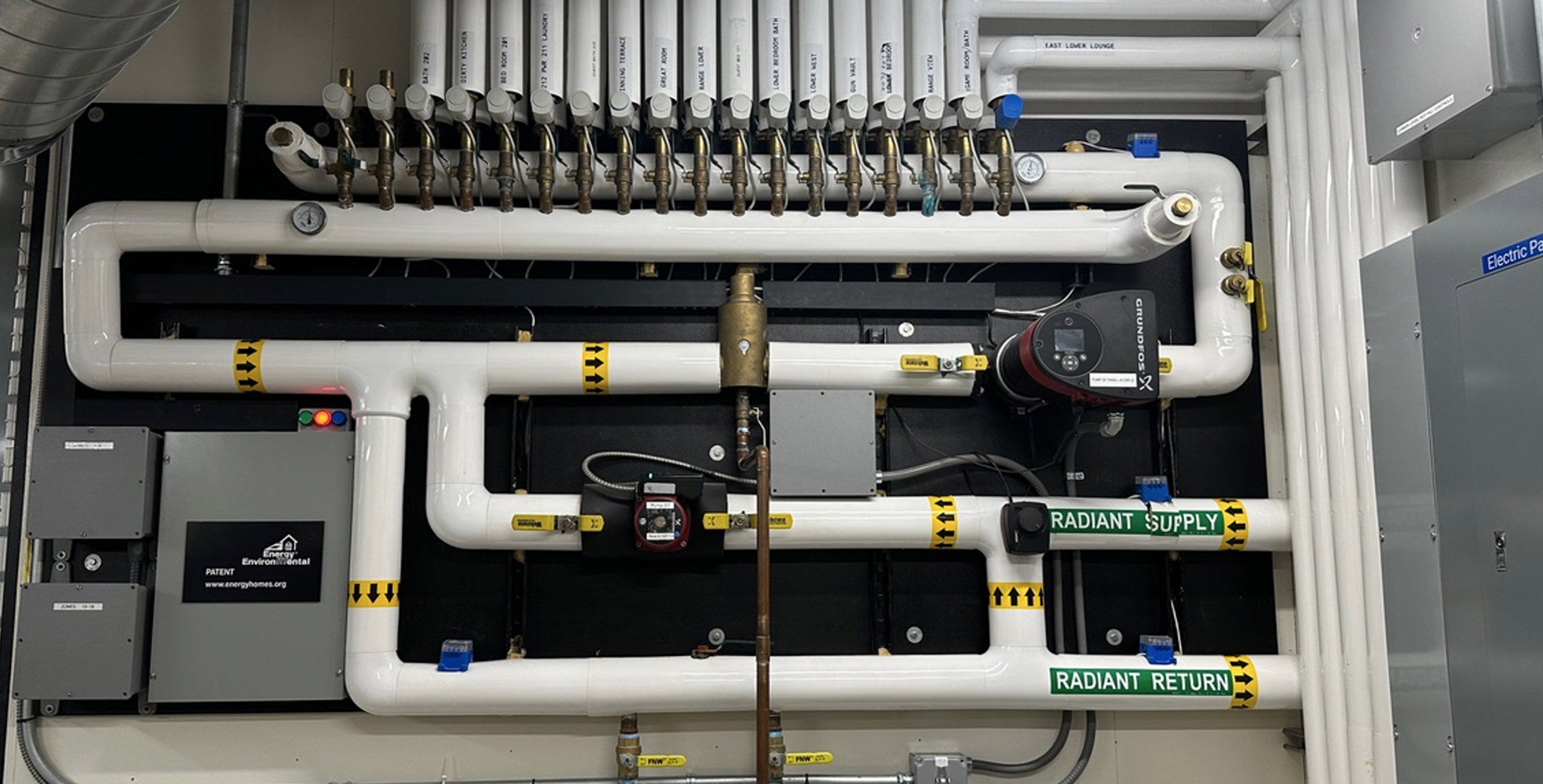
• Hydronic distribution panels are factory-built assemblies that accept hot or chilled water and provide integrated distribution piping, pumping and controls. Each modular panel can support up to 24 zones and serve spaces up to 10,000 square feet, functioning either as a standalone system for a large residence or as part of a modular configuration for a 30,000-square-foot building. The proven design simplifies maintenance and optimizes pipe and pump sizing to meet the required flow rates at maximum energy efficiency.
On-board 24VAC controls enable simplified commissioning yet provide accessibility through a DDC system — without additional programming — to prioritize radiant cooling calls over heating calls required for two-pipe distribution systems.
Current implementations operate in a two-pipe configuration, providing either heating or cooling. Four-pipe configurations, however, are forthcoming. This design enables simultaneous heating and cooling at the zone level, while still requiring only two distribution pipes per zone.
Binary hot or chilled water flow will occur at the zone valves on the panel, which reduces installation costs and increases operational flexibility. Within the next year, zone valves will also support mixing of supply and return fluids within a given zone, enabling precise, independent temperature control for each zone.
Radiant distribution panels streamline the installation of hydronic heating and cooling systems, reducing installation, operating and maintenance costs. Contractors only need to install the distribution tubing and wiring for each zone, connect them to the panel, and then pipe the panel into the hot and cold water supply. They are scalable at 10,000-square-foot increments, and individual ports/controllers can be combined to support larger zones within that modular space.
3. Apply DDC only where needed
By applying the methods outlined in this article, the number of DDC points required for system control can be reduced by more than 80%. For example, simply calling functions for stage 1 cooling with a humidity set point using a variable-speed compressor water-air heat pump is achieved with two control points, versus 50-plus control points internally used by the manufacturer for optimizing fan speed, compressor speed, refrigerant pressures, air flow and source water flow, based on inputs from dozens of internal sensors and allowing the heat pump to control source side pumping.
This reduction improves reliability, lowers cost and ensures ongoing factory support for installed subsystems. Much like the evolution from structured queries in IT, detailed BACnet logic is unnecessary. Instead, control is executed through functional calls that are simple to implement, offering a level of abstraction comparable to generative AI.
Importantly, leveraging on-board controls does not limit data availability for system performance reporting. When equipped with a BACnet interface card, these subsystems can integrate seamlessly with enterprise-level control and reporting platforms — without the risks and costs of proprietary implementations.
Today, the frontier is moving from analyzing existing data to generative artificial intelligence, which leverages these datasets to deliver real-time solutions with minimal programming overhead. HBSC may be the next step. How we capitalize on these innovations requires us to learn from history, lest we repeat old mistakes.