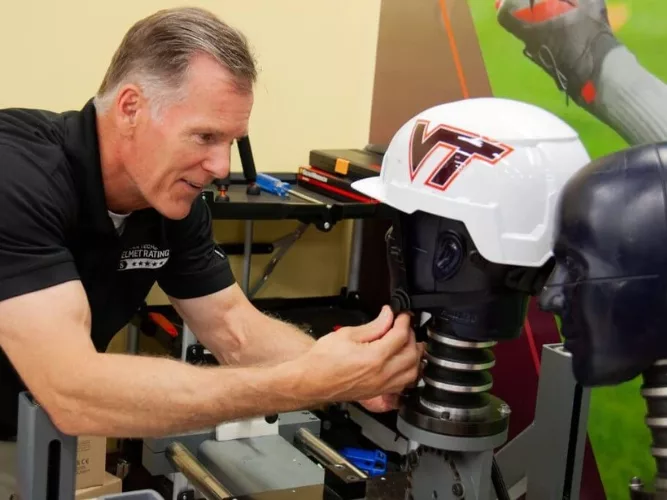
In a major advancement for workplace safety, the Virginia Tech Helmet Lab has unveiled its first-ever ratings system for construction helmets after a two- year research study. This initiative, funded by the John R. Gentille Foundation, ELECTRI International, the American Society of Concrete Contractors, and The Association of Union Constructors, evaluates helmets based on their ability to reduce concussion and skull fracture risk during severe but survivable falls on construction sites.
Science-Driven Safety: The STAR Testing System
The ratings are based on Virginia Tech’s STAR (Summation of Tests for the Analysis of Risk) protocol, which assesses helmets through a series of oblique drop tests. These tests simulate real-world fall scenarios using a medium NOCSAE headform dropped onto a 25° steel anvil coated with sandpaper at two speeds—5.5 m/s and 6.8 m/s. Each helmet undergoes 12 impact tests across three locations, with results weighted according to the frequency of fall types observed in job-site accident reports.
The STAR score predicts the number of head injuries a worker might sustain if exposed to 100 such impacts. A lower score indicates better performance, and helmets earning 4 or 5 stars are recommended for workers exposed to fall hazards.
Type II Helmets Outperform Traditional Hard Hats
The study highlights a critical distinction between traditional Type I hard hats and modern Type II helmets. Type II helmets, which include interior energy-absorbing materials and chin straps, significantly outperform their counterparts:
- Concussion risk reduction: Up to 48%
- Skull fracture risk reduction: Up to 77%
These findings underscore the life-saving potential of upgrading to Type II helmets, especially in an industry where falls account for 60% of traumatic brain injury fatalities and nearly half of all fatal slips and trips.
A Call to Action for the Construction Industry
The Helmet Lab’s research is a response to real-world tragedies, such as the 2018 Miami pedestrian bridge collapse, which exposed the limitations of traditional hard hats. Advocates like Scott Greenhaus, co-founder of the Hats to Helmets initiative, have long pushed for change, and Virginia Tech’s data-driven approach provides the evidence needed to support that shift.
Looking Ahead
New helmets will be added to the ratings as they become available, ensuring the system remains current and comprehensive. The lab’s work is independent of manufacturer influence, offering consumers and safety professionals an objective tool to make informed decisions.
For and overview visit VT’s Rating Page and for technical details, the full STAR Protocol for Construction Helmets is available through Virginia Tech’s VTechWorks repository.