In today’s world, many basic amenities help set a minimum expectation for our day-to-day lives. We wake up and grab our fully charged phones, take a shower in clean water and start a pot of hot coffee. Some of us then have our breakfast with a handful of vitamins and medicines to keep us running smoothly throughout the day.
We expect all these things to be available to us, and the mechanisms that deliver them to work flawlessly without inspection or thought. What if that medicine had a high chance of being contaminated and causing us to get sick? What if our phones were prone to shorting out? What if a trip to the doctor were a roll of the dice? Would we get better or worse?
Why don’t we need to worry about these things? There are a variety of variables; however, one of the most important reasons, the topic of the day, is cleanrooms.
History
Cleanrooms have not been around for as long as you would have guessed. In the mid- to late-1800s, chemist and microbiologist Louis Pasteur and physician Robert Koch developed what is known as germ theory. They discovered that specific microorganisms, such as bacteria, viruses and fungi, are the primary cause of infectious diseases.
Soon after this discovery, a surgeon, Joseph Lister, began a movement to control germs in surgical applications. He is mainly credited with hand-washing and cleaning procedures to sterilize the tools used in surgery. These were major breakthroughs in the medical field.
The surgical environment began to slowly improve with these recommendations, and germ contamination steadily decreased. In the 1960s, Willis Whitfield is credited with inventing the first cleanroom by using laminar flow air devices to consistently reduce particle counts while working for Sandia National Laboratories, gaining him the nickname “Mr. Clean.” This marked the beginning of the modern cleanroom era.
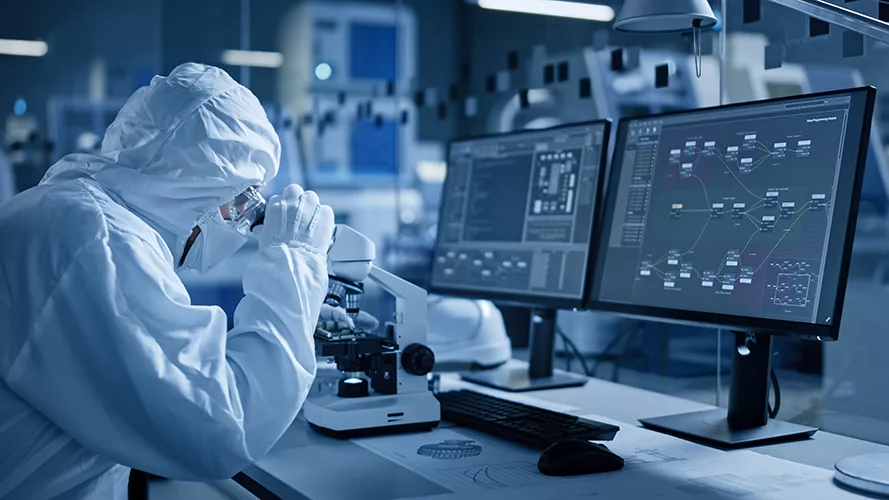
Once other industries saw what this technology could accomplish for their applications, the implementation of these spaces exploded. Many industries have begun to use this technology to improve the quality of their products or processes. Some of the major industries using cleanrooms include pharmaceutical/biotech, microelectronics/semiconductors, healthcare, aerospace, life sciences and higher education. Each industry employs a similar approach that has been adapted to its unique needs.
However, all cleanrooms work to achieve similar outcomes. Let’s talk through the basics of how these cleanrooms work.
Decreasing contaminated particles
The primary goal of these spaces is to reduce the number of contaminating particles within the room. The main weapon in this fight is the filter. Filters work by forcing the air to move through a web of media that stops particles in three main ways. First, large particles cannot pass through the small openings formed in the webbing of the media.
Second, for smaller particles that can pass through the media, the route requires many turns and changes in direction; the particles can’t keep up with the air and crash into the media, getting captured as they work their way through. Think of a classic car chase where the main character (the air) can weave through tight spaces, but those chasing (the particles) are not as skilled and crash into the obstacles.
Third, really small particles do what is called Brownian motion or diffusion, which basically means they fly in a random zigzag pattern, giving them a higher chance of crashing into the filter media.
The American Society of Heating, Refrigerating and Air-Conditioning Engineers has Standard 52.2, Method of Testing General Ventilation Air-Cleaning Devices for Removal Efficiency by Particle Size, which outlines the specific testing requirements and outcomes for comparing the efficiency of filters. Three size ranges are used in the testing: 0.3 to 1 microns, 1 to 3 microns, and 3 to 10 microns. They use minimum efficiency reporting value ratings to make it easier to classify the different filter ranges. ASHRAE standard 52.2 rates filters from MERV 1 up to MERV 16.
Most modern cleanrooms use filters that exceed this MERV scale, requiring us to opt for high-efficiency filters, which are called either high-efficiency particulate air or ultra-low particulate air filters. HEPA filters are designed to capture 99.97% of particles of 0.3 microns. This is considered the hardest particle size to capture, named the most penetrating particle size. We rate these filters using the particle size they are the least effective at catching, meaning larger and smaller particles are captured at a higher efficiency.
Because ASHRAE does not have standard testing procedures for these highly efficient filters, we refer to a Department of Energy guide for HEPA filters, which rates them from H11 to H14, with H14 the most efficient at capturing 0.12-micron particles at an efficiency of 99.995%. The DOE has an even higher efficiency range from U15 to U16, which we refer to as ULPA filters, where the efficiency reaches 99.9995%.
Now that we understand a little about filters, how do we use them?
Filter science
The power of the filter only works if we pass air through it. To ensure our space maintains the low particle counts we want, we need to recirculate the air through the filter more often to capture any particles generated in the space. To determine how much air we should recirculate, we need to understand how many particles are acceptable for each application; this helps us determine the required filtration and airflow.
A standard exists outlining these acceptable particle ranges, known as ISO Standard 14644-1, Classification of air cleanliness by particle concentration. This standard specifies the classification of air cleanliness in terms of airborne particle concentration across a range of particle sizes from 0.1 micron to 5 microns.
Note that while the ISO standard is great for specifying the allowable ranges for particle counts, it is not a prescriptive guide on how to achieve them. The reason is that each cleanroom is unique and requires a tailored approach to achieve the space’s goals.
Airflow
Now we understand that filters are our best tool for capturing particles and we know how many particles we plan on allowing in our space. So, how do we ensure our cleanroom meets these setpoints? While the filter is a critical piece of the puzzle to making a cleanroom, it only works if we can get the air to constantly pass over the filter media. Our goal is to pass the room air over the filters as many times as we can to keep a consistent particle count in the space.
This is where the term air changes per hour comes into play: how many times we change out the volume of air inside a room in one hour. So, if we have a room 10 feet wide x 20 feet long x 15 feet tall, the room volume is 10x20x15 = 3,000 cubic feet. If we wanted one ACH, we would need to circulate 3,000 cubic feet per hour of airflow. If we reduced down to our standard unit for airflow, it would be 50 cubic feet per minute.
How do we determine how many air changes we need to deliver? The answer is the classic engineering answer: it depends.
Here is how I recommend approaching the question:
1. Understand the particle count goals of the space. It is all about the allowable amount in the process itself. Hopefully, the end-user knows this to start. If not, using similar applications as a guide can be effective.
2. Understand the process in the space. Is the process in the room particle-free or does it generate its own particulate that needs to be dealt with? A clean process will require fewer air changes than a dirty one.
3. Understand the cleaning protocols of the facility. What type of smock or bunny suit is required in the space? What is the frequency of cleaning the surfaces? These items can be critical in the fight against particles; the cleaner the protocols, the lower the ACH may be able to get the target classification.
4. Use industry guides as a starting point for reference. Many filter manufacturers and cleanroom vendors offer guides that can be used to get an ACH range to target for each ISO class.
5. Adjust the target ACH. Do this based on how you answered No. 2 and No. 3 above.
Designing a cleanroom
Let’s do an example together. We need to build a cleanroom for our new process. Based on our understanding of our product, this cleanroom should be classified as an ISO 4 cleanroom. Based on ISO standard 14644-1, an ISO class 4 space should allow fewer than 1,020 particles at the 0.3-micron size.
To understand the process in the space, let’s imagine that this process is very clean. Most, if not all, of the work will occur within a closed tool with little to no particle generation in the space.
Now we need to understand the cleaning protocols. Everyone entering the space will be wearing full smocks, limiting as much skin exposure as possible. This is important because often the biggest particle generator in the cleanroom is the people.
Lastly, we refer to our industry guide, which says that an ISO class 4 cleanroom should be between 300 and 540 ACH.
Knowing that our process and cleaning are unlikely to generate large particles, we may start by looking at 300 ACH as our baseline. If this is not our first cleanroom, we can refer to other sites and rooms to determine if 300 ACH is higher or lower than what we have used in previous installations with this process and adjust accordingly.
Maybe this same process is being completed at another site in a room with 350 ACH, but at every particle check, it is well above ISO class 4 levels, so we decide to target a lower ACH of 250 based on what we know.
With good experience and data, it is not uncommon to see ACH rates that differ significantly from those indicated in industry guides. If we look at our room from the example earlier, to achieve 300 ACH in our 3,000 cubic feet of space, we will need 15,000 cfm to meet that air change rate. However, to achieve 250 ACH, we would need 12,500 cfm, saving a significant amount of fan energy and project cost.
Laminar flow and fan filter units
It can be a big challenge to find space for all the components needed to recirculate this much airflow through our filters. Not only do we need fans capable of supplying the airflow, but we also need space for the filters and a path back to the fans.
Cleanrooms differ from commercial applications because we work to achieve what is called laminar flow in the space. We want any particles that appear to get captured and move in a straight path down and away from the process. The airflow should move from high to low at a low velocity to best accomplish this.
The return path also needs to be positioned so as not to cause any turbulence within the space. Most often, we use a low wall return or a raised floor with return walls along the low perimeter of the room to allow air to flow back to the fans without mixing with the cold supply air. To get the air back to the fans, we implement chases within the walls to give us maximum free area for this return air to recirculate back to the fans.
Because some cleanrooms require extremely high amounts of airflow for particle prevention, the solutions can be quite different than commercial HVAC applications. If a single air-handling unit could accommodate all the air change rates as well as all space conditioning needs, that would be a great solution. Likely though, this unit will be too large to fit in the space available. We may then look to break this unit up into multiple smaller units but, again, space can be a challenge here as well.
One of the great space-saving mechanisms for cleanrooms is the fan filter unit. This device houses a small fan with approximately 500 cfm along with a HEPA filter, all contained within a 4-foot x 2-foot package that is mounted within a ceiling grid assembly. The FFU provides laminar flow down through the room and allows us to use our ceiling space to achieve our airflow requirements. This allows us to separate the air-handling unit so we only have to worry about the room conditioning using a much smaller piece of equipment.
Sometimes, finding room for this smaller air-handling unit can still be an issue, so we move the components of the AHU to the cleanroom as well. It is not uncommon to find cooling coils in the return air plenums of a cleanroom so that space conditioning is also taken care of within the room envelope. Many variations of these components can be used, depending on the space available, application and process requirements.
Cleanrooms are controlled environments designed to minimize the number of airborne particles, primarily by recirculating the air through high-efficiency filters. This can be done in many different ways.
Beyond filtration, we also need to consider many other things such as temperature and humidity, electrostatic discharge flooring, special lighting to limit damage, dust-resistant surfaces, material and personnel movement in and out of the space, tool hook-up and removal, and room pressurization. Each of these elements offers a variety of design solutions to make every cleanroom unique.
This column only scratches the surface of cleanroom design, but I hope it gives you a foundational understanding of how a cleanroom works. So tomorrow when you wake up, take a moment to appreciate the cleanroom where the microelectronics in your phone were developed, making it possible for you to hit the snooze button on your alarm.
Brandon Hoke, PE, of TDIndustries, is a licensed professional engineer specializing in HVAC system design and project management. With a wealth of experience across various sectors, including hospitality, semiconductor, mission-critical, office and multi-purpose spaces, he has learned from industry leaders to deliver innovative and efficient HVAC solutions.