
To say that liquefied natural gas (LNG) is a big business in North America is a definite understatement. LNG is natural gas that has been cooled to a liquid state, at about -260 F, for shipping and storage, according to the U.S. Department of Energy. The volume of natural gas in its liquid state is about 600 times smaller than its volume in its gaseous state, making it possible to transport natural gas to places pipelines do not reach.
North America’s LNG project pipeline
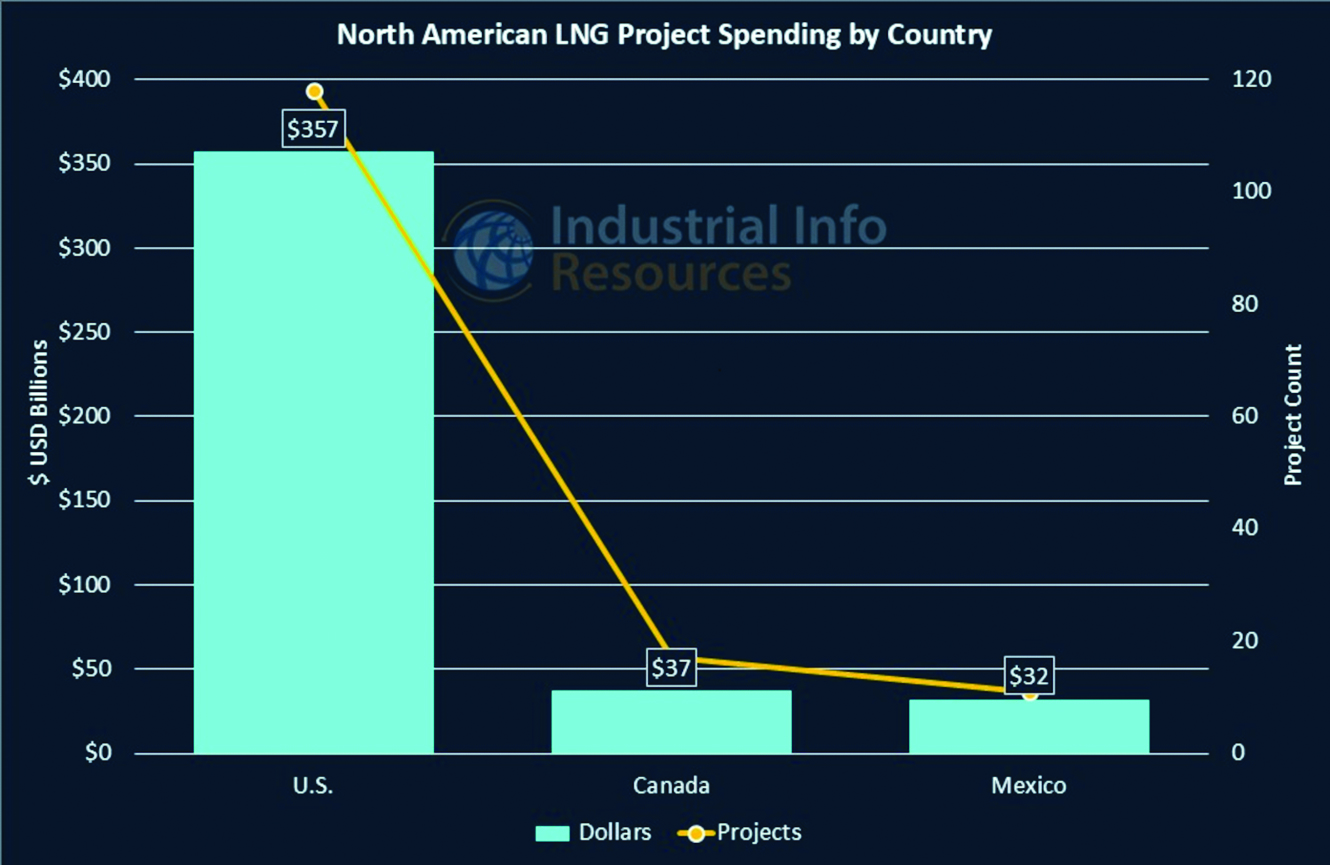
Industrial Info Resources (IIR) is tracking 146 LNG production projects in North America, valued at $426 billion, that list pipe, valves and fittings among their key equipment needs. The United States, dominated by big-ticket projects along the Gulf Coast, dwarfs Canada and Mexico in potential spending (see chart).
The United States was the world’s largest LNG exporter in 2024, shipping out the equivalent of 11.9 billion cubic feet per day (Bcf/d), according to the U.S. Energy Information Administration (EIA). The government estimates the average will reach 16 Bcf/d by next year.
However, U.S. LNG exports in 2024 remained essentially flat when compared with 2023, mainly because of several unplanned outages at existing LNG export facilities, lower natural gas consumption in Europe and very limited new LNG export capacity additions since 2022. Also, natural gas production remained relatively flat in 2024, growing by less than 0.4 Bcf/d when compared with 2023 to average 113 Bcf/d, the EIA said.
The LNG situation has changed. Former President Joe Biden tried to pause new permits for LNG terminals while his administration studied the potential for exports up and down the supply chain, but the courts suspended his order. President Donald Trump overturned it altogether in his quest for U.S. energy dominance.
In December 2024, the Plaquemines LNG Phase 1 project in Louisiana, operated by Venture Global (Arlington, Virginia), shipped its first export cargo and became the eighth U.S. LNG export facility in service.
U.S. LNG export trends
While Europe remained the primary destination for U.S. LNG exports in 2024, accounting for 53% of the total exports, the share of U.S. LNG exports to Asia increased from 26% to 33%.
In July this year, Venture Global had reached a final investment decision (FID) for the first phase of its Calcasieu Parish 2 (CP2) LNG project in Louisiana, together with an associated pipeline. Venture Global valued the project at $15.1 billion, maintaining that it represents the largest standalone project financing ever. The project attracted loans from 29 banks from the U.S., Europe and Asia.
CP2, including phases 1 and 2, would have a nameplate capacity of 20 million metric tons per year, and a peak capacity of 28 million metric tons per year under optimal conditions, according to data from Industrial Info. The project is expected to deliver LNG beginning in 2027.
Trump has pressed for even more projects. Two facilities — Delfin LNG and Golden Pass — have secured permit extensions from the Trump administration this year.
Nearly all existing U.S. LNG export capacity is on the U.S. Gulf Coast, and all new capacity being built is on the Gulf Coast in Texas and Louisiana, according to the EIA’s Annual Energy Outlook 2025.
The Energy Outlook’s reference case projects that natural gas converted to LNG for export will increase to nearly 27 Bcf/d in 2037, compared with 11.9 Bcf/d in 2024. Of this new capacity, the EIA assumes the five LNG export projects already under construction will enter service by 2028 and account for almost 60% of the projected growth. The remaining 40% results from additional LNG export capacity that the EIA projects will be economical to build later in the projection period.
“After the mid-2030s, we expect exports to remain essentially flat through 2050,” the EIA adds.
Also in July, Venture Global says it expects to be a leading supplier of LNG to the German market, while the European Commission reports the United States overtook Russia as the European Union’s (EU) second-largest natural gas supplier during the first quarter of 2025. Norway was the largest supplier.
In addition, the United States and the EU announced a trade agreement in July that would include the EU purchasing $750 billion worth of U.S. energy imports, including LNG, through 2028. The deal was met with a big dose of skepticism, however. Total energy imports to the EU from the United States accounted for less than $80 billion last year, far short of the $250-billion-per-year promise made in the deal, according to some economists.
Global LNG market dynamics
On the other hand, China’s overall LNG imports were estimated to have clocked in at 5 million metric tons in June 2025, representing a 12% year-on-year decline, marking the eighth straight month of declines, according to ship-tracking data by Kpler Holding via Bloomberg. Full-year imports for 2025 are now expected to fall 6% to 76.65 million metric tons, reports OilPrice.com.
Over the last decade, China has gone from being the world’s sixth-largest gas producer to its fourth, according to the Energy Institute’s (London, England) latest Statistical Review of World Energy. Its domestic production now meets 56% of its domestic gas demand.
The International Energy Agency (IEA) has warned of potential trouble ahead for the LNG industry as supplies look to overtake demand levels. In its gas market report for third-quarter 2025, the IEA forecasts global natural gas demand growth to slow from 2.8% in 2024 to about 1.3% in 2025.
Nonetheless, Kinder Morgan says in July that it looks to be “an incredible year” for the U.S. LNG sector, with record-setting levels of demand for feed gas and exports.
“Longer term looks robust as well, as LNG nameplate capacity is expected to more than double by 2030,” notes Kinder Morgan CEO Kim Dang. “Overall, total demand for natural gas is expected to grow by 20% through 2030, led by LNG exports.”
Richard D. Kinder, the executive chairman of Kinder Morgan, says: “We are truly in an age of American global energy leadership.”
The United States isn’t the only country with LNG export ambitions. In Canada, Cedar LNG, a floating liquefied natural gas (FLNG) facility located in Kitimat, British Columbia, sis expected to have a production capacity of 3.3 million metric tons per year. Joint venture partners Pembina Pipeline Corp. (Calgary, Alberta) and the indigenous Haisla Nation announced an FID on the project last year, with a completion date set for 2028.
Cedar LNG and another facility, LNG Canada, are seen as potential suppliers to Asian economies as they shift away from coal for power generation. The 14 million metric-ton-per-year LNG Canada facility delivered its first export cargo in June.
Brian Ford is editor in chief at Industrial Info Resources and has been with IIR since 2014. With global headquarters in Sugar Land, Texas, and 18 offices worldwide, IIR is a provider of global market intelligence specializing in the industrial process, heavy manufacturing and energy markets. To contact IIR, visit www.industrialinfo.com or call 713-783-5147.




