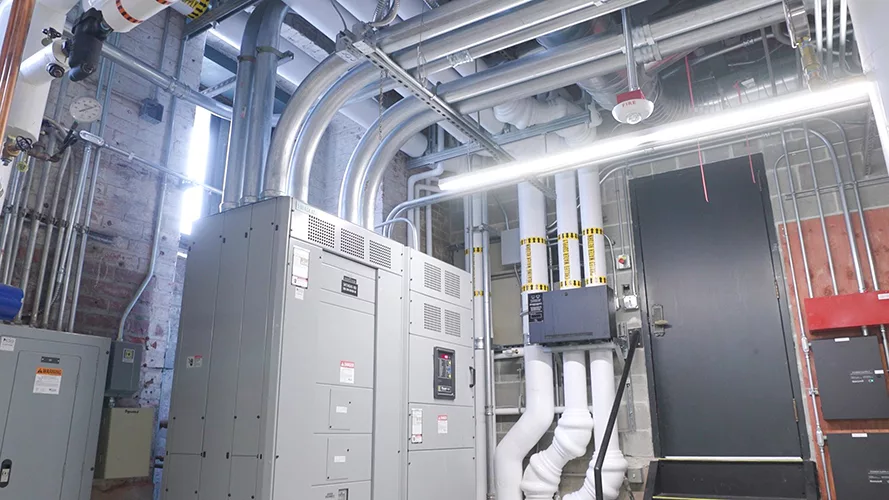
As the demand for energy-efficient buildings and sustainable solutions continues to rise, the role of mechanical contractors becomes increasingly vital in optimizing building performance and reducing energy costs. From upgrading HVAC systems to integrating advanced technologies, these experts are leading the charge in optimizing building performance.
Sophisticated challenges are always good for mechanical businesses’ bottom lines. And even better, plenty of funding opportunities are available to help contractors and their clients afford energy upgrades. Together, we’re in good company creating cleaner and greener spaces for our customers and the community.
The benefits of building optimization and energy efficiency
For mechanical contractors, optimizing building performance is more than a value-add — it’s helping customers meet requirements. Today’s building codes are evolving rapidly, with stricter energy standards designed to reduce environmental impact and improve system efficiency.
Staying ahead of these codes isn’t only about compliance — it’s an opportunity to deliver smarter, more competitive solutions that align with the market’s growing focus on sustainability and performance.
Code-compliant systems directly impact occupant comfort by ensuring consistent indoor temperatures, better air quality and overall system reliability. And occupant comfort matters. When HVAC systems perform efficiently and quietly, people are more productive, stay healthier and report higher satisfaction — outcomes that keep building owners and facility managers happy.
The COVID-19 pandemic brought indoor air quality into sharp focus, highlighting how ventilation, filtration and overall system performance can directly affect health and safety. It’s no longer an abstract concept; real-life concerns such as the spread of airborne viruses, the buildup of carbon dioxide in classrooms, or poor humidity control in office spaces are now front of mind.
Code-compliant HVAC systems address these issues head-on, offering peace of mind and tangible health benefits in everyday environments.
However, the benefits go beyond comfort. Energy-efficient systems reduce utility costs, extend equipment life and minimize maintenance demands. These savings will be built over time, increasing long-term return on investment for building owners. Often, optimized systems can also increase property value and appeal, making buildings easier to lease or sell.
For contractors, that means not only delivering code-compliant solutions but positioning clients for long-term success — and, even better, repeat business.
Key energy-efficiency upgrades
Energy-efficiency upgrades come in many forms, but some offer more impact — and quicker ROI — than others. For mechanical contractors, identifying and implementing the right mix of strategies is critical to maximizing performance and meeting both budget and code requirements:
HVAC system retrofits and replacements: Upgrading aging HVAC equipment to high-efficiency models can significantly reduce energy consumption and improve occupant comfort. Variable-speed drives, advanced controls and demand-based ventilation systems allow more precise control, lowering operational costs.
A major energy retrofit of the historic Washington State Temple of Justice — home to the state’s Supreme Court and more — included HVAC and lighting system replacements to enhance comfort and efficiency while preserving the building’s historic architectural integrity.
The project reduced its Energy Use Intensity from 80,000 BTU/square foot to 66,000 BTU/square foot, with future targets as low as 30,000 BTU/square foot. It is projected to cut energy use by 15% and carbon emissions by more than 60%.
Altogether, this prestigious old building now meets Washington’s Clean Buildings Performance Standard, one of the most stringent clean energy standards in the United States.
Solar, building automation and controls: Integrating building automation systems or upgrading existing controls enables smarter, more responsive facility management. Energy use is optimized in real time, and faults can be detected early, reducing downtime and maintenance costs.
A centralized energy management system was installed at the Fort Worden campus in Port Townsend, Washington, as part of a broader initiative to reduce reliance on dirty and increasingly expensive fossil fuels, as well as lower operating costs.
The system enables targeted heating control across the campus, contributing to significant energy savings and emissions reductions equivalent to removing 43 cars from the road annually.
Equipment insulation and duct sealing: Poorly insulated piping and leaky ductwork lead to significant energy losses. Addressing these issues is a low-cost, high-impact upgrade that boosts overall system efficiency.
At the Washington Department of Labor & Industries Tumwater building, replacing a 25-year-old chiller and associated systems significantly improved energy efficiency and occupant comfort. By upgrading aging, poorly insulated components and sealing connections, the project reduced energy losses and delivered long-term operational savings with minimal disruption to tenants.
System commissioning, monitoring-based commissioning and recommissioning: Verifying that systems are installed, calibrated and operating according to design intent can reveal hidden inefficiencies. Recommissioning existing buildings can identify performance drifting and bring systems back in line.
Monitoring-based commissioning at Swedish Issaquah Hospital in Issaquah, Washington, led to more than 7% energy savings and more than $95,000 in cost reductions by leveraging detailed building automation data to guide ongoing system optimization. With strong collaboration and minimal capital investment, the hospital decreased its EUI from 115 to below 100 while meeting the state’s clean buildings law compliance requirements.
The work has made Swedish Issaquah one of the country’s most efficient hospitals, a proud honor for such complex buildings.
These upgrades not only enhance building performance but also align with utility incentive programs and energy-efficiency grants, making them financially attractive for building owners. For contractors, they offer a clear path to delivering measurable value while staying ahead of code and market demands.
Available funding and incentive programs
Grants, loans, rebates, tax breaks — there’s a lot out there for you and your customers. Worth a look, right?
• Federal funding opportunities
1. Section 179D offers powerful funding for both tax-liable and tax-exempt entities under the federal IRS. Building owners and designers can access tax deductions up to $5/square foot and investment tax credits up to 30%, with additional bonuses for meeting criteria such as domestic sourcing, workforce standards and location in designated energy communities. Even tax-exempt entities can benefit through Direct Pay and transferred credits.
2. Section 48 is a federal tax credit for the cost of systems such as ground-source heat pumps, combined heat and power systems, thermal energy storage systems, geothermal and waste energy recovery. Available to both tax-liable and tax-exempt building owners.
3. Assisting Federal Facilities with Energy Conservation Technologies Program. This program offers grants for energy and water efficiency upgrades in federal buildings.
4. Energy Improvements in Rural or Remote Areas funding. The program has $50 million available for small clean energy projects in rural communities.
5. Rural Energy for America Program. This focuses on loan guarantees and grants for renewable energy and efficiency projects for rural businesses.
• Regional incentives
1. Energy Savings Performance Contracting can identify and install energy and utility improvements in existing facilities. With total project costs guaranteed, customers get equipment performance and energy savings. The Washington state program is a national leader.
2. Clean Buildings Performance Standard early adopters’ incentives. These incentives provide funding for private or public buildings that achieve their first compliance obligations early.
3. Energy-Efficiency Retrofits for Public Buildings grants. These grants offer funding for schools, hospitals and municipal buildings to improve energy efficiency.
4. Custom grants for energy-efficient retrofits or new construction. Available from Puget Sound Energy, Seattle City Light, Snohomish PUD and other utilities, these can cover 70% to 100% of costs for eligible efficiency upgrades.
5. Building electrification grants allow multifamily residential and commercial building owners and tenants to deploy and demonstrate grid-enabled, high-efficiency, all-electric buildings that reduce greenhouse gas emissions and accelerate the path to zero-carbon.
6. State project improvement grants cover the additional up-front costs of higher-efficiency heating systems for projects at existing state-owned buildings.
7. Energy as a Service is a construction delivery model that affordably aligns incentives, helps offset upfront capital requirements, and can provide ongoing operations and maintenance service. Creatable anywhere.
8. Property Assessed Clean Energy programs offer privately owned buildings low-cost financing for HVAC, IAQ, insulation, and more. They are repaid through a special assessment on the property tax bill (rather than the owner’s balance sheet) over a period of 15 to 25 years.
Turning funding into lasting efficiency gains
Securing funding is only the first step. Success depends on how effectively mechanical contractors collaborate with clients, engineers and utility partners to turn those dollars into measurable outcomes. Benchmarking energy use, aligning project goals and clearly defining roles can help ensure upgrades are implemented efficiently and deliver maximum impact.
When all stakeholders stay engaged, projects not only meet but often exceed performance targets. By leveraging available incentives and fostering strong partnerships, contractors can unlock deeper savings, ensure code compliance and deliver long-term value that keeps clients coming back.
Trevor Mays, CEM, serves as the director of energy and environment at UMC. His interest in the accessibility of low-impact solutions and sustainable design sensitive to place led him to join UMC in late 2018. Mays works methodically through problems while exploring all options to ensure UMC creates energy-efficient systems and seeks out the opinions of all team members to provide clients with the best possible outcome, every time.



