In the late 1980s, the United States finally caught up with Europe and brought high-efficiency boilers into commercial settings. Not too much later, in the 1990s, the residential market followed suit, ushering in a new era of efficiency and low-cost heating. But did it really?
Like any product with good marketing, the bright and loud text highlighting more than 95% boiler efficiencies caught everyone’s eye. This was a massive upgrade from decades earlier, being stuck in a 75% to 86% efficiency range using cast-iron boilers. Despite being dependable workhorses, people wanted to spend less on ever-increasing utility bills, as the government wanted the nation to use fewer resources.
It was a noble and worthwhile goal, considering that more than 20% of every energy unit you paid for went up the stack as waste heat. The issue was, and frankly still is today, understanding why and how boilers reach those high efficiencies.
What is boiler efficiency?
First, let’s define what efficiency is. In 1987, the U.S. Department of Energy (DOE) introduced the Annual Fuel Utilization Efficiency (AFUE) for 300 MBH boilers under the Energy Policy and Conservation Act. AFUE is an equation stating Total Useful Heat Output ÷ Total Energy Consumed over the course of a year.
This policy was to stop deceptive efficiency claims and take on the energy crisis from the prior decade. The steady-state efficiency rating made more sense in larger commercial hot water boilers. ANSI Standard Z21.13, Gas-Fired Low-Pressure Steam and Hot Water Boilers, was first used by manufacturers in 1992 as the DOE set commercial efficiency standards. This considered the ratio of useful heat output to fuel input under steady-state full-load operation, flue gas analysis and standby losses.
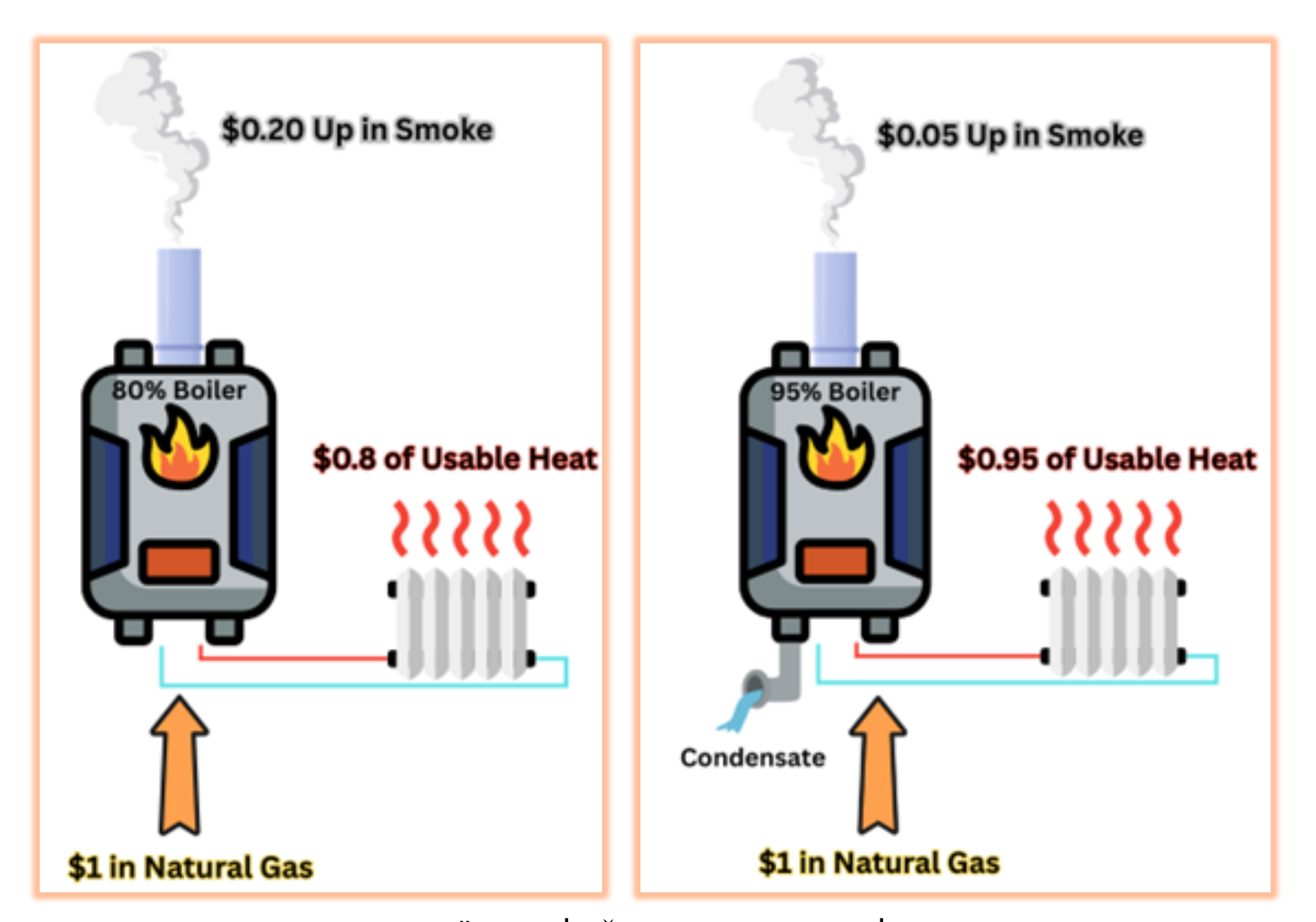
A standard noncondensing boiler is considered 80% to 86% efficient, while a high-efficiency condensing boiler is 90% to more than 98.5% efficient. The simplest way of thinking of efficiency is imagining $1 of natural gas and burning it in a boiler. In a high-efficiency system, 90 cents goes out as usable heat, while 10 cents goes out of the stack (see Figure 1). In a standard boiler, 80 cents is used, and 20 cents goes up the stack. Note how I used the system and not just the boiler there.
What makes a boiler efficient or not requires considering the entire heating system. For a system to reach more than 90% efficiency, it needs to use the heat trapped in the water vapor, a byproduct of combustion, in the flue gas. Flue gas condensation begins when the exhaust gas temperature drops below the dew point, typically around 130 F, hence the term condensing boiler.
In heating systems where the supply water temperatures are 180 F and return temperatures are 160 F, there’s never a chance (ignoring startup and other issues) for the flue gases to drop to that magical 130 F point. Instead, this water stays as vapor and goes out the chimney. If the return water temperature is less than 130 F, the flue gases are cooled enough so the water vapor becomes a liquid. The latent heat trapped in this now liquid is absorbed by the heat exchanger as it washes down and out in the drain. This captures the additional 10% to 12% efficiency otherwise lost.
Outdoor reset curve and proper system sizing
For every pound of water vapor converted into a liquid state, about 1,000 BTUs of energy is gained. Herein lies the issue as to why some commercial and residential high-efficiency boilers do not get the gas “mileage” that’s advertised. There are two common scenarios where this occurs. The first is a contractor replacing an existing boiler with high supply water temperatures with a high-efficiency model. The second is that a new heating system is incorrectly paired with a high-efficiency model from the start.
In the first scenario, the existing heating system likely consists of baseboards, cast-iron radiators or fan coils. Typically, these heat emitters are sized for a supply water temperature at 180 F or even 200 F in older systems. With a 20 F or even 30 F temperature Delta, there’s no way that water vapor will condense if the return water temperatures are at the very lowest 150 F.
In the best case, these systems won’t see anything better than about 86% efficiency. After this brand new, expensive boiler gets installed and the customers’ gas bill doesn’t change, it’s not a good look.
There is, however, a possibility of using these high-temperature emitters with a high-efficiency boiler properly, and that’s with an outdoor reset curve. Using an outdoor sensor, supply water temperature setpoints are programmed into the boiler.
For example, if it’s -15 F outside, the system will need the full 180 F to perform. When it’s 45 F outside, it can likely use a lower temperature to still deliver the necessary heat to the space. This is called an outdoor reset curve. The contractor must decide if this is a workable option by comparing the space’s heat load against what the heat emitters can provide at different temperatures. These figures are available from the emitter manufacturer.
A word of caution: Do not try to force a cast-iron boiler to do this job. The hydrochloric acid in the condensate will destroy the flue and heat exchanger material.
This leads into the second scenario of heat emitters not being properly sized from the start. While working with your heat emitter manufacturers, request a maximum water temperature of 160 F during the design phase. Most heating systems can be used with low temperatures; they just need more surface area to account for the lack of heat.
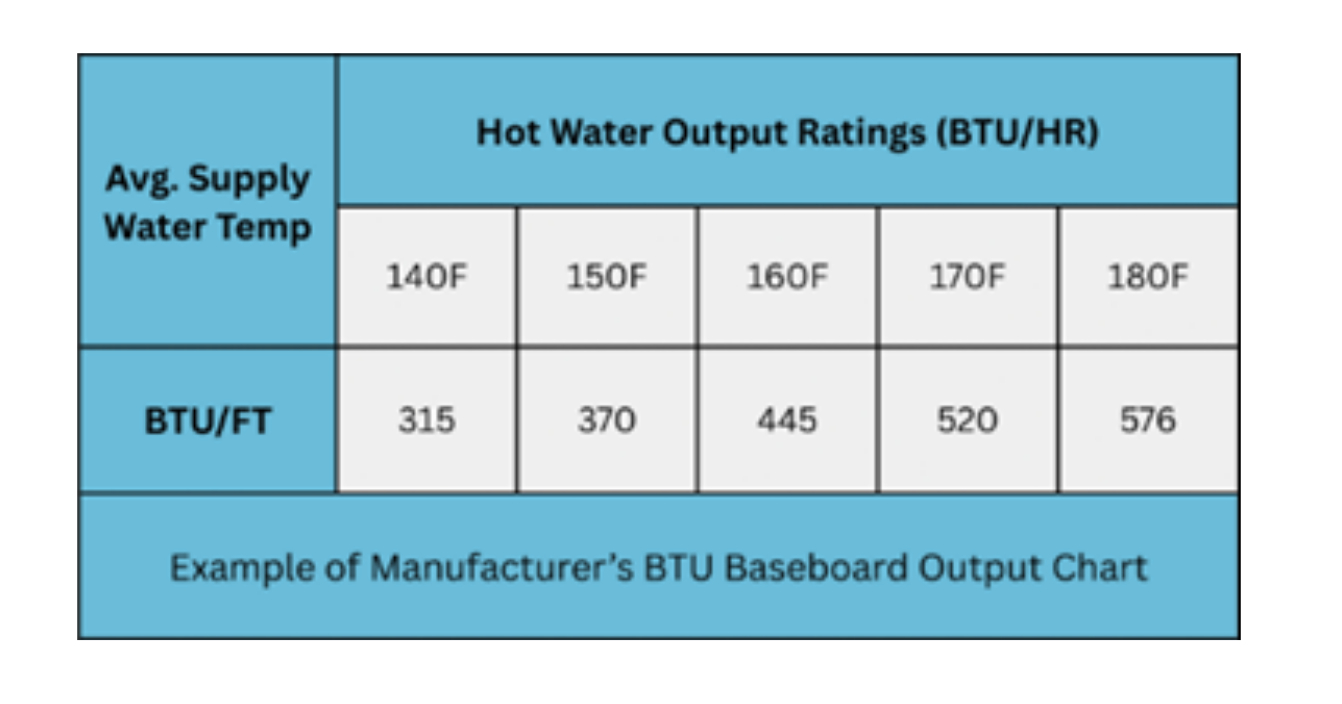
For example, if you have a room with 12 feet of baseboard with 180 F supply water temperatures, you might need 16 feet with 140 F supply water temperatures (see Figure 2).
While potentially more expensive up front, they’ll easily pay for the differential and more over their lifespan. Some heat emitters are designed to work at lower temperatures from the start. If radiant ceiling panels or radiant flooring are a possibility, these are great ways of adding comfort and using the boiler to its fullest.
Whether you’re retrofitting an old heating system or building a new one, always try to remember the magic return water temperature of 130 F. If you can hit that number or below, you will get the most mileage out of every drop of fuel you can.
Andy Williams is a piping system designer and project engineer at Aldag Honold Mechanical in Sheboygan, Wisconsin. He completed his bachelor’s degree in environmental science at UW-Green Bay and is registered in Wisconsin as a designer of engineering systems. His specialties are in-floor heating, boiler system design and renewable energy systems.