By Jacob Newman
A survey of over 1,000 single-family homeowners on public water systems in the United States reveals a significant gap in knowledge around residential backflow prevention. The survey explored awareness levels, perceived responsibility, and the impact of basic education on homeowner support for safety measures.
Understanding the Risks of Backflow
When backflow occurs, water from homes or businesses flows back into the public water supply, potentially bringing harmful chemicals or bacteria with it. In 2024, Grand Prairie, Texas experienced a major backflow incident when firefighting foam entered the local water system. While no one was physically harmed, the disruption to daily life was widespread.
The city issued a two-day ban on water use. Sixty thousand residents lost access to tap water. More than 637,000 bottles of water were distributed, and the financial impact exceeded $100,000. This included both remediation costs and lost business revenue. The entire situation could have been avoided with proper backflow protection.
Backflow preventers are devices that stop contaminated water from reversing direction into public pipes. When installed and maintained correctly, they provide an important barrier that protects drinking water. Despite their importance, most homeowners have never heard of these devices.
Most Homeowners Are Unfamiliar with Backflow Prevention
The survey revealed that two out of three homeowners in America have never heard of a backflow preventer. Even among those who were aware of the term, many did not understand the device’s purpose or whether one was installed at their home.
This lack of awareness weakens public support for protective regulations. It also leads to fewer homeowners taking proactive steps, such as testing or maintaining their backflow preventers.
Education Leads to Stronger Support
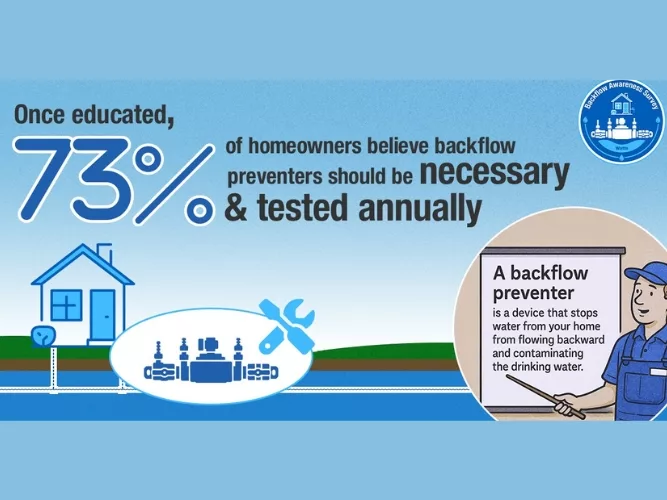
Once survey participants were provided with basic, easy-to-understand information about backflow prevention, their views shifted significantly. Seventy-three percent of homeowners said backflow preventers should be required for homes connected to public water systems. Seventy-one percent said these devices should be tested at least once a year.
These results show that when people understand what backflow is and how it can be prevented, they are much more likely to support the necessary safety measures. Education turns confusion into clarity and drives action.
Homeowners Want to Help but Need Clearer Information
The survey found that most homeowners believe they have a role in protecting public drinking water. However, many are unclear on exactly what actions to take.
This uncertainty is not due to a lack of interest. It stems from limited communication and guidance from trusted sources. Many respondents admitted they did not know if their home had a backflow preventer. Among those who believed they had one, less than half reported paying to have it tested.
These findings highlight the need for better public outreach and practical education about how backflow prevention works and why it matters.
Municipal Education Efforts Are Falling Short
According to the survey, four out of five homeowners feel their local municipality has not properly educated them about backflow prevention. Most feel uninformed and unaware of how their actions at home can affect the larger water supply.
When asked how they would prefer to receive this information, homeowners pointed to simple and familiar formats. Sixty-five percent said they would read educational inserts included in utility bills. Forty-seven percent preferred mailed flyers. Another 47 percent said they would benefit from annual reminders. Online resources, incentive programs, and other outreach methods also received support, although to a lesser degree.
These results show that the public is open to learning, but the information needs to be delivered in a way that is easy to access and understand.
The Path Forward
The Grand Prairie incident serves as a reminder of what can happen when backflow protection fails or is neglected. Clean drinking water is a shared resource, and homeowners play an essential role in protecting it.
This national survey confirms that awareness of backflow prevention is low, but the desire to help is high. By delivering straightforward education through the channels homeowners already trust, municipalities and industry leaders can close the knowledge gap and build support for stronger backflow prevention programs.
With better communication and community outreach, homeowners will be better equipped to do their part in maintaining the safety of the water we all rely on.
Jacob Newman
As marketing manager for Fluid Solutions at Watts Water Technologies, Newman leads strategic campaigns that educate and engage customers while driving growth across a robust and evolving product portfolio. Since joining Watts in 2019, he has played a key role in shaping go-to-market strategies, building demand generation programs, and supporting product launches that connect innovative technologies with real-world applications.



