In my nearly 20 years in the plumbing engineering industry, one thing stands out: the unwavering passion everyone has for their work. Sometimes, this passion is almost overwhelming! However, I’ve noticed that many engineers tend to keep their enthusiasm confined within the industry. Why is that? For a long time, I was one of those engineers, perhaps even more so. My passion rarely extended beyond my organization, and if it did, it certainly didn’t reach beyond my local community.
For years, I was scared to step out and talk about my passion. The thought of sharing my ideas and enthusiasm with a broader audience was intimidating. I worried about being judged or misunderstood, and it felt safer to keep my excitement within familiar circles. This fear kept me from connecting with others who might share my interests or benefit from my experiences.
A memorable experience at Homestead High School
Recently, my coworker Ray Schwalbe and I had the privilege of speaking to a group of 11th- and 12th-grade engineering students at Homestead High School in Mequon, Wisconsin. This event was part of a regular series of presentations that their teacher includes, where professionals from industries related to engineering share their career paths and experiences. The goal is to get them thinking about engineering careers, especially ones they wouldn’t even know to consider.
The best part: While we were setting up in the morning, the teacher talked about what we could expect the attendance to be for that day. It was 7:30 on a Friday morning, after all, but they all showed up! Even a few capstone students said they would skip working on their project to listen. Hell, yeah! And what’s even better is that the students had great, thoughtful questions.
Sharing our journey
As plumbing engineers, Ray and I have had diverse experiences that have shaped our professional lives, but it was important for us to start at the true beginning of our journey. We did, after all, start at the same point they are at — sitting in high school trying to figure out what to do after graduation. We talked about our choices in college and our first jobs.
Although similar to Ray’s, my journey into the working world was different. Ray started his career working as an engineer for a mechanical contractor prior to starting to work at the same company as me. On the other hand, I have only worked for the same organization since graduating from college. The importance of this story: it’s OK to move careers, it’s OK to make changes. As an individual, you need to do what is right for you.
We also shared many stories from our careers, highlighting the challenges and rewards of working in this field. We discussed the importance of problem-solving, creativity and collaboration in our daily work. By sharing our personal journeys, we aimed to give the students a realistic view of what it means to be a plumbing engineer and the impact we have on building safe and efficient infrastructures.
Professional responsibilities
In addition to explaining what a plumbing engineer does, we also provided an overview of our professional responsibilities, emphasizing the technical skills required in plumbing engineering. From designing intricate systems to ensuring compliance with safety standards, our work combines technical expertise with practical application.
I shared a story from the COVID-19 pandemic where we were called into action to support the design of turning a fairground expo hall into a field hospital. We only had an hour to react and spent the next 24 hours coming up with a design. It was a great example of top-notch collaboration and teamwork. I didn’t pick what plumbing contractor was selected; one showed up at a moment’s notice. If we had differences, it didn’t matter at that point. Thankfully, we didn’t, and the team was amazing to work with.
At the end of our 10-day journey for that project, we were exhausted. Not only was I focusing on work, but I also had to find time to help my child through remote learning. The moral of my story: I learned that I can do really hard things as an engineer.
We demonstrated how we use advanced tools and technologies to develop efficient plumbing systems tailored to modern buildings. This presentation segment aimed to illustrate the wide range of opportunities in the field and the vital role plumbing engineers play in the construction industry. By sharing these personal anecdotes, we hoped to give the students a realistic and inspiring view of what it means to be a plumbing engineer.
Engaging with technology
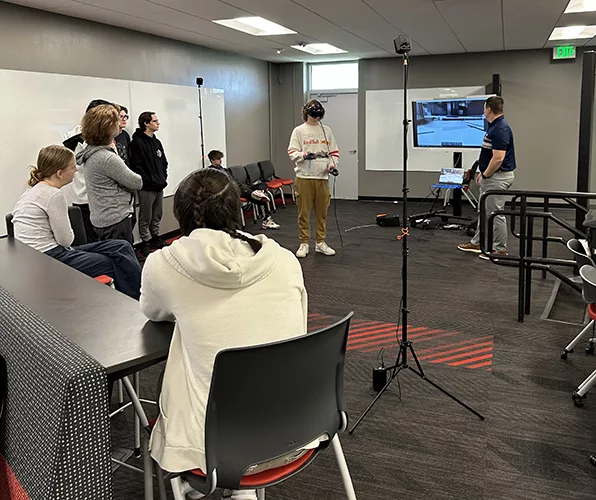
One of the highlights of our visit was the virtual reality (VR) experience we offered to the students. With the help of our local in-house digital practice group, we set up equipment that allowed the students to immerse themselves in a virtual environment showcasing our technological capabilities. The VR experience demonstrated how we use technology in our work, from 3D modeling to virtual simulations.
The students were thrilled, and many remarked that it felt like a video game. This interactive session made the learning experience fun and highlighted the innovative tools we use in our profession.
A really cool part was when a student walked around the virtual model and ended up below the floor slab, ultimately looking at the footings. He was confused for a second, and then the teacher said, “Everyone, take a look at the screen; these are spread footings just like we learned about earlier in the week.” So not only was the exercise relatable to what they were learning, but I could also tack on how it is important for plumbing to coordinate around these footings.
Looking to the future
These students are the future of engineering, and it was an honor to contribute to their education and inspire them to follow their passions. By sharing our experiences and providing hands-on learning opportunities, we hope to have sparked their interest in plumbing engineering and other engineering disciplines. Encouraging young minds to explore and pursue careers in engineering is a small but significant way to give back to the community and ensure the continued growth and innovation in our field.
So, was it scary?
It wasn’t at all. Our visit to Homestead High School was a rewarding experience. It allowed us to connect with the next generation of engineers, share our knowledge and inspire them to pursue their dreams. We look forward to seeing these students become our colleagues and contribute to the engineering community in the future.
Our preparation
It may seem like this kind of thing would take a lot of time to prepare. It can, I suppose, but Ray and I pulled our presentation together the morning of the event. That might be the other extreme of lack of preparedness, but it’s important to remember that all we have to do is talk about our journey and what we do. We live it every day, so it’s easy to talk about; the students don’t care about a PowerPoint presentation anyway. The VR took some extra time to set up and prepare, but since it is a tool we regularly use, most heavy lifting was already done.
I will be honest: when this came up the week before, I dreaded that I had made this commitment. However, it was a blast when it was all said and done. Ray and I had fun but, more importantly, the high schoolers had fun. I was quickly reminded how activities like this restore my passion for what I do and why I do it.
“Passion is energy. Feel the Power that comes from focusing on what excites you.” — Oprah Winfrey