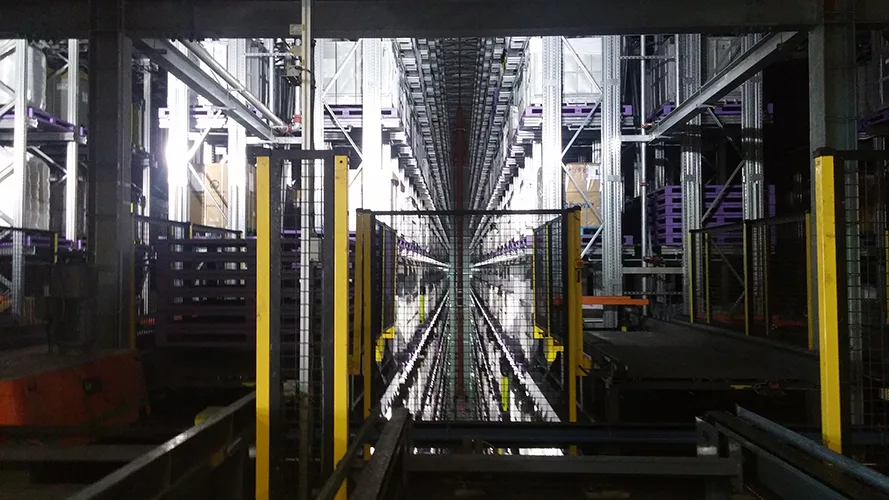
The latest data from the National Fire Protection Association (NFPA) shows that, on average, more than four warehouse fires occur each day in the United States, with fire departments responding to an annual average of 1,508 fires in warehouses between 2018 and 2022 (https://bit.ly/3RZvLJT). These fires caused an estimated annual average of three civilian deaths, 19 civilian injuries and $323 million in direct property damage.
These statistics underscore the fact that warehouses and other distribution centers face unique challenges. However, these risks can be mitigated through proper design, installation, inspection, maintenance and testing of the fire protection systems within them.
Commodity classifications for products and packaging
The most obvious unique characteristic of a warehouse is that the purpose of the building is to store a large number of goods and products. This can increase the fire load by a significant amount. This is why it is essential, when designing an automatic sprinkler system for a warehouse, that the items being stored are assigned the proper commodity classification.
When determining the commodity classification, it is important to consider not only the product itself but also the packing material, container and pallet. The different commodity classifications, as outlined in NFPA 13, Standard for the Installation of Sprinkler Systems, are as follows:
• Class I. A noncombustible product that is either stored in single-layer cardboard boxes or shrink-wrapped or paper-wrapped. The product can be stored with or without wooden pallets.
• Class II. A noncombustible product stored in either wooden crates or multiple-layered cardboard boxes. The product can be stored with or without wooden pallets.
• Class III. A product made from wood, paper, natural fibers or Group C plastics. This can be stored with or without wooden crates and pallets.
• Class IV. A product that can be made from a mixture of Group B plastics with wood, paper, natural fibers or Class C plastics. The product is allowed to be made from a small percentage of Group A plastics.
• Group C Plastics. Certain plastics, such as PVC. This is treated the same as a Class III commodity.
• Group B Plastics. Certain plastic rubbers, such as silicone. This is treated the same as a Class IV commodity.
• Group A Plastics. The most flammable plastics and natural rubbers. This group is further subdivided into expanded or nonexpanded plastics. This is treated differently from all other commodity classifications.
In-rack sprinklers: A unique aspect of warehouse fire protection
Warehouses are the only location where you will find sprinklers at the ceiling level as well as in racks closer to ground level. This is a unique way to get water in the racks and applied to a fire before it is able to grow beyond the capabilities of the sprinkler system.
Some higher-hazard commodities will require in-rack sprinklers; other commodities might have the option to include in-rack sprinklers while decreasing the required robustness of the ceiling sprinklers.
Other issues include:
1. Prewetting is not always effective in warehouses. Most sprinkler systems rely on the concept of prewetting as a critical component in controlling a developing fire. Prewetting is when the sprinkler system activates and wets the fuel in front of the fire’s path, slowing down the fire’s growth.
The issue with warehouses is that they can contain encapsulated products, which are impervious to prewetting — think of something wrapped in plastic on all sides, for example. Due to this challenge, the sprinkler system in warehouses might need to be designed to be robust enough to be able to control a fire without prewetting.
2. Obstructions can render ESFR sprinklers ineffective. There is the potential for early suppression fast response (ESFR) sprinklers to be used in warehouses. ESFR sprinklers rely on getting water to the fire quickly; this means both activating earlier than normal sprinklers and discharging water at a higher velocity.
Because of this unique design feature, it makes it even more important to ensure that these sprinklers are clear of obstructions. If water is prevented from reaching the fire during the early stages of fire growth, the sprinkler system could be ineffective.
3. Change management in warehouses. Warehouses are likely to include stored items with varying commodity classifications. Sprinkler design can account for this by either designing to the highest-hazard commodity or by creating separate zones for higher- and lower-hazard commodities. Either way, when warehouses change what they are storing, it is essential that the new products do not exceed the hazard level that the sprinklers were initially designed for.
4. Flammable liquids and gases. Another unique fire protection challenge for warehouses is the possible presence of large quantities of hazardous materials such as flammable liquids and gases. These types of materials typically fall outside of the scope of NFPA 13 and into the scope of other NFPA codes and standards, such as NFPA 30, Flammable and Combustible Liquids Code; NFPA 52, Vehicular Natural Gas Fuel Systems Code; NFPA 55, Compressed Gases and Cryogenic Fluids Code; or NFPA 58, Liquefied Petroleum Gas Code.
These codes contain requirements on the specific containers, building construction and sprinkler design required for the storage of these more hazardous materials.
The importance of ITM
Even the most robust fire sprinkler system is rendered useless if critical valves are left closed or have otherwise not been properly maintained. For this reason, the importance of inspection, testing and maintenance (ITM) of sprinkler systems in warehouses is significant.
NFPA data indicates that 79% of sprinkler system failures could have been prevented with proper ITM. Regular inspections can identify potential issues, such as corrosion or leaks, before they lead to catastrophic failures.
Periodic ITM is mandated by codes and standards such as NFPA 25, Standard for the Inspection, Testing, and Maintenance of Water-Based Fire Protection Systems, which specify frequencies for various tasks, ranging from weekly to annually. Warehouse owners or their designated representatives are responsible for ITM, often hiring qualified contractors to do the work.
These are only some of the many unique fire protection challenges for warehouse and other similar distribution centers. For more information, check out the NFPA Warehouse Fire Safety fact sheet (https://bit.ly/4jHFRLi).
Additionally, an April 2025 webinar from NFPA featured a 90-minute discussion on evolving warehouse challenges and their impact on fire protection systems and system ITM. The conversation not only covered unique fire protection challenges for warehouses, fire protection systems and how NFPA 13 and NFPA 25 can help, but also considerations for warehouse fire alarm systems and NFPA 72, National Fire Alarm and Signaling Code. Register and watch the webinar for free (https://bit.ly/3GizUGd).
[Editor’s note: This was originally published as a blog post on the National Fire Protection Association’s website. It is published here with permission and some light editing.]
Brian O’Connor, PE, is an engineer in the Technical Services department at the National Fire Protection Association and past president of the New England Chapter of the Society of Fire Protection Engineers. At NFPA, O’Connor focuses on topics such as aviation, portable extinguishers, water-based fire protection, lithium-ion batteries/energy storage systems and health-care facilities.



