They say everyone in a leadership position needs to keep someone close who will call them on their BS. In my world, this is not a problem, as there are many — perhaps too many — who feel their calling is to keep me humble. They have more than served their purpose. However, one of the most treasured compliments I’ve ever received is when a publication wrote, “He has the unique ability to make the complex understandable.”
Mark Twain said, “If you are the smartest person in the room, you’re in the wrong room.” I spent my career placing myself in rooms with really smart people, and when combined with real-life experience and academic research, here I am. A journey blessed by the enlightenment of others. There are indeed those smarter than me in any subject matter, but my differentiation is hopefully the ability to explain.
In that regard, I pull from William of Ockham (1287-1347), known for Ockham’s razor. Grossly oversimplified, he suggested, “When there is more than one way to explain something, always choose the simpler.” Therefore, that is my differentiation. Yes, we can go down the rabbit hole of the International Trade Expansion Act of 1962, including Section 232 and Section 122, which often ends with eyes glazed over. However, I choose not to.
Wilbur Ross, former U.S. Secretary of Commerce (2017-2021) and who once was one of us (ISG), said, “No one wants a trade war, but no one wins with trade surrender, either.” Simply stated, tariffs are a tax. They are activated when one perceives a violation of international trade law. In the United States, it is against the law to sell (dump) a product that is lower than the price at which you sell in your homeland or lower than your cost of production.
In my view, there are three types of tariffs: punitive, reciprocal and motivational. For example, why tariffs against two of our important relationships in Mexico and Canada? I mean, with an entire world that hates us, why tariff the two that actually like us? These are punitive tariffs, which in the case of Mexico, are encouragement to have them control the flow of illegal immigration and fentanyl into this country.
In the case of Canada, it is to encourage more restraint and less complicity in allowing goods from China to flow through their country to America. When allowed or facilitated, it is a method for China to circumvent trade laws.
Reciprocal tariffs are simply tit for tat. Whatever duty you place on our exported goods, we will apply a similar tariff on your exported goods to us. Seems fair to me as for too long, we’ve been an easy dumping ground without consequences to the offenders.
We have become the world’s convenient dumping ground of subsidized products, while our exports are taxed throughout the world. This has resulted in an existential threat to our nation’s future and the future of our next generation. We are now too reliant on foreign goods. In many cases, reliant on our potential enemies. What if they elected to stop shipments? Just think, 85% of our antibiotics come from China. Same with microchips, essential to let’s just say — everything! We are finally building U.S. plants to provide microchips just in the nick of time.
While we have offshored too much of what is critical to our independence, we have depleted our entire nation of the skill sets required to assimilate the reshoring. We are in the very last opportunity to secure possible victory from the jaws of certain defeat.
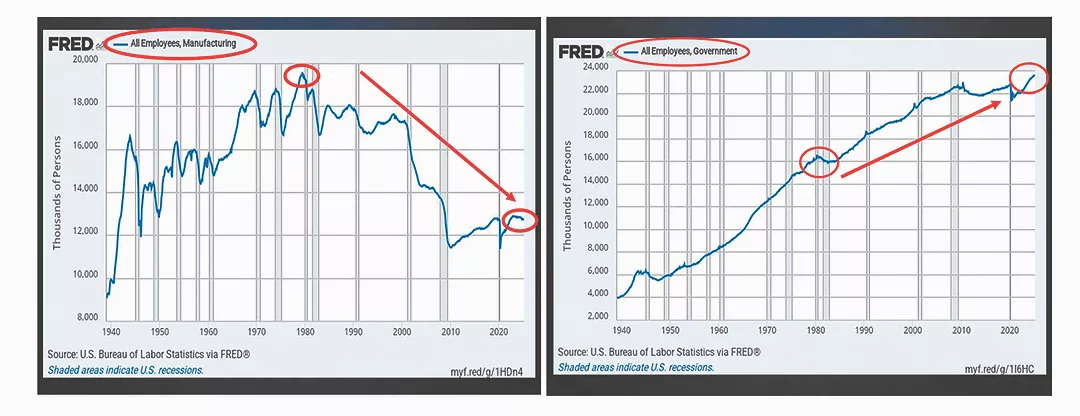
Manufacturing employment peaked at 20 million in 1979, yet today sits at 13 million. That’s 7 million manufacturing jobs lost! Yes, some to automation and improved efficiency, but most to offshore. Note that, over that exact period, government employment has increased at the precise number of jobs (see chart).
Fundamentally, isn’t one of the primary responsibilities of a nation to keep its citizens safe? How does a government provide such without a military? How do you have a military without an arsenal? How do you have an arsenal without a manufacturing sector? Is it a good strategy to subcontract the manufacture of your defense weapons to your potential enemies?
The final tariffs I refer to as motivational tariffs. While the implementation of tariffs commands the headlines throughout the world and panic elevates, the intent is simply to bring the culprits who violate trade law to the table. As you can see, this is exactly what is happening. Within 10 days of the announcement of the tariffs, more than 70 countries reached out to us for discussions.
The exception was China, which, in an effort to “puff up” and avoid embarrassment, increased their tariffs to U.S. imported goods. Our administration responded and we went to battle at 125%. Shortsighted on China’s part in a trade war, the disadvantage clearly goes to the country with excess capacity.
China alone has enough steelmaking capacity to supply the entire world’s demand. Of the trade that occurs between the United States and China, 80% is this country importing from China. As of this writing, China has now reached out, and tariffs on both sides have been reduced to 10%. However, this tariff trade war arrangement may be short-lived, as having the offenders now at the table allows us to recalibrate trade relationships moving forward.
So, if we could set political differences aside and, more importantly, political personalities, had we not addressed the inequities of our trade imbalance and delayed or ignored them for one more administration, we would have depleted our nation’s ability to staff a manufacturing sector with the required skill sets. Even in the absence of hyperbole, we sit on the brink of never being an independent country again. Reliance on others for essential goods and services is never a good strategy. To be reliant and dependent on others for what is critical to our independence is a prescription for ruin. Thus, the Emergency Economic Powers Act.
In closing, sovereignty is a country’s ability to govern itself without outside interference or reliance on others. Our forefathers fought to the death to secure our nation’s sovereignty. How dare we allow such to be surrendered or mitigated on our watch! It was Edmund Burke (1729-1797) who said, “The only thing necessary for the triumph of evil is for good men to do nothing.” Shame on us if we are those good men who do nothing.
“The tariff of the United States, which protects the industry and enterprise of our people, is one of the great measures of the government.” — Abraham Lincoln, 16th U.S. President




