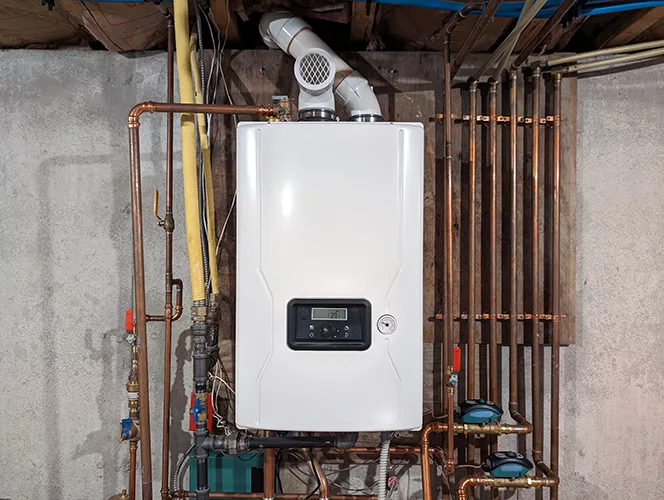
There are plenty of matters on the minds of hydronics manufacturers, primarily the continued march toward carbon reduction and exactly where all their various product options — electric; fossil-fueled; combi; condensing or noncondensing boilers; combination plants; heat pumps; and specifically, hybrid systems combining heat pumps and boilers — fit best in the mix to provide the basics of heat in the most efficient way possible.
However, this year regulations don’t appear to be a top-of-mind matter as manufacturers wait for more certainty in an uncertain regulatory climate to market their products.
Four of our manufacturers didn’t take the opportunity to answer our question on regulations — a departure from past surveys that included our report’s most dynamic answers. Which isn’t to say that those who did answer didn’t share strong thoughts.
“There is still tremendous uncertainty within legislative and regulatory bodies in terms of future requirements for heating products,” says Dan Moffroid, director of product management, Bosch Home Comfort. “The potential transition away from fossil fuels to electrification is unknown, especially the how and when, not to mention the cost implications. Even the future of noncondensing models remains in doubt. Bosch continues to monitor and participate in these discussions on a regular basis to ensure our products are both compliant with pending legislation as well as leading the market into the future.”
This uncertainty isn’t only at the federal level, but state and local levels, too.
“Due to the constantly changing patchwork of local, state and federal regulations around sustainability,” says Mike Senk, product specialist, IBC Technologies USA Inc., “at IBC we innovate with sustainability at the forefront of our design process. During product development, we look at the Earth-friendly attributes of our products, such as efficiency, packaging, performance, features and recyclability.”
Adds Moffroid: “Some local utilities offer a rebate for a condensing boiler while others do not. And some states or cities have pushed to modify building codes to try to restrict fossil fuels while others have taken a more hands-off approach. But other than that, the need and desire for a comfortable and reliable heating product that is easy to install, use and service is universal.”
This year we sent out questionnaires to the following manufacturers to find out more about the current state of the hydronics market: AERCO (a Watts brand); Bosch Home Comfort; ECR International; HTP/Ariston Group; IBC Technologies USA Inc. (a Rheem company); Laars Heating Systems; Lochinvar; Mestek, Inc.; Navien, Inc.; NTI/Ariston Group; Rinnai America Corp.; Thermal Solutions; U.S. Boiler Co.; and Weil-McLain.
Our first question asked the following:
• What current regulatory mandates will impact the design of your products in the next 18 months?
You don’t have to look far to understand why some manufacturers didn’t answer the question. While energy standards for commercial boilers were made mandatory two years ago, there’s much more ambiguity for the residential boiler market.
Last January, the DOE withdrew its proposed rule to increase the minimum energy efficiency standards for residential boilers in the last days of the Biden Administration. In 2023, the DOE had recommended that residential boilers would have to meet or exceed an AFUE of 95%, thus eliminating noncondensing boilers from the U.S. hydronics market.
“This landscape is always shifting from proposed to implemented,” says Matt Kleszczynski, director of marketing, Mestek, Inc., “so we are always cognizant of the regulation playing field.”
The DOE’s Office of Energy Efficiency and Renewable Energy published the withdrawal stating that while it “continues to support the intent and purpose of the proposed energy conservation standards for consumer boilers, based on the considerable feedback received through the public comment process, the forthcoming change in the Administration, and the significant resources needed to review and consider all relevant matters presented in the public comments, EERE has determined it appropriate to withdraw the proposed rule.”
For at least one manufacturer we heard from, its products are already up to the standard that the DOE just withdrew.
“All heating only and combi boilers that Navien manufactures are 95% AFUE condensing products; we exceed any current or upcoming changes to efficiency requirements,” says David Hoskyn, director of product management, Navien, Inc. “In addition, all of our products are low NOx, so they meet the requirements in areas that have limitations on emissions, although we are monitoring the recent bans on emissions that are proposed such as in the California Air Districts. Beyond that we are looking at the changing requirement on circulator energy use to determine how that will potentially affect our products.”
In addition, AERCO had an award-winning product ready to go.

“One key innovation is our CFR boiler, which was developed in response to the now vacated regulation,” says Christian Zapata, product manager, AERCO. “It won this year’s AHR Innovation Award and offers a great stepping stone to transition to high-efficiency boilers without requiring the budget for a full infrastructural upgrade right away.”
In addition, the company is all set to go for our neighbor to the North.
“There are no major changes expected in the U.S., as the current administration’s plans are still a bit unclear,” Zapata says. “In Canada, however, a new regulation took effect on Jan. 1, 2025 that requires only condensing boilers be used in systems. Since all AERCO boilers are already condensing boilers, we don’t need to make any design changes.”
While U.S. regulations are “a bit behind,” Zapata explains, “Canada’s move towards higher efficiency requirements ensures that any new boiler installations will be high efficiency. AERCO is well-positioned to comply with any incremental increases in these standards over the coming years without needing to alter our current designs.”
Likewise, the proposed regulation may be gone, but it’s business as usual for Mike Boyd, product manager, Weil-McLain.
“As the leading North American boiler manufacturer with one of the broadest lines of products in the industry,” Boyd says, “Weil-McLain has honed an agile product development process. This approach allows the company to quickly adapt and allocate resources for future innovations while addressing compliance needs for existing legacy products.”
Outside D.C.
As Senk and Hoskyn mention, not every regulation comes out of D.C. To Hoskyn’s point, California plans to reduce NOx and carbon monoxide emissions by 2030. Namely, the state’s South Coast and Bay Area Air Quality Management Districts have proposed zero NOx and carbon monoxide emissions standards, potentially driving the adoption of new technologies and fuels in the heating sector.
In addition, several states and localities are still considering or have on the books bans on fossil-fueled boilers in new construction to promote cleaner energy sources. For last year’s report, several manufacturers also talked about another proposal that is still up for debate, which would require boilers (and furnaces) to monitor and manage carbon monoxide levels, aiming to prevent hazardous CO exposure.
“Right now, we’re seeing a lot of regulatory changes in the boiler industry that are coming from state and local governments,” says Robert Wiseman, segment development manager, hydronics, Lochinvar. “Most of these regulations focus on supporting the industry-wide shift toward decarbonization. We continue to monitor these changes to be certain that our products meet the evolving needs of our customers.”
Boiler trends
Our second question always elicits great feedback from our respondents and this year was no different. We asked:
• What boiler trends are you seeing in different parts of the United States?
Related to our first question, Daniel Rettig, product manager, Thermal Solutions, says that trends in different parts of the U.S. center around regulations and mandates.
“Boiler manufacturers need to keep in the know about all the state and local codes,” Rettig adds. “They need to fully understand the implementation and enforcement of the codes so they can make sure there are relevant products in the changing market.”
One of the biggest items “to keep in the know” is the trend toward decarbonization — whether that be with boilers of all of types or heat pumps or a bit of both.
Take, for example, the adoption of electric boilers.
“Interest has increased quite a bit in our electric product portfolio,” says Chuck O’Donnell, director of marketing, Laars Heating Systems, “notably in areas where renewable electricity drives lower electricity rates.”
Electric boilers have an output that is typically “on par with high efficiency gas units,” Wiseman adds, and offer important user-friendly features such as easy installation, fast startup/shutdown time and quiet operation.
“An electric boiler converts nearly 100% of the electrical energy into heat with no stack or heat transfer losses,” he explains.
Likewise, mandates on gas bans and emission reduction mandates have Rettig looking for new technologies to meet these requirements with plenty of options for the hydronics market.
“Electric boilers are not a new technology,” Rettig adds, “but there has been a renewed interest in them to meet emission requirements. There have been several new electric boilers introduced into the market over the last 12 months and we expect to see many more in the next 18 months. These mandates will definitely impact what the Thermal Solutions product portfolio looks like in the coming years.”
Factors that influence boilers are more related to electrification and carbon footprint reductions, says Kleszczynski.
“The trends vary from region to region,” Kleszczynski adds. “Some are going all electric and some of you will see a hybrid approach of both fossil fuel-based equipment and electric.”
 Versatility
According to Bob Shea, executive director of sales, ECR International, “Electric boilers are becoming more popular as an add-on heat source for air-to-water heat pump systems.”
This hybrid approach is rising in popularity, Boyd adds, and for good reasons.
“Hybrid dual-fuel hydronic systems that use heat pumps for efficiency and rely on boilers for dependable backup help homeowners contribute to lower carbon emissions and support a more sustainable future,” Boyd explains.
Other manufacturers agreed with taking the hybrid approach while all shared the sheer versatility of their equipment to save energy, particularly with condensing boilers.
“In builds and retrofits where engineers cannot or do not need to specify a fully electric unit, high efficiency condensing gas boilers can present an excellent alternative while still supporting a building’s transition to sustainable solutions,” Wiseman adds. “Condensing boilers deliver significantly higher efficiency than noncondensing units — and they’re also lighter and more compact.”
Hoskyn continues to see the shift toward higher efficiency products in the market, with the condensing boiler market, growing over the last 12 months.
“In addition we are seeing trends of making the condensing boilers easier to adapt to noncondensing applications,” Hoskyn adds.
At Laars, its residential and commercial high efficiency boiler lines continue to grow in volume based on customer demand across North America.
“Homeowners and business owners see value in upgrading their older heating systems to condensing boiler technology,” O’Donnell adds.
While no strangers to past surveys, we heard more this year about combi boilers, which provide hot water and space heating in the same system.
“Across the category of high efficiency boilers, the trend continues to be an appreciation for the benefits of a dual function, combi boiler,” says Jason Fitzsimmons, national heating sales director, Rinnai America Corp. “The consumers are enjoying the space savings of moving from the floor-mounted boiler and tank water heater to the compact size of a wall-hung boiler. The financial ROI for this equipment investment makes sense for homeowners who are replacing aged-out boilers and atmospheric gas water heaters and putting in a single, highly efficient system.”
Adds Hoskyn: “The combi boiler market remains strong as contractors become more confident in the products and end-users see the benefits in combined products in both performance and space savings.”
Another option that AERCO discussed are combination system platforms that pair an indirect water heater with a high-efficiency boiler.
“Overall, the push for high efficiency and adoption of combination plants are the main trends we’re seeing regardless of the specific regional characteristics or state regulations,” Zapata adds. “More customers are getting on board with combination plants because they reduce the need for extensive venting and piping, which saves space and money.”
This trend is particularly strong in urban areas, where space and energy efficiency are key.
Region by region
As noted, what heat source get picked depends to a large extent on location due to regulatory differences, but also on climate.
“In the Northeast and Midwest, high-efficiency condensing boilers dominate as homeowners prioritize performance in cold winters and seek lower energy bills,” says Chris Decato, product manager, U.S. Boiler Co. “Many are pairing these boilers with smart controls and outdoor reset technology to optimize comfort and efficiency.”
Meanwhile in states such as California and New York, decarbonization policies are driving interest in hybrid systems.
“Compact, space-saving designs also appeal to urban areas with limited installation space,” Decato adds.
And in the South and West, boilers are less common, but are gaining traction in niche applications such as radiant heating for luxury homes and high-end renovations.
Finally, across all regions, Decato says “demand for connectivity is growing, with technicians and homeowners favoring systems with advanced diagnostics, remote monitoring and app-based controls.”
Daniel Torres, regional product director of HTP/Ariston Group agrees: “The trends we see are to provide products that are simple, easy and reliable.”
Despite all these changes, Boyd says don’t count out the traditional reliables.
“In many areas, the shift toward high-efficiency residential products continues,” Boyd explains, “but there remains a significant need for standard efficiency cast-iron boilers where economic factors, distribution system designs and venting constraints make them the better option.”
Torres, who also serves in the same role at NTI/Ariston Group, adds: “In some areas of the U.S., there is a trend back to lower efficient boilers. This is due to some incentives and credits being removed. In other areas, the trend is away from boilers/fossil fuels.”
For commercial systems, Boyd adds that a hybrid boiler strategy continues to gain popularity for high-temperature replacement applications.
“This approach uses a noncondensing boiler during peak heating months and a condensing boiler for the rest of the year, optimizing both comfort and efficiency,” he explains.
By focusing on “high-efficiency equipment, renewable energy integration and future-ready technologies,” Boyd adds that Weil-McLain is “well-positioned to lead the hydronic heating industry in its transition toward a low-carbon future, supporting decarbonization efforts at all levels.”