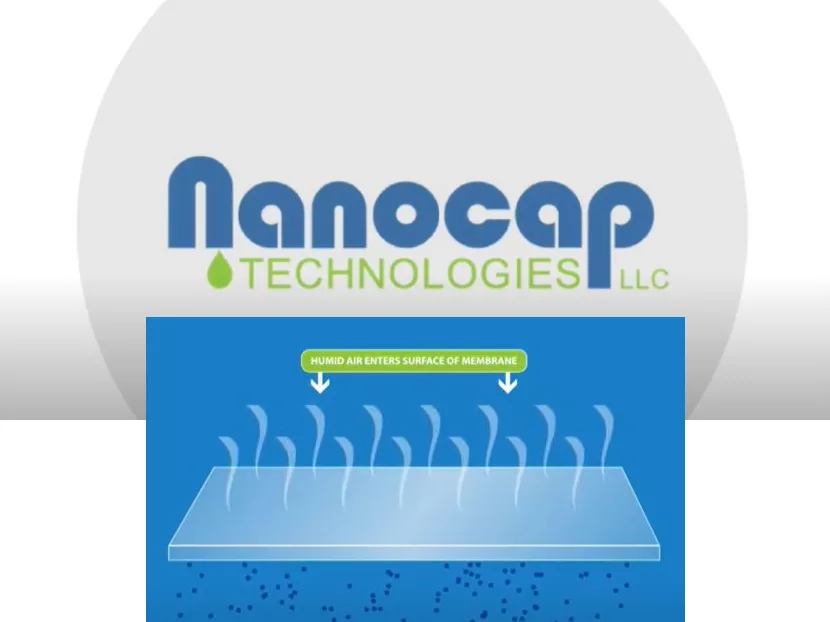
Nanocap Technologies has announced the latest, highly-advanced iteration of its Nanocap Process, combining capillary condensation and osmosis through a semi-permeable membrane to dry air. Available for immediate licensing, this green process is considerably more efficient than the most common vapor compression model which requires cooling to dehumidify — in use since air conditioning was invented by Willis Carrier in 1902.
The current system squanders a large amount of energy, while Nanocap's transformative process avoids this waste by separating the cooling process from the dehumidification process. The Nanocap Process may be viewed here.
Benefits
- Substantial, positive environmental impact
- Utilizes existing, proven technology, within architecture developed through cooperation with global leaders in the production of membrane filtration
- Improved reliability
- Semi-modular design
- Increased customer satisfaction
Energy Savings
- Energy savings of 20-35% possible during typical air conditioning use
- Helps meet current and future efficiency standards
- Air is dried separate from the cooling process
- Energy-intense air conditioning would not be needed when only dehumidification is desired
Increased Customer Comfort and Satisfaction
- Environmentally friendly
- Lower operating costs
- Humidity control is independent of cooling so air is neither too warm nor too cold
- "Comfort-stat" will have humidistat and thermostat separated for individual comfort
- Air won't be "muggy" in very humid spaces
- Noise levels may be significantly reduced
- Add-in health benefits. No bacterial growth, no harsh chemicals that get entrained in the air causing respiratory illness, etc.
Lower Costs
- Standard air conditioning cycle is used to cool dehumidified air only when needed
- Dehumidifier may be incorporated in air conditioning systems either as embedded technology during the manufacturing process or as a retrofit to existing systems




