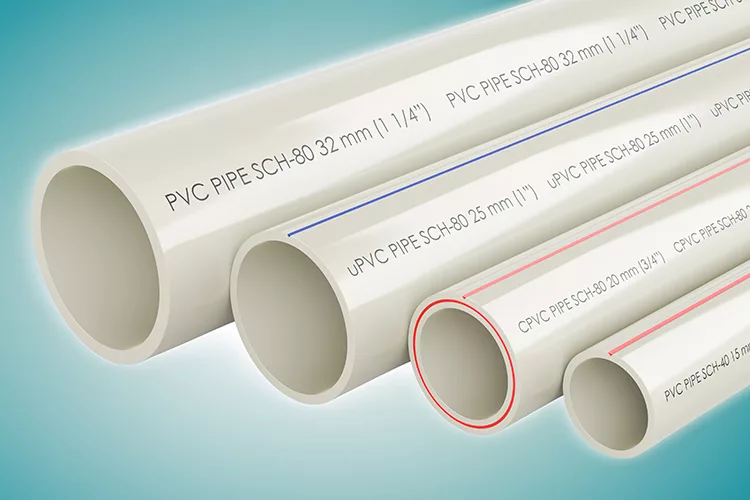
Chlorinated polyvinyl chloride (CPVC) has been used in fire protection for almost 50 years. It is well-suited for this application due to its ability to withstand high temperatures and pressures while resisting fire. It is not susceptible to microbial-induced corrosion and has excellent overall corrosion resistance.
Beginning with residential sprinkler system applications, CPVC has been used successfully for decades. Prince George’s County, Maryland, adopted a residential ordinance in 1987; it was fully enacted in 1992, leading to CPVC installations. Philadelphia also has high-rise installations that date to 1988.
Still, many fears and misconceptions exist about using CPVC for fire protection. One common fear is that CPVC pipe will melt or be negatively affected by heat.
The truth is, CPVC is a difficult material to set on fire. It has a Limiting Oxygen Index (LOI) of 60. LOI is expressed as the percentage of oxygen needed to sustain a burn. The oxygen required for CPVC to combust is 60%.
Additionally, CPVC is self-extinguishing. In accordance with UL 94, Standard for Tests for Flammability of Plastic Materials for Parts in Devices and Appliances, CPVC has a V-0 rating. To attain this classification, the test samples are subjected to an open flame. They must self-extinguish within 10 seconds, among other criteria, to meet this stringent standard.
For fire protection, CPVC is tested in accordance with UL 1887, Fire Test of Plastic Sprinkler Pipe for Flame & Smoke Characteristics, for NFPA 90A air return plenum compliance. UL 1887 is an actual burn test. During this test, pipe is not filled with water. This evaluation is part of the CPVC listing for fire protection.
When CPVC is “tested” with the less formal “Saboteur” method of applying a blow torch to the pipe when it’s empty, similar results can be seen. While this method is not recommended due to the release of chlorine gas and the possibility of a jobsite fire, it does clearly demonstrate that CPVC does not burn readily. The torch will turn it black and can potentially put a hole in it, but the material will not combust until temperatures exceed 800 F or the LOI is reached. Again, not a recommended test method, but it is effective for the skeptics and protection against would-be arsonists.
The biggest fear with CPVC in fire protection is environmental stress cracking (ESC). ASTM F412, Standard Terminology for Plastic Piping Systems, defines ESC as the “development of cracks in a material that is subjected to stress or strain in the presence of specific chemicals.” This can sound vague and scary.
CPVC is a very predictable material. Outside of fire protection, CPVC is considered to have excellent chemical resistance. CPVC is often used to transfer chemicals such as sulfuric acid and sodium hydroxide in industrial environments.
CPVC reactions
However, every material has its weakness. CPVC reacts to specific chemical groups. Steel is affected by oxygen and moisture; CPVC is susceptible to solvents and certain oils. Unfortunately, solvents and oils are often found in many common building products. Contact with things such as wiring, solvent- or oil-based paints and mold control agents can cause long-term problems for CPVC that is used in fire protection systems.
Building products fall into three categories:
1. The product is compatible and specifically states that it’s intended for use with CPVC fire protection applications. This would include residual oil from steel manufacturing, which is compatible with it. Compatible cutting oils and thread sealants are available for use with both steel and CPVC.
2. The product can be a stress-crack agent. By itself, it might be compatible, but when combined with the pressures, temperatures and stresses of a working system, it can cause failure. This is ESC, chemical and stress from the application. Incompatible fire-stops, certain duct sealants and compressor oils are problematic examples.
3. The product is outright incompatible and causes immediate fractures and chemical attack. Fragrances and perfumes added to the system “to help find the leaks” fall into this category. In HVAC applications, POE oil is extremely aggressive to CPVC.
Solvent cements for CPVC contain specific solvents used in a controlled way to melt the pipe and create fusion between the pipe and fitting. Solvents can also be found in a surprising array of products, such as joint sealants, some caulks and aerosols, so it’s always best to double-check the compatibility of everything that comes in contact with the CPVC pipe and fittings.
Avoiding these products is not complicated. Approved products should be available on the CPVC pipe and fittings manufacturer’s website. Lubrizol, a resin manufacturer, also maintains a compatible products list. Nothing else should touch the pipe, and if it does, the CPVC manufacturer should be contacted. Fire-stopping should be done by a professional who understands the specific needs, requirements and materials of the system.
Wires and cables can also contain components incompatible with CPVC. Many contain plasticizers, which soften plastics to make them flexible. CPVC pipe and fittings are plasticizer-free. Contact with plasticized items can cause ESC. Even some products, such as metal cabling, can have incompatible residual oils. Wires and cable should not come in contact with CPVC fire protection pipe and fittings. Nor should they be dragged across the piping during installation.
Spray foam is another material that can cause compatibility concerns. Some of this is due to a range of products being referred to as “spray foam.” There are aerosols and actual spray foam insulation; users must follow the manufacturer’s installation.
Fully-reacted, finished spray polyurethane foam is compatible with CPVC systems. Most manufacturers recommend installing spray foam insulation before mechanical systems, as they are not meant to be encased. If the liquid spray is applied inappropriately, it may not cure properly. The curing of the foam involves an exothermic reaction. If the foam is misapplied to CPVC pipe filled with water, the heat can cause the water to begin to form vapor and steam. The steam will begin to expand, potentially damaging the CPVC pipe. Spray foam insulation should be installed by a qualified contractor.
Aerosol spray foams intended for gap filling or other applications are not for use with CPVC fire protection systems. These aerosols may have names that imply they are safe, but a close read of the technical sheet indicates they are not meant for use in fire protection systems. When all manufacturers’ instructions are followed, problems are considerably minimized. Aggressively using aerosol foams to fill every gap on every mechanical system is not helpful.
Other stress-cracking factors
The other contributing factors to stress cracking are also easy to avoid. Hangers should be spaced appropriately for the size and be well-aligned. If the CPVC is sagging or bowing, something is wrong. When supported properly, it should be nearly as straight as steel.
When transitioning to steel, use the appropriate grooved adapter. Each manufacturer has one that is for use with CPVC and another that is not. The presence of brass in a CPVC grooved adapter can lead to overconfidence. The brass still requires a CPVC-appropriate connection. Choose wisely.
The best way to ensure your project is as problem-free as possible is to specify that the installing contractors be factory-trained. Training should include not only proper solvent cement and joining techniques but also raise the awareness of the potential for ESC and the importance of best practices such as hangers and alignment.
Most CPVC fire protection manufacturers offer this service at no cost to the contractor. Ideally, contractors receive training on CPVC fire protection systems every two years.
Also, general contractors need to be aware that CPVC fire protection requires specific, compatible products. Paints must be water-based. All fire-stop materials must be compatible. Nothing touches the life-safety system without verification. All the various manufacturers’ instructions need to be followed.
Prevention is the best protection. CPVC is a solid choice for wet systems installed in accordance with NFPA 13. Proper training ensures that the system will last a lifetime.
AFSA News
No Tricks in ’26: AFSA has Apprentice Training
AFSA’s Virtual Instruction Program (VIP) for apprentices uses the newly updated sprinkler fitting curriculum to provide related technical instruction to your apprentices. Bring the training to your apprentices wherever they are: the office, home, a jobsite and anywhere else they can access the internet, so you can focus on field training while leaving classroom instruction to the experts at AFSA.
• Convenient and flexible; 24/7 online testing and class schedules;
• Special access to instructors, courses and practice exams;
• Save money; no need to hire trainers!
A well-trained workforce offers numerous benefits. Investing in your employees increases employee productivity and performance, creates stronger overall workforce capabilities, reduces costs associated with errors and rework, and limits employee turnover. Limit your liability and enhance your team’s safety with AFSA’s VIP. Register your apprentices today to increase confidence and motivation, enhance skills and knowledge and improve company culture.
Visit https://bit.ly/45qhw82 to learn more and register for AFSA’s VIP!
Lici Resch is the senior technical associate for Spears Mfg. She has been in the CPVC fire protection industry for 22 years and covers Pennsylvania, Maryland and the District of Columbia. Her background in engineered thermoplastics began in 1992.