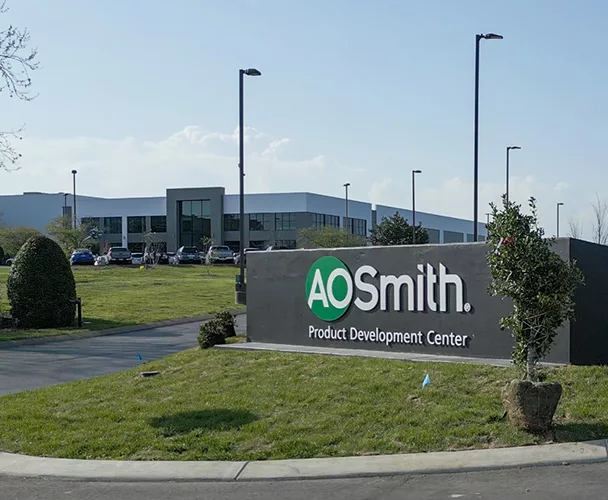
When A. O. Smith Corp. opened the doors to its new 60,000-square-foot Product Development Center last April in Lebanon, Tennessee, it wasn’t just celebrating a new building. The PDC represents a new strategic direction for engineering collaboration, product development and sustainable technology.
A. O. Smith’s new innovation hub unites its North America commercial water heating team with the Lochinvar boiler engineering team, bringing two industry-leading brands under one roof to accelerate product development and strengthen the company’s position in the high-efficiency water heating and hydronics market. Lochinvar has been an A. O. Smith company since 2011.
Building on a legacy of technical breakthroughs, such as Cyclone commercial condensing water heater and Lochinvar’s Crest condensing boiler with Hellcat Combustion Technology, the new PDC represents a next-generation approach to engineering, where cross-functional, cross-brand collaboration drives the creation of solutions tailored to fast-changing customer demands and market conditions.
“The PDC is really an opportunity for us to prioritize our talent and technology as we ramp up our high efficiency products,” says Bob Heideman, A. O. Smith’s recently retired chief technology officer. “Whether it’s high efficiency gas or heat pump water heaters or condensing gas boilers or electric boilers, our customers are demanding more sustainable products. This center allows us to better prioritize talent and resources in a way we haven’t before.”
Shared platforms, shared purpose
The need for the PDC was born from a growing realization that engineering synergies between the company’s leading commercial product lines—water heaters, boilers and emerging heat pump technologies—had outgrown their independently run legacies.
For decades, A. O. Smith’s top commercial engineering talent operated from separate facilities: water heating teams were based in McBee, South Carolina, while Lochinvar’s boiler team worked from its Tennessee campus. Meanwhile, electronics teams were split between locations, further complicating collaboration on increasingly connected and software-driven products.
“Communication technology has improved so much in recent years, but it’s still no substitute for the kind of spontaneous collaboration that happens when teams work side by side,” says Steve O’Brien, president and general manager of A. O. Smith North America Water Heating (NAWH). “This facility was designed to enable what we call ‘intentional’ and ‘unintentional’ collaboration—planned design reviews, sure, but also those impromptu hallway conversations.”
To foster these types of collaboration, the PDC includes extensive open office areas, flexible meeting rooms, engineering labs, electronic development bays and a large, shared lab space.
Bringing together the engineering forces of A. O. Smith’s NAWH business and Lochinvar represents a strategic shift to tackle the future of high-efficiency heating from a united front.
“In the 1980s, 85% thermal efficiency was considered high,” says Darrell Schuh, president and general manager of Lochinvar. “Today, 95% and above is the expectation. That kind of performance demands precision engineering, whether you’re talking about a condensing boiler or a tank water heater.”
Both brands also share an increasing focus on heat pump technologies, driven by growing market demand for electrification and decarbonization. The PDC includes dedicated testing infrastructure for heat pump systems—capabilities that simply didn’t exist before on either side of the business at this scale.
“Our products are highly efficient already,” Heideman adds. “But if we can even nudge that performance up a little further using data, or help customers avoid downtime through smarter alerts, that’s real value.”
Corporate culture
While the technology inside the PDC is cutting edge, perhaps its most powerful contribution is cultural. By creating a workplace that engineers actively want to be part of, A. O. Smith is betting that innovation will follow.
Though the company has a flexible remote work policy—allowing salaried employees up to two days per week at home—many choose to come in daily. According to Schuh, engineers and support staff alike value the face-to-face collaboration, especially when working on complex physical systems that require cross-disciplinary thinking.
“You can’t test a boiler on Zoom,” Schuh says. “Plus, we now share advanced lab space for heat pump testing and combustion analysis. This shared access reduces redundancy, saves money, and increases our capacity to test and iterate.”
Adds Heideman: “Having your electronics team just down the hall from engineers means faster problem solving. If someone needs help debugging a control board or testing an interface, they can get real-time feedback.”
The culture shift isn’t limited to internal teams. The PDC also serves as a platform for closer interaction with customers. Through structured Voice of the Customer programs and ad hoc feedback sessions, engineers and product developers gain early insight into contractor needs, installation challenges and performance expectations. Product managers and field teams regularly bring real-world insights back into the lab to shape further improvements.
“The best ideas often come from people who have to install, maintain or troubleshoot our equipment in the field,” O’Brien says. “The PDC gives us the ability to act on those ideas faster than ever before.”
The investment also reflects confidence in Lebanon and the surrounding Middle Tennessee region as a magnet for engineering and technical talent. According to Heideman, the area’s access to universities, technical programs, and an affordable cost of living made it an ideal location to house and grow the company’s next generation of product development professionals.
Beyond engineering, the PDC also expands A. O. Smith’s manufacturing footprint in Lebanon. Roughly one-third of the new building is allocated to production space, offering additional capacity for assembly and pilot-scale runs of new product lines. This is particularly important as the company expands its commercial heat pump offerings, which require new production tooling and test procedures.
As of mid-2025, the PDC houses more than 120 engineers and technical professionals, with room to grow.
“What makes this facility special isn’t just the equipment inside it,” Heideman says. “It’s the people, and how they’re now empowered to innovate together.”