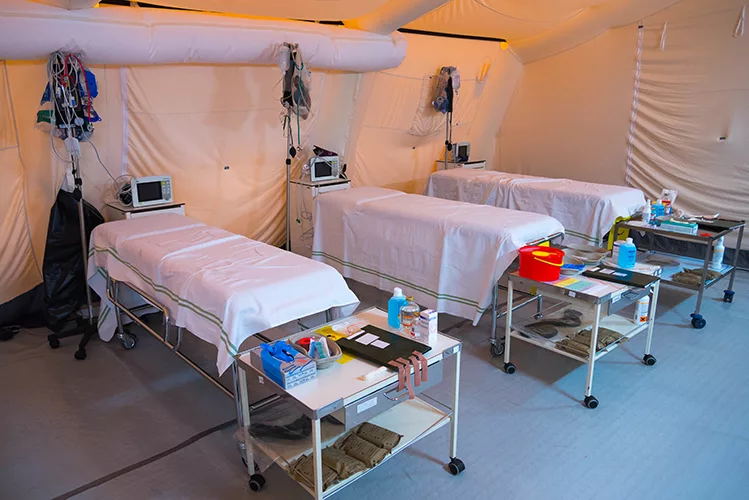
Many may not be familiar with the TV series “M*A*S*H” (an acronym for Mobile Army Surgical Hospital), a sitcom that ran from 1972 to 1983. The series follows a team of doctors and support staff stationed at the 4077th Mobile Army Surgical Hospital in Uijeongbu, South Korea, during the Korean War (1950–1953). I was an avid fan of the show myself.
As I look back and reflect on the time my son was deployed in Helmand Province, Afghanistan (Helmand was a hotbed of insurgent activities and some of the heaviest fighting during the war), hundreds were being killed each month, civilians and soldiers alike. My son saw combat and buddies die in his arms while others were shipped to the nearest forward surgical team to treat their wounds.
The evolution of mobile surgical care
The MASH era: The MASH unit was introduced in 1950 during the Korean War to provide immediate trauma care near the front lines. These units consisted of tents outfitted with operating rooms, recovery areas and essential medical supplies that were rapidly deployed to stabilize and treat soldiers and civilians (https://bit.ly/3F6g5Bi).
MASH units revolutionized military medicine by drastically reducing the time between injury and treatment, thereby increasing survival rates. They employed innovative triage methods, rapid transport and emergency surgical procedures. Their proximity to the battlefield meant wounded soldiers and civilians received care within hours, a significant improvement over waiting for evacuation to distant medical centers.
Forward surgical teams and combat support hospitals: By the late 20th century, MASH units were phased out in favor of Forward Surgical Teams (FSTs) and Combat Support Hospitals (CSHs), which provided even more agile and sophisticated medical care.
• FSTs are small, highly trained teams deployed rapidly to stabilize critically wounded patients before evacuation. They typically include surgeons, anesthetists and support staff who perform life-saving procedures in makeshift operating rooms.
The FST typically includes 20 staff members, four surgeons, three registered nurses, two certified registered nurse anesthetists, one administrative officer, one detachment sergeant, three licensed practical nurses, three surgical techs and three medics.
• CSHs are larger, more comprehensive medical facilities comparable to civilian hospitals. They provide intensive care, diagnostic imaging and extended post-operative treatment in mobile structures or repurposed buildings.
Advancements in medical equipment and gas systems
One of the most critical advancements in rapid mobile surgical medicine has been the evolution of medical gas equipment. Oxygen delivery, anesthesia, and respiratory support systems have undergone significant improvements:
1. Early MASH units: Relied on large oxygen cylinders and basic field anesthesia machines using ether or nitrous oxide.
2. Introduction of oxygen concentrators: Reduced dependence on heavy cylinders by extracting oxygen from ambient air, ensuring a steady supply in remote locations.
3. Modern battlefield medicine: Features portable oxygen generation systems producing medical-grade oxygen (93% to 95%) on-site. Compact, battery-operated ventilators and advanced anesthesia machines enhance precision and reliability in extreme conditions.
Future challenges and considerations
As conflicts, natural disasters and pandemics challenge global healthcare infrastructure, emergency medical preparedness must evolve. Some pressing questions include:
• Scalability: Can our oxygen supply chains and generation systems meet surges in demand?
• AI and telemedicine: How can artificial intelligence and remote diagnostics enhance field medical care?
• Personnel readiness: Are healthcare workers trained to operate in extreme environments and maintain deployed units?
• Blood supply management: How do large-scale emergencies impact blood bank reserves, and what strategies can mitigate shortages?
Industry solutions and rapid deployment options
As conflicts and disasters become more complex and emergency preparedness requires even greater mobility, the future of emergency trauma medicine will involve enhanced telemedicine capabilities, AI-driven medical diagnostics and even more advanced portable medical gas solutions (https://go.cms.gov/4hU0pzG). These innovations will ensure that medical personnel can continue to provide rapid, life-saving care to patients, no matter where they are in the world.
Organizations such as JB Roche and Losberger De Boer specialize in rapid deployment medical facilities. These units range from instantly deployable inflatable shelters to larger, semi-permanent structures equipped with hospital-grade medical air and vacuum systems.
Medical gas piping solutions vary; they can include brazed copper piping systems with Lokring couplings or corrugated medical gas tubing, such as MediTrac.
Are we prepared?
The transition from MASH units to modern FSTs and CSHs represents significant progress in emergency medicine. However, as global emergencies grow in scale and complexity, we must critically assess whether our current preparedness strategies are sufficient. Investments in medical technology, infrastructure and personnel training are essential to ensure effective response capabilities.
As we reflect on past advancements and future challenges, the question remains:
• Are we truly prepared for the next large-scale medical crisis? Now is the time to act, ensuring that our healthcare systems remain resilient in the face of adversity.
• Can our oxygen supply keep up?
• Can the oxygen generation facilities provide the delivery vehicles and cylinders needed to serve the deployed units and the healthcare facilities?
• Is this a likely event to occur? I don’t know, but it is better to be prepared and hope for the best.
As AI and other technologies continue to emerge, we need to always strive to think outside the box and continue to grow.
As the saying goes, “It’s better to be prepared and not need it than to need it and not be prepared.”





