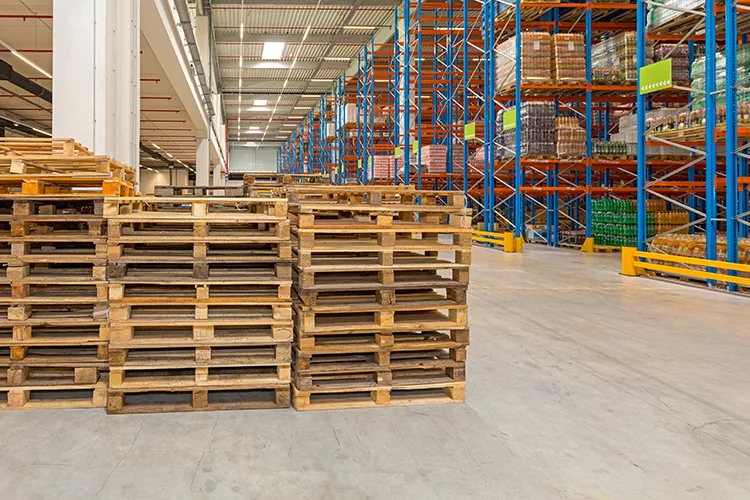
When thinking about automatic sprinkler protection for a warehouse, one might start by asking, “What will be stored in the building?” That will define the fire hazard. This is a great starting point, but it’s also important to ask yourself additional questions: “What type of operations will take place in the building? Will the owner need to store any idle pallets?”
Although the latter may seem like an odd question, pallets can be a significant fire hazard — at times even greater than the commodities stored in the building. Failing to consider the hazard of idle pallets may result in an automatic sprinkler system that is ineffective in controlling a potential fire within the building.
Pallet fires have been shown to release large amounts of energy, challenging the effectiveness of automatic fire sprinkler systems. Stacked pallets provide airflow spaces that can optimize fire spread, while the upper pallets shield the lower ones, allowing what could be a concealed fire to rapidly develop. This type of fire is a challenge for even a well-designed sprinkler system.
The 2025 edition of NFPA 13, Standard for the Installation of Sprinkler Systems, includes criteria specifically for idle pallet storage in section 20.17, which is based on the type and storage arrangement used. It is important to note that idle pallets are treated separately from the other types of stored commodities and low-piled storage in NFPA 13.
Idle pallet storage is not limited to warehouses, either. It can be a concern anywhere goods are received in bulk and broken down for sale or distribution. This may include buildings such as big-box stores, grocery stores, distribution centers, factories, and even smaller stores such as pharmacies and convenience stores.
Let’s review the types of pallets and configurations covered in NFPA 13 and some of the schemes provided for automatic fire sprinkler system design.
Types of pallets
Pallets can be constructed from either wood or plastic. NFPA 13 defines a wood pallet as “a pallet constructed entirely of wood with metal fasteners,” while the standard defines a plastic pallet as “a pallet having any portion of its construction consisting of a plastic material.”
In general, plastic pallets are considered a higher fire hazard than wood pallets. However, for the purpose of automatic fire sprinkler design, plastic pallets can be treated as equivalent to wood pallets when it’s been demonstrated that their fire hazard is equal to or less than that of wood pallets and they’ve been listed for such equivalency.
The protection schemes available are specific to the type of pallet, with some schemes not available when plastic pallets have not been considered equivalent to wood.
Storage arrangements
Although NFPA 13 recognizes that idle pallet storage can occur outside, in a detached building or indoors, the standard only provides protection criteria for indoor pallet storage.
In this case, pallets can be arranged in stacks on the floor or on racks. The height of the pallet “pile,” the separation distance from other piles and the height of the ceiling are all part of the storage arrangement and will play a role in identifying the correct protection scheme.
It should be noted that the storage of idle pallets on solid-shelf racks is not permitted due to the difficulty in extinguishing idle pallet storage combined with the shielding of the shelves.
Protection schemes
• Density/area method: Ordinary Hazard Group II. When designing the sprinkler system for the protection of idle pallets, it’s important to remember that both wood and plastic pallets can be stored inside and protected by a density/area design criterion equivalent to Ordinary Hazard Group II. For wood pallets, the pile cannot exceed 6 feet (1.8 m) in height, and for plastic pallets, the pile cannot exceed 4 feet (1.2 m) in height.
In both cases, the piles must be separated by a minimum of 8 feet (2.4 m) of clear space or 25 feet (7.6 m) of stored commodity. Each wood pile is limited to four stacks, and each plastic pile is limited to two stacks. This scheme enables occupancies such as department stores and small factories to store idle pallets in limited quantities.
• Control mode density/area method. The protection schemes for idle wood pallets using the density/area method allow storage heights between 6 feet and 20 feet (1.8 m and 6.1 m), with maximum ceiling heights up to 30 feet (9.1 m), using 0.2 gpm/ft2 to 0.6 gpm/ft2 (8.2 mm/min to 24.5 mm/min) over areas between 2,000 ft2 to 5,000 ft2 (185 m2 to 450 m2).
When plastic pallets are not separated in a dedicated storage room, the piles can be up to 10 feet (3.0 m) in a building, with a maximum ceiling height of 30 feet (9.1 m) and a density of 0.6 gpm/ft2 over 2,000 ft2 (24.5 mm/min over 185 m2), using a minimum K-factor of 16.8 (240).
• Control mode density/area method: Dedicated room. Plastic pallets are permitted to be stored in a dedicated room separated from other storage by a 3-hour-rated fire wall. Storage piles can reach up to 12 feet (3.7 m), using a density of 0.6 gpm/ft2 (24.5 mm/min) over the entire room, with protection provided by the steel columns in the room.
Wood pallets do not have the same protection scheme equivalent.
• Control mode-specific application sprinklers. Only wood pallets may be protected using the control mode-specific application (CMSA) method. Pallet storage can be up to 20 feet (6.1 m) in height, with maximum ceiling heights between 30 feet and 40 feet (9.1 m and 12.2 m). The range of available K-factor designs is 11.2 to 19.6 (160–280), with different criteria for minimum design pressure and number of heads in the design.
Currently, storage on racks without solid shelves is not permitted with the CMSA design scheme.
• Early suppression fast response sprinklers. Early suppression fast response sprinklers are designed for challenging fires, making them an option for idle pallet storage. NFPA 13 provides protection schemes for wood pallet arrangements, both on the floor and on racks without solid shelves, at storage heights from 20 feet to 35 feet (6.1m to 10.7 m), with maximum ceiling heights between 30 feet and 40 feet (9.1 m and 12.2 m), using K-factor designs from 14 to 25.2 (200 to 360) and minimum operating pressures between 15 psi and 75 psi (1 bar and 5.2 bar).
The schemes for plastic pallets are not limited in storage height but in maximum ceiling height, with schemes up to 40 feet (12.2 m) in height, using K-factor designs from 14 to 25.2 (200 to 360) and minimum operating pressures between 35 psi and 75 psi (1 bar and 5.2 bar).
• High expansion foam. For plastic pallets stored in a dedicated room separated from other storage by a 3-hour-rated fire wall with storage piles up to 12 feet (3.7 m), a high expansion foam system combined with a sprinkler density of 0.3 gpm/ft2 (12.2 mm/min) over the entire room and protection from the steel columns in the room can also be used.
• In-rack sprinkler protection. Both wood and plastic pallets are permitted to be stored in racks when they’re protected in accordance with the in-rack sprinkler requirements for an exposed expanded plastic commodity in accordance with 25.7. It’s important to note that the protection criteria for in-rack sprinklers vary, depending on the type of sprinkler used at the roof level.
Additionally, unlike most roof sprinklers, in-rack sprinkler protection criteria are based on a maximum vertical and horizontal spacing, not a density/area or number of heads at a minimum pressure.
• Specific test data. Recognizing the significant fire challenge of idle plastic pallet storage, any protection scheme based on test data is not only permitted but encouraged to take precedence over the listed protection schemes. However, this same clause does not exist for the protection of idle wood pallets.
The storage of idle pallets is a significant fire hazard. When this hazard is not considered during the design of an automatic fire sprinkler system, the potential exists for a significantly undersized sprinkler system.
Whether you’re designing a warehouse or a storage/loading dock in an office building, it is important to consider the storage of idle wood pallets in the design. The type of pallets, height of the pallet piles and ceiling height all influence the available protection schemes. l
Editor’s Note: This column is adapted from a blog (https://bit.ly/4o5Jtdj) that covered the 2022 edition of NFPA 13 requirements. Robin Zevotek, PE, revised the article to include updated provisions within the 2025 edition of the standard. It has been lightly edited for clarity and style.
Robin Zevotek, PE, is a principal fire protection engineer with the Technical Services department at the National Fire Protection Association. His background includes engineering design, firefighter safety research and emergency services. At NFPA, he serves as a subject matter expert in emergency response and responder safety as well as fire protection systems and building and life safety. Zevotek also holds the rank of fire chief with the Ellicott City Volunteer Fire Department in Howard County, Maryland.



