Our inboxes are overflowing. Much of it is drudgery as junk newsletters, routine requests and important but unexciting reports cause the little white number next to “Inbox” or superimposed on your phone’s mail icon to rise and fall throughout the day.
There are certainly exciting juxtapositions to this routine. There are orders, contracts, profitable problems and project opportunities that raise heartbeats and drive our businesses every day. Once in a while, something unique drops in that catches your attention.
At the beginning of the year, when budgets and sales projections still filled my inbox, I got one of those unique emails from Dr. Jason Reese, the acting dean of the Rushe College of Business and Stephen F. Austin University (SFA), inviting me to speak to his sales management class on my choice of topics. How fun!
SFA is a four-year college with about 11,000 undergrads deep in the piney woods of East Texas. I’ve been volunteering at SFA for years. My dad is class of 1980, and as he slowed down in our business, he increased his volunteer time at the university, eventually serving on the board for the college of business.
Rusche has a program called the College to Career Conference, where it hosts roundtable discussions with business leaders on a variety of topics to prepare students for the real world. They want their students to hear from people in the working world on topics such as acing interviews, personal branding, career development, professional behavior, etc. The students have prepped questions and a professor moderates. This is followed by an invite-only job fair for the business school’s top students.
My dad reached out to me one year when the school needed volunteers, and as a serial volunteer, I couldn’t say no. I’ve attended since 2017 and really enjoy the experience. I even hire from the job fair and have launched students into our industry.
Everyone should hang out with young people. There is something about explaining topics that you take for granted and getting the questions and insights from a true outsider’s point of view that’s both refreshing and inspiring. It’s been a fun ride.
After a few conversations with Dr. Reese, I decided to speak on the subject of sales structures and sales force organization. As a manufacturer’s rep, it’s a topic I enjoy. I’ve been through Pepco’s growth and seen us go from a team of about 10 in sales and sales support to now more than 50 people in those roles. We used to have two roles and now have five roles in just sales, with another three departments backing them up.
We also represent large manufacturers such as A. O. Smith, Apollo, Pfister, Uponor and more. These companies have large and sophisticated sales organizations that have grown and morphed over time. I planned on telling the story of growth and drawing from my experience in both building and working with large sales teams to prepare for my talk.
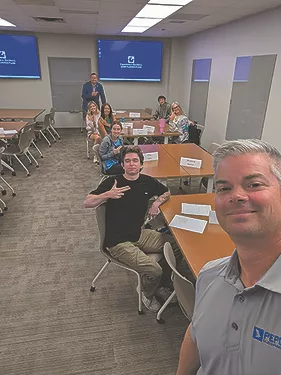
Just another day in class
Finally, it’s time! My class is at 8 a.m., so I make the three-hour drive from Dallas to Nacogdoches the day before and settle into the Fredonia Hotel. (Quick aside: the Fredonia is a beautifully restored mid-century modern hotel in the heart of Nacogdoches next door to a brewery. If you ever find yourself in “Nac,” it’s the place to stay). The SFA campus, like many campuses, is beautiful. It’s set among the piney woods and azaleas of East Texas — a scene in spring that never gets old.
As I find my way to the classroom, I’m about 20 minutes early; quickly, students start to filter in. They’re all friendly and welcoming. They greet me, help me pirate the campus Wi-Fi and even ask me some questions. I expected a warm welcome, but it’s always nice to receive it.
After a short opening by Dr. Reese, I start my part of the class. Here’s a quick walk-through of my presentation:
Introduction to me, Pepco, the PCHP industry and manufacturers’ reps place in it. I used a very cool graphic from Uponor showing the buildings and applications using our pipe in downtown Austin. The students caught on quickly to the supply chain, the role of sales, reps, wholesalers and made some insightful connections. Great start.
Next, I explained the importance of a clear vision. A clear vision and goals drive strategy and tactics. If you’re lacking a clear direction, then it’s tough to design and execute on sales goals.
I then outlined a simple plan for a sales team: As you grow from a smaller team with fewer resources to a larger team with more resources, your team design evolves from a territory-based system to an account-based system to a function-based system.
In other words, national sales managers add regionals who then add account managers who are eventually supported by trainers, commercial sales or any number of other specialists.
I introduced customer relationship management (CRM) systems, a topic that they had learned about. I took “prepare for the real world” approach and gave them tips on how to make a CRM successful both as an individual contributor and as a manager. I did want them to leave with some real-life lessons.
Finally, I spoke about accountability and how it’s mandatory for accomplishing goals, not always about compensation and how incentives can have unintended consequences.
To make this personal, I set up a scenario to get some engagement and participation. They’ve partnered with a friend from the engineering department to create a device that assists in sports recovery. It works so well that SFA has made it to the NCAA tournament and their device has spread throughout the Southland Conference. Now poised for a breakout, and flush with a Series A round, they need to decide how to deploy their startup capital.
Given this prompt, I had them do the Crazy Eights brainstorming exercise, then each student had to present at least one idea.
What followed absolutely floored me. This one class came up with every detail I imagined we’d get to, but also so much more. They had tangential industries, additional revenue streams and marketing ideas while also hitting up the obvious threads like assigning a salesperson to each conference. I loved it.
Furthermore, they had no idea how good they were. To them, it was just another day in class. I appreciated their creativity and quick thinking. The class ended with five minutes from a group of alumni who had joined the Fastenal management training program — an interesting and creative touch from Dr. Reese to get these students ready for the real world.
Get involved
What I learned from my experiences at SFA is that the school cares deeply about getting its students launched into successful careers. These events and my guest speaking day are a strategic effort by school leadership to set students up for success and get employers excited about students from SFA. They want kids to be successful but also attract employers who enthusiastically hire from their university.
This is important to all of us seeking to recruit into our industry. Craft a relationship with a local college and take chances on interns and new hires. Find a school that matches your culture. SFA is filled with the sons and daughters of small-business owners, salespeople and even tradespeople.
Those schools exist throughout the country. Find one. Get involved. Before long, you’ll have the honor of introducing sharp young people to our industry. Happy recruiting!
Charlie Parham, CPMR, is CEO at Pepco Sales and Marketing, a PHCP manufacturers’ representative firm that has grown beyond sales and distribution to include specifying, training, marketing, graphic design and delivery.