
The International Code Council (ICC) is the leading global source of model codes and standards and building safety solutions. The International Codes (I-Codes), developed by ICC, are a family of 15 coordinated, modern building safety codes that help ensure the design and construction of safe, sustainable and affordable structures.
Currently, the plumbing, mechanical and fuel gas (PMG) I-Codes are adopted in more than 75% of the United States, setting the minimum safety standards for PMG design, plan review, installation and inspection.
Updated every three years, the I-Codes are developed with input from subject matter experts worldwide who volunteer their time to keep the codes current and practical. These professionals not only contribute to development but also support the adoption and implementation efforts of the codes.
For contractors, designers and code officials, staying informed about significant changes and understanding how to interpret the codes is critical. In this article, we highlight some of the significant changes within the 2024 International Plumbing Code (IPC), the 2024 International Mechanical Code (IMC) and the 2024 International Fuel Gas Code (IFGC).
Significant changes in the 2024 IPC
312.4: Vacuum Testing for DWV Piping
• Change summary. A new method for testing DWV piping.
• 2024 IPC text. “312.4 Drainage and vent vacuum test. The portion of the drainage and vent system under test shall be evacuated of air by a vacuum-type pump to achieve a uniform gauge pressure of [-5] pounds per square inch or a [-10] inches of mercury column (-34 kPa). This pressure shall be held without the removal of additional air for a period of 15 minutes. Any adjustments to the test pressure required because of changes in ambient temperatures or the seating of gaskets shall be made prior to the beginning of the test period.”
• Change significance. Water or wastewater leaks from installed piping can have serious health consequences for the inhabitants of a building. Leaks can cause bacteria and mold to grow in concealed areas. If a leak continues long enough, structural members of the building can be compromised, rendering it unsafe to occupy. It is crucial that piping systems be tested at stages where leaks can be readily identified and repaired before the piping is concealed.
Plastic piping cannot be tested using compressed air because of the risk of explosion and personal injury. Vacuum (i.e., evacuation of air) testing offers the same ease of testing as compressed air without the explosion danger. This testing method is especially useful during winter months, when using water is not an option due to freezing temperatures.
403.3.6: Door Locks
• Change summary. Code modification allows for the inside locking of doors for multiple-user toilet facilities.
• 2024 IPC text. “403.3.6 Door locking. Where a toilet facility is provided for the use of multiple occupants, the egress door for the room shall not be lockable from the inside of the room. This section does not apply to family or assisted-use toilet facilities.
“Exception: The egress door of a multiple occupant toilet room shall be permitted to be lockable from inside the room where all the following criteria are met:
“1. The egress door shall be lockable from the inside of the room only by authorized personnel by the use of a key or other approved means.
“2. The egress door shall be readily openable from the toilet room in accordance with International Building Code(IBC) Section 1010.2.
“3. The egress door shall be capable of being unlocked from outside the room with a key or other approved means.”
• Change significance. Some multiple-occupant toilet rooms have a locking door to facilitate closure of the toilet facility for maintenance or for security when the toilet room is closed after a building’s occupancy hours. This section prohibits the lock from being engaged on the inside of the door so that users cannot lock themselves in the toilet room.
This requirement was originally to prevent multiple-occupant toilet rooms from becoming safe havens for illicit activities. Because family/assisted-use toilet rooms are provided to offer privacy to a user and a family member or caretaker, the lock prohibition does not apply to those types of toilet rooms.
In the 2024 IPC, three exceptions are introduced. Multiple-user toilet facilities can provide a safe area of refuge in the event of an emergency, such as an active shooter situation. Although a simple thumb-turn latch on the inside of the door would offer the intended protection, such a device defeats the purpose of not having the door lockable from the inside.
Therefore, the exception allows a lock only when authorized personnel are able to lock the door, the door is easily opened from the interior and the door may be unlocked from the exterior side. Any specific design of locking hardware offering control over who can lock the door from the inside while offering egress by anyone may work for this application.
Significant changes in the 2024 IMC
1101.2.1: Group A2L, A2, A3 and B1 Refrigerants
• Change summary. Specific standards were added to provide the applicable requirements for high-probability equipment using Group A2L, A2, A3 and B1 refrigerants.
• 2024 IMC text. “1101.2.1 Group A2L, A2, A3 and B1 high probability equipment. High-probability equipment using Group A2L, A2, A3 or B1 refrigerant shall comply with UL 484, UL/CSA 60335-2-40 or UL/CSA 60335-2-89.”
• Change significance. Refrigerants are classified in accordance with ASHRAE 34. Each refrigerant is classified based on safety classifications for toxicity and flammability. The toxicity classification is either A (lower toxicity) or B (higher toxicity).
Regarding flammability, a total of four classifications exist. Class 1 refrigerants do not propagate a flame when tested, Class 2 refrigerants are flammable and Class 3 refrigerants have a higher flammability. Class 2 refrigerants have a subclassification, 2L, consisting of lower flammability refrigerants that are difficult to ignite. Examples of A2L refrigerants include R-1234yf, R-1234ze(E), R-32, R-452B, R-454A and R-454B.
The addition of Section 1101.2.1 in the 2024 IMC provides the applicable standards for the listed refrigerants in high-probability equipment. Notably, the code change involves the addition of Group A2L refrigerants, which are now available for use in high-probability systems for human comfort (see “Significant changes to IMC Section 1104.3.1”).
The introduction of new provisions for the intermediate flammable A2L refrigerants is necessary due to the expected increase in the use of Group A2L refrigerants as a substitute for hydrofluorocarbon refrigerants, which are greenhouse gases being phased out.
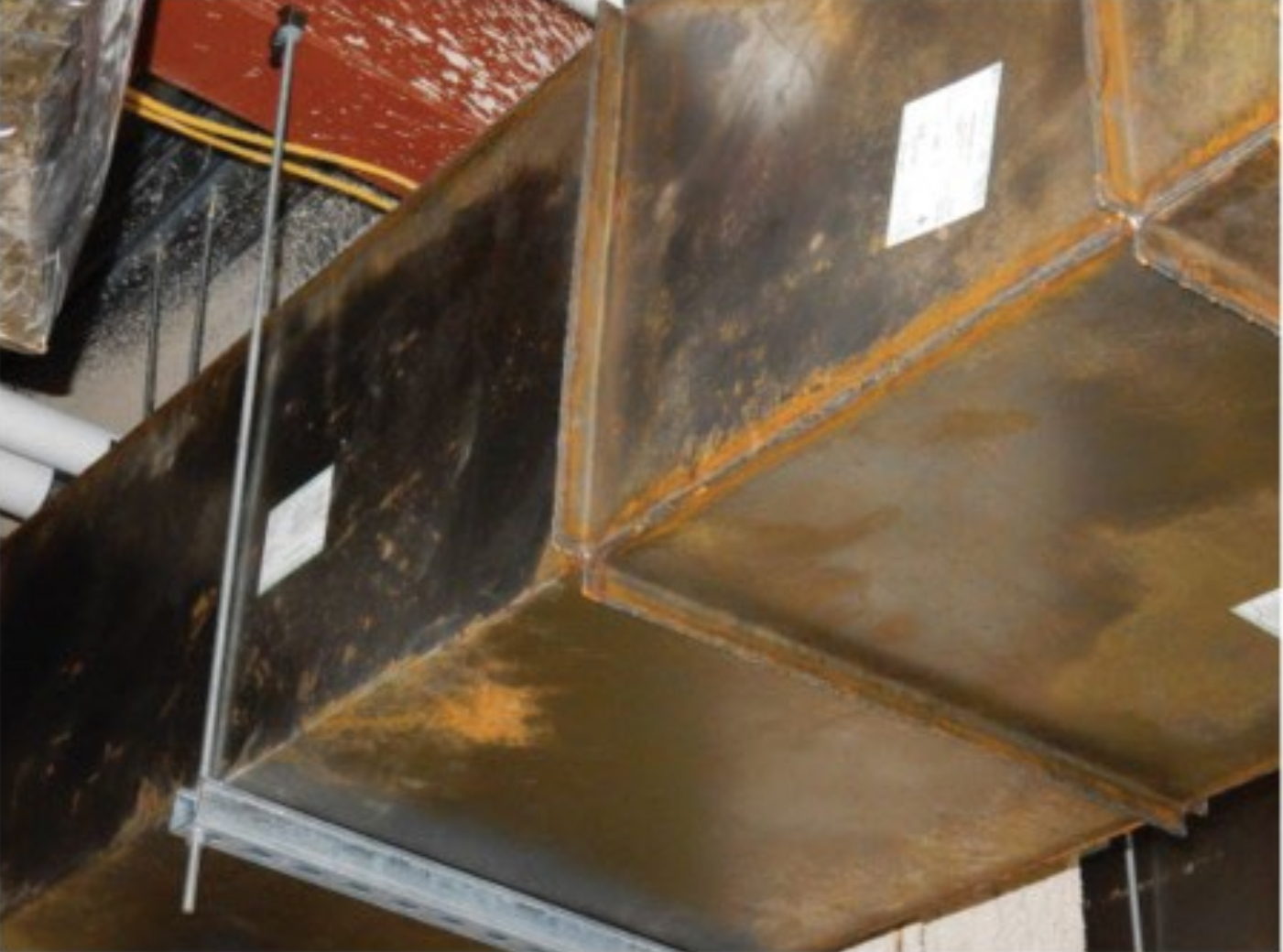
202: Definition of Grease Duct
• Change summary. A grease duct is defined, and relevant sections are modified to clarify the intent of the code.
• 2024 IMC text. “Section 202 Definitions: Grease Duct: A duct serving a Type I hood, or cooking appliances equipped with integral down-draft exhaust systems that produce grease, to convey grease-laden air from the hood or cooking appliance directly to the outdoors.”
• Change significance. IMC Section 506 and its many subsections frequently use the term grease duct. Understanding what a grease duct is drives a designer’s ability to correctly design a kitchen hood ventilation system.
The 2024 IMC adds a definition for grease ducts, clarifying a previously ambiguous term. Although somewhat self-explanatory, the term grease duct has multiple meanings depending upon the trade and region of the country. The new definition specifically ties grease ducts to either a Type I hood or other integral down-draft cooking appliances.
Most importantly, the definition indicates that grease ducts are designed to convey grease-laden air outdoors. Previously, there was room for debate regarding whether the term grease duct only applied to Type I hoods or to both Type I hoods and cooking appliances with integral downdraft exhaust systems.
Significant changes in the 2024 IFGC
406.5.1: Leak Detection
• Change summary. Gas detectors must be listed for use.
• 2024 IFGC text. “406.5.1 Detection methods. The leakage shall be located by means of a listed combustible gas detector, a noncorrosive leak detection fluid or other approved leak detection methods.”
• Change significance. Any pressure drop is a failure of the pressure test, except where the drop can be attributed to a change in temperature or other cause. This is difficult to demonstrate in the field, especially for short test durations. A true leak should show up as a continuous drop in test pressure. If the rate of pressure drop slows as the test progresses, it may be caused by the cooling of the test medium, which causes the pipe to contract.
Once a pressure-measuring instrument indicates leakage, the leak or leaks must be located for repair or replacement. Electronic sensors and bubble fluids are used to locate leaks not readily detected by human senses. Open flames must never be used for leak detection due to the danger of a potential explosion and because they cannot detect small leaks.
Many people who have worked with or inspected gas piping installations can recall instances of personal injury, fires and close calls that were caused by searching for leaks with an open flame.
406.7.3.1 Inspection, Testing and Purging
• Change summary. Purging of abandoned fuel gas piping is required.
• 2024 IFGC text. “406.7.3.1 Abandoned fuel gas piping. Where fuel gas piping is removed from service for an indefinite time period, it shall be purged.”
• Change significance. Purging is intended to prevent the creation of a flammable gas-air mixture in the piping. A flammable mixture can pose a fire or explosion hazard in the piping, room or space, or in an appliance combustion chamber. There have been documented accidents involving explosions caused by failure to take the necessary precautions during piping purging operations.

Once a piping system has been conditioned (seasoned) by exposure to gas, its ability to absorb the chemical additive in fuel gas diminishes with time. If personnel purge piping into an enclosed area and depend on their sense of smell to detect when gas has reached the purge discharge outlet, they could be fooled if the gas has lost its odor. The sense of smell should never be relied upon to detect the presence of fuel gas.
Combustible gas indicators and detectors are commonly used to detect gas during purging operations. Section 406.7 requires that after the gas piping has been properly purged and charged with fuel gas, the appliances served must be purged of air before startup.
These are just a few examples of the significant changes included within ICC’s 2024 PMG I-Codes.
To learn more about ICC’s PMG life-saving provisions, please visit the dedicated webpage at https://bit.ly/4l9Masa. To stay updated on the latest PMG industry news, subscribe to the Code Council’s PMG newsletter at https://bit.ly/3Tls1TW.
Richard “Rich” C. Anderson, CBO, is a director of PMG technical resources for the International Code Council. His responsibilities include developing, coordinating, directing and implementing programs to ensure the successful completion of the team’s goals and objectives as they apply to the International Plumbing Code (IPC), International Mechanical Code (IMC), International Fuel Gas Code (IFGC), International Swimming Pool and Spa Code (ISPSC), International Private Sewage Disposal Code (IPSDC), and related services and programs of the International Code Council.