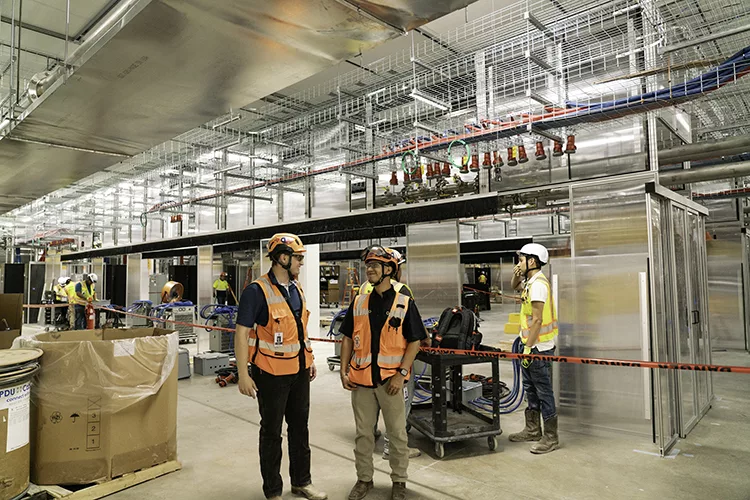
As any parent would be, I was elated when my kids recently asked, “Hey, what are you working on, Dad?” Of the many cutting-edge processes I could mention, one stood out. My kids love their devices. So, my answer was, “Hey kids, do you want to learn about liquid-cooled data centers?”
What’s a data center?
OK, a data center is a building with a lot of computer equipment inside. The computers there help to connect other computers, such as our phones, TVs, tablets or voice-activated home assistants. We need these buildings because our devices do not have enough computing power to do many of the things we ask — like run software applications for work, school or fun.
So, we build a building to house all the computer equipment, or servers, and components we need to keep our technology running smoothly. Because these buildings are housing equipment that serves many different people at once, it is important that the systems inside them do not break — such as the electricity, climate control and security systems.
Mechanical, electrical and plumbing engineers build them with something called redundancy to ensure that if part of one system breaks, the building can keep running without affecting everyone and the rest of the equipment inside. There are different ways to build in redundancy and ways to describe it. An example would be N+1 redundancy, which means that if we need an “N” number of air conditioners, then we will install “N” plus one additional air conditioner so that if there is any break, the extra one will take over.
Wow, that is really cool!
Well, kids, it is really hot. You see, all the servers in the data center make heat when they are working, so one of the big challenges with them is that they get hot. We need to cool them down to keep them from getting too hot and breaking.
Historically, we would cool them with cold air using equipment called computer room air handlers or CRAH units. They make cold air and blow it under a floor raised off the ground, so it has space for the air to move under all the servers; then, we put holes in the floor where we want the cold air to blow up at the front of the servers. The servers have little fans in them to take the cold air from the cold side and blow it across the hot parts into the back of the server.
We put all the backs of the servers facing the same way to make a hallway where all the hot air goes, called a “hot aisle.” Then, this air is returned to our CRAH unit to cool down again. We use water at the CRAH units to move the heat from inside the building to the outside to other equipment called chillers.
All the equipment works to ensure our servers stay cool and are always working. This is one common variation, but other ways exist to accomplish the cooling. The version I described is one that has been improved little by little over time as data center cooling needs have grown and more efficient methods were needed to properly cool them.
So, when you said the buildings were ‘liquid-cooled,’ is that the water you were talking about?
No, not quite; the system I described is what we call an air-cooled system since it is cooled air used to cool the servers. We can use other methods considered liquid-cooled.
Immersion cooling: Immersion cooling takes the whole server and sinks it down into a special fluid called a nonconductive fluid or dielectric fluid. This type of system uses either a single-phase or two-phase approach. By single phase, I mean that it stays a liquid the whole time and uses a heat exchanger to move the heat out of the building to the chillers.
For the two-phase immersion cooling systems, the liquid turns to vapor when it gets hot, and the vapor is sent to the heat exchanger, where it gets cooled and turns back into a liquid before going back to the servers.
Direct-to-chip cooling: We also have direct-to-chip systems. These methods leave the servers in a room like an air-cooled system but take chilled water to a computer distribution unit, which is a type of heat exchanger. From there, it takes the liquid right to the chips in the servers.
The chips are made with a special part called a cooling plate that cools the hottest parts of the chip, such as the central processing unit or graphics processing unit. However, other parts of the chip and server that make heat are not attached to the cold plate. For these parts, we still need some air-cooled systems to cool them. To determine how much of each cooling type we need, we usually start using what we call the 80/20 rule: 80% goes to the liquid-cooled system, and 20% goes to the air-cooled system.
Other ways to accomplish liquid cooling or air cooling are slight variations. The industry is always innovating to find a way to do it better than before.
OK, sounds like you guys have it all figured out. Does it get boring doing that all the time?
Ha, it is actually always changing. Data centers keep getting bigger and making more heat, so we have to find newer and more efficient ways to cool. Sometimes, it is challenging to get enough equipment to cool all the heat that is being made. It takes a lot of energy to cool the air or liquid, plus the servers need a lot of energy to run. It can make it tough to work out all the details when a new data center is needed.
One of the reasons liquid cooling is becoming more popular is it is much more efficient than air cooling, which means that for the same total energy to run the building, you can get more servers inside. If we can lower how much power the cooling systems need, we can maximize the power available to the servers. Also, when the system is more efficient at cooling, the servers can be more densely packed in the same floor space, allowing the rooms to be loaded with more computing power.
Liquid cooling is super new, right?
No. Actually, liquid cooling has been around for a long time. Immersion cooling was used all the way back in the 1960s as a way to cool some of the first computers, though more expensive. It was really only used for high-performance data centers or for owners who really wanted a high-efficiency system, even if it cost a lot more money upfront.
Because it was not the most cost-effective way to build data centers, there were not many options for manufacturers who made the equipment or installers who knew how to install them. Some immersion-cooling systems became a little more popular when crypto mining created a need for large, dense computing systems.
However, it was still not the most common method. Air-cooled systems have been the go-to method for a long time, and because they were the most common, innovation has been making these systems more and more efficient to meet the demands of the data centers they serve. We even modified how rooms are laid out, like the hot aisle and underfloor air-cooling methods I described earlier, to keep the rooms working more efficiently.
If liquid cooling is not new, and air-cooling has been so great, why does anyone want a liquid-cooled data center?
We are hitting a new point in data center performance requirements that is straining the traditional air-cooled systems and bringing forward more efficient liquid-cooling methods. Due to the development of high-performance graphics and artificial intelligence chips, the amount of heat generated can no longer be efficiently cooled by air-cooled systems.
Specifically, the large language models used by AI programs require a massive computing load at the data center. The overall size of the data centers needed to increase, but so did the density at the chip level. This made liquid cooling look more appealing than it had in previous years, and a wave of innovation hit the market.
New technology was available on a larger scale than had ever been available. Competition has grown and has made for a flood of products and services that make liquid cooling a viable option on larger-scale buildings.
Because it was not well-known, there have been some hiccups along the way as building owners, design engineers and contractors learned more about liquid cooling. The benefits of going to liquid cooling were hard to deny; it was only a matter of figuring out how to do it efficiently.
Liquid cooling does not come without its risks/issues, such as having water so close to critical IT equipment, causing damage if a leak occurs; corrosion of the elements over time due to the natural reactions that occur with water systems; and significantly more piping, which may be a more expensive material or installation.
Wow, thanks! I can’t wait to tell all my friends at school about data centers.
Just know that you will become the most popular kid at school now that you understand data-center cooling technology. Make sure to be nice to everyone, and don’t let it go to your head.
Brandon Hoke, PE, specializes in HVAC system design and project management at TDIndusries. With a wealth of experience across various sectors, including hospitality, semiconductor, mission-critical, office and multipurpose spaces, he has learned from industry leaders to deliver innovative and efficient HVAC solutions.